If $\begin{vmatrix}a+b+2c&a&b\\ c&2a+b+c&b\\ c&a&a+2b+c\end{vmatrix} = 2 $, then $a^3 + b^3 + c^3 - 3abc$ =
- $1 - 3ab - 3bc - 3ca$
- $0$
- $1 - 2ab - 2bc - 2ca$
- $1$

The Correct Option is A
Solution and Explanation
$\Rightarrow 2(a+b+c)\begin{vmatrix} 1 & a & b \\ 1 & b+c+2 a & b \\ 1 & a & c+a+2 b\end{vmatrix}=2 $
[ Applying $C_{1} \rightarrow C_{1}+C_{2}+C_{3} $ and
taking $2( a + b + c) $ common from $C_{1} ] $
$\Rightarrow 2(a+b+c) \begin{vmatrix}1 & a & b \\ 0 & b+c+a & 0 \\ 0 & 0 & c+a+b\end{vmatrix} =2$
[ Applying $ R_{2} \rightarrow R_{2}-R_{1}$ and $ R_{3} \rightarrow R_{3}-R_{1}] $
$\Rightarrow 2(a+b+c)^{3}=2$ [ expanding along $ C_{1}] $
$\Rightarrow (a+b+c)^{3}=1 $
$\Rightarrow a+b+c=1 $
Now, $ a^{3}+b^{3}+c^{3}-3 a b c $
$ =(a+b+c)\left(a^{2}+b^{2}+c^{2}-a b-b c-c a\right) $
$ = 1 \cdot\left[a^{2}+b^{2}+c^{2}-a b-b c-c a\right] $
$= (a+b+c)^{2}-2 a b-2 b c-2 c a-a b-b c-c a $
$ = 1-2 a b-2 b c-2 c a-a b-b c-c a $
$ = 1-3 a b-3 b c-3 c a$
Top Questions on Transpose of a Matrix
- The variance of the following probability distribution is:
\[ \begin{array}{|c|c|} \hline x & P(X) \\ \hline 0 & \frac{9}{16} \\ 1 & \frac{3}{8} \\ 2 & \frac{1}{16} \\ \hline \end{array} \]- MHT CET - 2024
- Mathematics
- Transpose of a Matrix
- The negative of \( (p \land (\sim q)) \lor (\sim p) \) is equivalent to:
- MHT CET - 2024
- Mathematics
- Transpose of a Matrix
- The converse of \( ((\sim p) \land q) \Rightarrow r \) is:
- MHT CET - 2024
- Mathematics
- Transpose of a Matrix
- If \( A = \begin{bmatrix} 0 & 1 & 2 \\ 1 & 2 & 3 \\ 3 & 1 & 1 \end{bmatrix} \), then \( A^{-1} \) is:
- MHT CET - 2024
- Mathematics
- Transpose of a Matrix
- If \[ B = \begin{bmatrix} 3 & \alpha & -1 \\ 1 & 3 & 1 \\ -1 & 1 & 3 \end{bmatrix} \] is the adjoint of a 3x3 matrix \( A \) and \( |A| = 4 \), then \( \alpha \) is equal to:
- MHT CET - 2024
- Mathematics
- Transpose of a Matrix
Questions Asked in AP EAMCET exam
Which of the following are ambident nucleophiles?
[A.] CN$^{\,-}$
[B.] CH$_{3}$COO$^{\,-}$
[C.] NO$_{2}^{\,-}$
[D.] CH$_{3}$O$^{\,-}$
[E.] NH$_{3}$- AP EAMCET - 2024
- Acids and Bases
- The correct sequence of enzymes involved in the commercial production of ethanol by fermentation from sugar is:
- AP EAMCET - 2024
- Acids and Bases
- At 298 K, the ionization constant of \( {CN}^- \) is \( 2.08 \times 10^{-6} \). What is the ionization constant of its conjugate acid? (Given \( K_w = 10^{-14} \))
- AP EAMCET - 2024
- Acids and Bases
Identify the anomers from the following.

- AP EAMCET - 2024
- Acids and Bases
The standard Gibbs free energy change \( \Delta G^\circ \) of a cell reaction is \(-301 { kJ/mol}\). What is \( E^\circ \) in volts?
(Given: \( F = 96500 { C/mol}\), \( n = 2 \))- AP EAMCET - 2024
- Acids and Bases
Concepts Used:
Transpose of a Matrix
The matrix acquired by interchanging the rows and columns of the parent matrix is called the Transpose matrix. The transpose matrix is also defined as - “A Matrix which is formed by transposing all the rows of a given matrix into columns and vice-versa.”
The transpose matrix of A is represented by A’. It can be better understood by the given example:
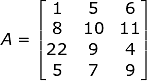
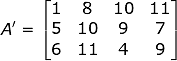
Now, in Matrix A, the number of rows was 4 and the number of columns was 3 but, on taking the transpose of A we acquired A’ having 3 rows and 4 columns. Consequently, the vertical Matrix gets converted into Horizontal Matrix.
Hence, we can say if the matrix before transposing was a vertical matrix, it will be transposed to a horizontal matrix and vice-versa.
Read More: Transpose of a Matrix