List of practice Questions

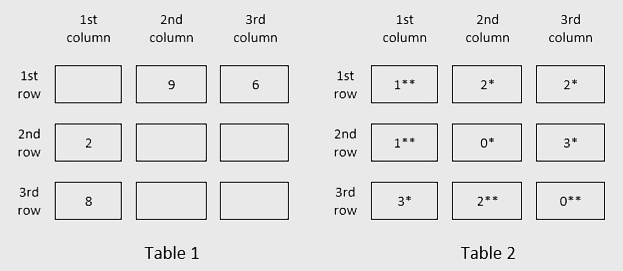
Three participants – Akhil, Bimal and Chatur participate in a random draw competition for five days. Every day, each participant randomly picks up a ball numbered between 1 and 9. The number on the ball determines his score on that day. The total score of a participant is the sum of his scores attained in the five days. The total score of a day is the sum of participants’ scores on that day. The 2-day average on a day, except on Day 1, is the average of the total scores of that day and of the previous day. For example, if the total scores of Day 1 and Day 2 are 25 and 20, then the 2-day average on Day 2 is calculated as 22.5. Table 1 gives the 2-day averages for Days 2 through 5.
Table 1: 2-day averages for Days through 5
Day 2Day 3Day 4Day 5
1515.51617
Participants are ranked each day, with the person having the maximum score being awarded the minimum rank (1) on that day. If there is a tie, all participants with the tied score are awarded the best available rank. For example, if on a day Akhil, Bimal, and Chatur score 8, 7 and 7 respectively, then their ranks will be 1, 2 and 2 respectively on that day. These ranks are given in Table 2. 
Table 2 : Ranks of participants on each day
 Day 1Day 2Day 3Day 4Day 5
Akhil12233
Bimal23211
Chatur31122
The following information is also known. 
1. Chatur always scores in multiples of 3. His score on Day 2 is the unique highest score in the competition. His minimum score is observed only on Day 1, and it matches Akhil’s score on Day 4. 
2. The total score on Day 3 is the same as the total score on Day 4. 
3. Bimal’s scores are the same on Day 1 and Day 3.
If Akhil attains a total score of 24, then what is the total score of Bimal? (This Question was asked as TITA)
Three participants – Akhil, Bimal and Chatur participate in a random draw competition for five days. Every day, each participant randomly picks up a ball numbered between 1 and 9. The number on the ball determines his score on that day. The total score of a participant is the sum of his scores attained in the five days. The total score of a day is the sum of participants’ scores on that day. The 2-day average on a day, except on Day 1, is the average of the total scores of that day and of the previous day. For example, if the total scores of Day 1 and Day 2 are 25 and 20, then the 2-day average on Day 2 is calculated as 22.5. Table 1 gives the 2-day averages for Days 2 through 5.
Table 1: 2-day averages for Days through 5
Day 2Day 3Day 4Day 5
1515.51617
Participants are ranked each day, with the person having the maximum score being awarded the minimum rank (1) on that day. If there is a tie, all participants with the tied score are awarded the best available rank. For example, if on a day Akhil, Bimal, and Chatur score 8, 7 and 7 respectively, then their ranks will be 1, 2 and 2 respectively on that day. These ranks are given in Table 2. 
Table 2 : Ranks of participants on each day
 Day 1Day 2Day 3Day 4Day 5
Akhil12233
Bimal23211
Chatur31122
The following information is also known. 
1. Chatur always scores in multiples of 3. His score on Day 2 is the unique highest score in the competition. His minimum score is observed only on Day 1, and it matches Akhil’s score on Day 4. 
2. The total score on Day 3 is the same as the total score on Day 4. 
3. Bimal’s scores are the same on Day 1 and Day 3.
What is the minimum possible total score of Bimal? (This Question was asked as TITA)
The passage below is accompanied by four questions. Based on the passage, choose the best answer for each question. 
The biggest challenge [The Nutmeg's Curse by Ghosh] throws down is to the prevailing understanding of when the climate crisis started. Most of us have accepted ... that it started with the widespread use of coal at the beginning of the Industrial Age in the 18th century and worsened with the mass adoption of oil and natural gas in the 20th . 
Ghosh takes this history at least three centuries back, to the start of European colonialism in the 15th century. He [starts] the book with a 1621 massacre by Dutch invaders determined to impose a monopoly on nutmeg cultivation and trade in the Banda islands in today's Indonesia. Not only do the Dutch systematically depopulate the islands through genocide, they also try their best to bring nutmeg cultivation into plantation mode. These are the two points to which Ghosh returns through examples from around the world. One, how European colonialists decimated not only indigenous populations but also indigenous understanding of the relationship between humans and Earth. Two, how this was an invasion not only of humans but of the Earth itself, and how this continues to the present day by looking at nature as a 'resource' to exploit. ... 
We know we are facing more frequent and more severe heatwaves, storms, floods, droughts and wildfires due to climate change. We know our expansion through deforestation, dam building, canal cutting - in short, terraforming, the word Ghosh uses - has brought us repeated disasters ... Are these the responses of an angry Gaia who has finally had enough? By using the word 'curse' in the title, the author makes it clear that he thinks so. I use the pronoun 'who' knowingly, because Ghosh has quoted many non-European sources to enquire into the relationship between humans and the world around them so that he can question the prevalent way of looking at Earth as an inert object to be exploited to the maximum. 
As Ghosh's text, notes and bibliography show once more, none of this is new. There have always been challenges to the way European colonialists looked at other civilisations and at Earth. It is just that the invaders and their myriad backers in the fields of economics, politics, anthropology, philosophy, literature, technology, physics, chemistry, biology have dominated global intellectual discourse.... 
There are other points of view that we can hear today if we listen hard enough. Those observing global climate negotiations know about the Latin American way of looking at Earth as Pachamama (Earth Mother). They also know how such a framing is just provided lip service and is ignored in the substantive portions of the negotiations. In The Nutmeg's Curse, Ghosh explains why. He shows the extent of the vested interest in the oil economy - not only for oil exporting countries, but also for a superpower like the US that controls oil drilling, oil prices and oil movement around the world. Many of us know power utilities are sabotaging decentralised solar power generation today because it hits their revenues and control. And how the other points of view are so often drowned out.
The passage below is accompanied by four questions. Based on the passage, choose the best answer for each question.
Understanding romantic aesthetics is not a simple undertaking for reasons that are internal to the nature of the subject. Distinguished scholars, such as Arthur Lovejoy, Northrop Frye and Isaiah Berlin, have remarked on the notorious challenges facing any attempt to define romanticism. Lovejoy, for example, claimed that romanticism is "the scandal of literary history and criticism"... The main difficulty in studying the romantics, according to him, is the lack of any "single real entity, or type of entity" that the concept "romanticism" designates. Lovejoy concluded, "the word 'romantic' has come to mean so many things that, by itself, it means nothing"...
The more specific task of characterizing romantic aesthetics adds to these difficulties an air of paradox. Conventionally, "aesthetics" refers to a theory concerning beauty and art or the branch of philosophy that studies these topics. However, many of the romantics rejected the identification of aesthetics with a circumscribed domain of human life that is separated from the practical and theoretical domains of life. The most characteristic romantic commitment is to the idea that the character of art and beauty and of our engagement with them should shape all aspects of human life. Being fundamental to human existence, beauty and art should be a central ingredient not only in a philosophical or artistic life, but also in the lives of ordinary men and women. Another challenge for any attempt to characterize romantic aesthetics lies in the fact that most of the romantics were poets and artists whose views of art and beauty are, for the most part, to be found not in developed theoretical accounts, but in fragments, aphorisms and poems, which are often more elusive and suggestive than conclusive.
Nevertheless, in spite of these challenges the task of characterizing romantic aesthetics is neither impossible nor undesirable, as numerous thinkers responding to Lovejoy's radical skepticism have noted. While warning against a reductive definition of romanticism, Berlin, for example, still heralded the need for a general characterization: "[Although] one does have a certain sympathy with Lovejoy's despair...[he is] in this instance mistaken. There was a romantic movement...and it is important to discover what it is" ...
Recent attempts to characterize romanticism and to stress its contemporary relevance follow this path. Instead of overlooking the undeniable differences between the variety of romanticisms of different nations that Lovejoy had stressed, such studies attempt to characterize romanticism, not in terms of a single definition, a specific time, or a specific place, but in terms of "particular philosophical questions and concerns" ...
While the German, British and French romantics are all considered, the central protagonists in the following are the German romantics. Two reasons explain this focus: first, because it has paved the way for the other romanticisms, German romanticism has a pride of place among the different national romanticisms ... Second, the aesthetic outlook that was developed in Germany roughly between 1796 and 1801 02 − - the period that corresponds to the heyday of what is known as "Early Romanticism" ...- offers the most philosophical expression of romanticism since it is grounded primarily in the epistemological, metaphysical, ethical, and political concerns that the German romantics discerned in the aftermath of Kant's philosophy.
The passage below is accompanied by four questions. Based on the passage, choose the best answer for each question.
Steven Pinker's new book, "Rationality: What It Is, Why It Seems Scarce, Why It Matters," offers a pragmatic dose of measured optimism, presenting rationality as a fragile but achievable ideal in personal and civic life. ... Pinker's ambition to illuminate such a crucial topic offers the welcome prospect of a return to sanity. ... It's no small achievement to make formal logic, game theory, statistics and Bayesian reasoning delightful topics full of charm and relevance.
It's also plausible to believe that a wider application of the rational tools he analyzes would improve the world in important ways. His primer on statistics and scientific uncertainty is particularly timely and should be required reading before consuming any news about the [COVID] pandemic. More broadly, he argues that less media coverage of shocking but vanishingly rare events, from shark attacks to adverse vaccine reactions, would help prevent dangerous overreactions, fatalism and the diversion of finite resources away from solvable but less-dramatic issues, like malnutrition in the developing world.
It's a reasonable critique, and Pinker is not the first to make it. But analyzing the political economy of journalism - its funding structures, ownership concentration and increasing reliance on social media shares - would have given a fuller picture of why so much coverage is so misguided and what we might do about it.
Pinker's main focus is the sort of conscious, sequential reasoning that can track the steps in a geometric proof or an argument in formal logic. Skill in this domain maps directly onto the navigation of many real-world problems, and Pinker shows how greater mastery of the tools of rationality can improve decision-making in medical, legal, financial and many other contexts in which we must act on uncertain and shifting information. ..
Despite the undeniable power of the sort of rationality he describes, many of the deepest insights in the history of science, math, music and art strike their originators in moments of epiphany. From the th 19 -century chemist Friedrich August Kekulés discovery of the structure of benzene to any of Mozart's symphonies, much extraordinary human achievement is not a product of conscious, sequential reasoning. Even Plato's Socrates - who anticipated many of Pinker's points by nearly 2,500 years, showing the virtue of knowing what you do not know and examining all premises in arguments, not simply trusting speakers' authority or charisma - attributed many of his most profound insights to dreams and visions. Conscious reasoning is helpful in sorting the wheat from the chaff, but it would be interesting to consider the hidden aquifers that make much of the grain grow in the first place.
The role of moral and ethical education in promoting rational behavior is also underexplored. Pinker recognizes that rationality "is not just a cognitive virtue but a moral one." But this profoundly important point, one subtly explor