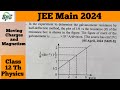
In the experiment to determine the galvanometer resistance by half-deflection method, the plot of \(\frac{1}{ \theta}\) vs the resistance (R) of the resistance box is shown in the figure. The figure of merit of the galvanometer is .............. ×10–1 A/division. [The source has emf 2V]


Correct Answer: 5
Solution and Explanation
Using the equation:
\[ i = K\theta, \]
At half deflection:
\[ \frac{2}{G + R} = K\theta. \]
Rearranging:
\[ \frac{1}{\theta} = \frac{(G + R)K}{2} = RK + \frac{GK}{2}. \]
From the slope of the graph:
\[ \text{Slope} = K = 0.5 = 5 \times 10^{-1} \, \text{A/division}. \]
Learn with videos:
Top Questions on Current electricity
- For two identical cells each having emf \(E\) and internal resistance \(r\), the current through an external resistor of \(6\,\Omega\) is the same when the cells are connected in series as well as in parallel. The value of the internal resistance \(r\) is ________ \(\Omega\).
- JEE Main - 2026
- Physics
- Current electricity
- An infinitely long straight wire carrying current $I$ is bent in a planar shape as shown in the diagram. The radius of the circular part is $r$. The magnetic field at the centre $O$ of the circular loop is :

- JEE Main - 2026
- Physics
- Current electricity
The equivalent resistance between the points \(A\) and \(B\) in the given circuit is \[ \frac{x}{5}\,\Omega. \] Find the value of \(x\).

- JEE Main - 2026
- Physics
- Current electricity
- In a meter bridge experiment to determine the value of unknown resistance, first the resistances \(2\,\Omega\) and \(3\,\Omega\) are connected in the left and right gaps of the bridge and the null point is obtained at a distance \(l\) cm from the left end. Now, when an unknown resistance \(x\,\Omega\) is connected in parallel to \(3\,\Omega\), the null point is shifted by \(10\,\text{cm}\) to the right. The value of \(x\) is ________ \(\Omega\).
- JEE Main - 2026
- Physics
- Current electricity
A Wheatstone bridge is initially at room temperature and all arms of the bridge have same value of resistances \[ (R_1=R_2=R_3=R_4). \] When \(R_3\) resistance is heated, its resistance value increases by \(10%\). The potential difference \((V_a-V_b)\) after \(R_3\) is heated is _______ V.

- JEE Main - 2026
- Physics
- Current electricity
Questions Asked in JEE Main exam
- A 20 m long uniform copper wire held horizontally is allowed to fall under the gravity (g = 10 m/s²) through a uniform horizontal magnetic field of 0.5 Gauss perpendicular to the length of the wire. The induced EMF across the wire when it travels a vertical distance of 200 m is_______ mV.}
- JEE Main - 2026
- Thermodynamics
- If the end points of chord of parabola \(y^2 = 12x\) are \((x_1, y_1)\) and \((x_2, y_2)\) and it subtend \(90^\circ\) at the vertex of parabola then \((x_1x_2 - y_1y_2)\) equals :
- JEE Main - 2026
- Probability
- The sum of all possible values of \( n \in \mathbb{N} \), so that the coefficients of \(x, x^2\) and \(x^3\) in the expansion of \((1+x^2)^2(1+x)^n\) are in arithmetic progression is :
- JEE Main - 2026
- Integration
- In a microscope of tube length $10\,\text{cm}$ two convex lenses are arranged with focal lengths $2\,\text{cm}$ and $5\,\text{cm}$. Total magnification obtained with this system for normal adjustment is $(5)^k$. The value of $k$ is ___.
- JEE Main - 2026
- Optical Instruments
Which one of the following graphs accurately represents the plot of partial pressure of CS₂ vs its mole fraction in a mixture of acetone and CS₂ at constant temperature?


- JEE Main - 2026
- Organic Chemistry