>
CBSE Class VII
>
Mathematics
List of top Mathematics Questions asked in CBSE Class VII
Find:
(i) 1.3 × 10
(ii) 36.8 × 10
(iii) 153.7 × 10
(iv) 168.07 × 10
(v) 31.1 × 100
(vi) 156.1 × 100
(vii) 3.62 × 100
(viii) 43.07 × 100
(ix) 0.5 × 10
(x) 0.08 × 10
(xi) 0.9 × 100
(xii) 0.03 × 1000
CBSE Class VII
Mathematics
Multiplication Of Decimal Numbers
In the given figures below, decide whether
\(l\)
is parallel to
\(m\)
.
CBSE Class VII
Mathematics
Checking For Parallel Lines
Fill in the blanks:
(a) 369 ÷ _____ = 369
(b) (–75) ÷ _____ = –1
(c) (–206) ÷ _____ = 1
(d) – 87 ÷ _____ = 87
(e) _____ ÷ 1 = – 87
(f) _____ ÷ 48 = –1
(g) 20 ÷ _____ = –2
(h) _____ ÷ (4) = –3
CBSE Class VII
Mathematics
Properties Of Division Of Integers
In a quiz, team A scored – 40, 10, 0 and team B scored 10, 0, – 40 in three successive rounds. Which team scored more? Can we say that we can add integers in any order?
CBSE Class VII
Mathematics
Properties Of Addition And Subtraction Of Integers
Fill in the blanks to make the following statements true:
(i) (–5) + (– 8) = (– 8) + (............)
(ii) –53 + ............ = –53
(iii) 17 + ............ = 0
(iv) [13 + (– 12)] + (............) = 13 + [(–12) + (–7)]
(v) (– 4) + [15 + (–3)] = [– 4 + 15] + ............
CBSE Class VII
Mathematics
Properties Of Addition And Subtraction Of Integers
The temperature at 12 noon was 10°C above zero. If it decreases at the rate of 2°C per hour until midnight, at what time would the temperature be 8°C below zero? What would be the temperature at mid-night?
CBSE Class VII
Mathematics
Properties Of Division Of Integers
Some pictures (a) to (c) are given below. Tell which of them show:
\((a)\)
\((b)\)
\((c)\)
(i) 3 ×
\(\frac{1}{5}\)
=
\(\frac{3}{5}\)
(ii) 2 ×
\(\frac{1}{3}\)
=
\(\frac{2}{3}\)
(iii) 3 ×
\(\frac{3}{4}\)
=
\(\frac{21}{4}\)
CBSE Class VII
Mathematics
Properties Of Division Of Integers
(i) For any integer a, what is (–1) × a equal to?
(ii) Determine the integer whose product with (–1) is
(a) –22
(b) 37
(c) 0
CBSE Class VII
Mathematics
Properties Of Multiplication Of Integers
The enrolment in a school during six consecutive years was as follows:
1555, 1670, 1750, 2013, 2540, 2820
Find the mean enrolment of the school for this period.
CBSE Class VII
Mathematics
Arithmetic Mean
Verify the following:
(a) 18 × [ 7 + (–3)] = [18 × 7] + [18 × (–3)]
(b) (–21) × [(– 4) + (– 6)] = [(–21) × (– 4)] + [(–21) × (– 6)]
CBSE Class VII
Mathematics
Properties Of Multiplication Of Integers
Here are the shadows of some 3-D objects, when seen under the lamp of an overhead projector. Identify the solid(s) that match each shadow. (There may be multiple answers for these!)
CBSE Class VII
Mathematics
Viewing Different Sections Of A Solid
Give three examples of shapes with no line of symmetry.
CBSE Class VII
Mathematics
Lines Of Symmetry For Regular Polygons
Convert each part of the ratio to percentage:
3:1
2:3:5
1:4
1:2:5
CBSE Class VII
Mathematics
Use Of Percentages
In a city, 30% are females, 40% are males and remaining are children. What per cent are children?
CBSE Class VII
Mathematics
Use Of Percentages
Find the area of each of the following triangles:
CBSE Class VII
Mathematics
Area of a Triangle
Find the value of the following expressions, when x =–1: (i) 2x – 7 (ii) – x + 2 (iii) x
2
+2x+1 (iv) 2x
2
–x–2
CBSE Class VII
Mathematics
Algebraic Expressions
If a figure has two or more lines of symmetry, should it have rotational symmetry of order more than 1?
CBSE Class VII
Mathematics
Line Symmetry And Rotational Symmetry
Find :
(i)
\(\frac{7}{24}\)
-
\(\frac{17}{36}\)
(ii)
\(\frac{5}{63}\)
-(
\(-\frac{6}{21}\)
)
(iii) -
\(\frac{6}{13}\)
-(-
\(\frac{7}{15}\)
)
(iv) -
\(\frac{3}{8}\)
-
\(\frac{7}{11}\)
(v)
\(-\frac{21}{9}\)
-6
CBSE Class VII
Mathematics
Need For Rational Numbers
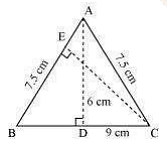
∆ABC is isosceles with AB = AC = 7.5 cm and BC = 9 cm (Fig 9.17). The height AD from A to BC, is 6 cm. Find the area of ∆ABC. What will be the height from C to AB i.e., CE?
CBSE Class VII
Mathematics
Area of a Triangle
(i) If z = 10, find the value of z
3
– 3(z – 10)
(ii) If p = – 10, find the value of p
2
– 2p – 100
CBSE Class VII
Mathematics
Algebraic Expressions
Evaluate each of the following:
(–30) ÷ 10
50 ÷ (–5)
(–36) ÷ (–9)
(– 49) ÷ (49)
13 ÷ [(–2) + 1]
0 ÷ (–12)
(–31) ÷ [(–30) + (–1)]
[(–36) ÷ 12] ÷ 3
[(– 6) + 5)] ÷ [(–2) + 1]
CBSE Class VII
Mathematics
Division Of Integers
The lengths of two sides of a triangle are 12 cm and 15 cm. Between what two measures should the length of the third side fall?
CBSE Class VII
Mathematics
Sum Of The Lengths Of Two Sides Of A Triangle
What other name can you give to the line of symmetry of
an isosceles triangle?
a circle?
CBSE Class VII
Mathematics
Lines Of Symmetry For Regular Polygons
Find the whole quantity if
5% of it is 600.
12% of it is Rs 1080.
40% of it is 500 km.
70% of it is 14 minutes.
(e) 8% of it is 40 litres
CBSE Class VII
Mathematics
Use Of Percentages
Which is greater:
(i)
\(\frac{2}{7}\)
of
\(\frac{3}{4}\)
or
\(\frac{3}{5}\)
of
\(\frac{5}{8}\)
(ii)
\(\frac{1}{2}\)
of
\(\frac{6}{7}\)
or
\(\frac{2}{3}\)
of
\(\frac{3}{7}\)
CBSE Class VII
Mathematics
Multiplication Of Fractions
Prev
1
2
3
4
5
...
10
Next