In a pond of water, a flame is held 2 m above the surface of water. A fish is at depth of 4 m from water surface. Refractive index of water is . The apparent height of the flame from the eyes of fish is:
- (A) m
- (B) m
- (C) m
- (D) m
Correct Answer

The Correct Option is D
Approach Solution - 1
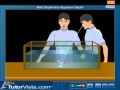
Given:Depth of the fish from the surface of the water = 4 mHeight of the flame BC = 2 mRefractive index of the water, We have to find the the apparent height of the flame from the eyes of the fish. The ray diagram is shown below:

Approach Solution -2
Real Depth and Apparent Depth
Real Depth is the real distance of an object under the surface as determined by immersing it with an accurate ruler.
The depth of an item in a denser media, as perceived from a rarer medium, is referred to as apparent depth in a medium. Its value is less than the real depth.
The relationship between the real depth and the apparent depth is given by
Real depthApparent depth=21=21
Where
- 𝜇2 = refractive index of the denser medium
- 𝜇2 = refractive index of the rarer medium
- 𝜇12 = refractive index of the denser medium with respect to the rarer medium
If an object lying in denser medium and is observed from rarer medium, then
Real depthApparent depth=21>1
⇒ Real depth > Apparent depth
That is why, the river bed appeared shallow
If an object lying in rarer medium and is observed from denser medium, then
Real depthApparent depth=21<1
⇒ Real depth < Apparent depth
That is why high flying airplanes appear to be higher than its actual height.
Learn with videos:
Top Questions on Reflection Of Light By Spherical Mirrors
- A concave mirror has a focal length of \( 10 \, \text{cm} \). An object is placed at a distance of \( 15 \, \text{cm} \) from the mirror. Calculate the position of the image formed.
- MHT CET - 2025
- Physics
- Reflection Of Light By Spherical Mirrors
- A ray of light strikes a plane mirror at an angle of incidence \(30^\circ\). What is the angle between the incident ray and the reflected ray?
- VITEEE - 2025
- Physics
- Reflection Of Light By Spherical Mirrors
- The geometric center of a spherical mirror is called:
- TS POLYCET - 2025
- Physics
- Reflection Of Light By Spherical Mirrors
- The SI unit of resistivity is:
- TS POLYCET - 2025
- Physics
- Reflection Of Light By Spherical Mirrors
- A light ray is incident on the surface of a sphere of refractive index n at an angle of incidence \(\theta_0\). The ray partially refracts into the sphere with angle of refraction \(\phi\) and then partly reflects from the back surface. The reflected ray then emerges out of the sphere after a partial refraction. The total angle of deviation of the emergent ray with respect to the incident ray is \(a\). Match the quantities mentioned in List-I with their values in List-II and choose the correct option.
List-I List-II P If \(n = 2\) and \(\alpha = 180°\), then all the possible values of \(\theta_0\) will be I \(30\degree\) or \(0\degree\) Q If \(n = √3\) and \(\alpha= 180°\), then all the possible values of \(\theta_0\) will be II \(60\degree\) or \(0\degree\) R If \(n = √3\) and \(\alpha= 180°\), then all the possible values of \(\phi_0\) will be III \(45\degree\) or \( 0\degree\) S If \(n = \sqrt2\) and \(\theta_0 = 45°\), then all the possible values of \(\alpha\) will be IV \(150\degree\) \[0\degree\] - JEE Advanced - 2024
- Physics
- Reflection Of Light By Spherical Mirrors
Questions Asked in JEE Main exam
The equivalent resistance between the points \(A\) and \(B\) in the given circuit is \[ \frac{x}{5}\,\Omega. \] Find the value of \(x\).

- JEE Main - 2026
- Current electricity
Method used for separation of mixture of products (B and C) obtained in the following reaction is:

- JEE Main - 2026
- p -Block Elements
- Consider light travelling from a medium A to medium B separated by a plane interface. If the light undergoes total internal reflection during its travel from medium A to B and the speed of light in media A and B are \(2.4 \times 10^8\) m/s and \(2.7 \times 10^8\) m/s, respectively, then the value of critical angle is :
- JEE Main - 2026
- Newtons Laws of Motion
In the following \(p\text{–}V\) diagram, the equation of state along the curved path is given by \[ (V-2)^2 = 4ap, \] where \(a\) is a constant. The total work done in the closed path is:

- JEE Main - 2026
- Thermodynamics
Let \( ABC \) be a triangle. Consider four points \( p_1, p_2, p_3, p_4 \) on the side \( AB \), five points \( p_5, p_6, p_7, p_8, p_9 \) on the side \( BC \), and four points \( p_{10}, p_{11}, p_{12}, p_{13} \) on the side \( AC \). None of these points is a vertex of the triangle \( ABC \). Then the total number of pentagons that can be formed by taking all the vertices from the points \( p_1, p_2, \ldots, p_{13} \) is ___________.
- JEE Main - 2026
- Coordinate Geometry