Evaluate the definite integral as limit of sums: \(∫^1_{-1} e^xdx\)

Solution and Explanation
Let \(I=∫^1_{-1} e^xdx...(1)\)
It is known that,
\(∫^b_a ƒ(x)dx=(b-a)\underset{n→∞}{lim}\frac{1}{n}[ƒ(a)+ƒ(a+h)...ƒ((a+(n-1)h]\),where \(h=\frac{b-a}{n}\)
Here,\(a=-1,b=1,\)and \(ƒ(x)=e^x\)
\(∴h=\frac{1+1}{n}=\frac{2}{n}\)
\(∴I=(1+1)\underset{n→∞}{lim}\frac{1}{n}[ƒ(-1)+ƒ(-1+\frac{2}{n})+ƒ(-1+2.\frac{2}{n})+...+ƒ(-1+\frac{(n-1)2}{n})]\)
\(=2\underset{n→∞}{lim}\frac{1}{n}[e^{-1}+e^{(-1+\frac{2}{n})}+e^{(-1+2\frac{2}{n})}+...e^{(-1+(n-1)\frac{2}{n})}]\)
\(=2\underset{n→∞}{lim}\frac{1}{n}[e^{-1}{1+e^{\frac{2}{n}}+e^{\frac{4}{n}}+e^{\frac{6}{n}}+e^{(n-1)\frac{2}{n}}}]\)
\(=2\underset{n→∞}{lim}\frac{e^{-1}}{n}[\frac{e^{\frac{2n}{n}-1}}{e^{\frac{2}{n}-1}}]\)
\(=e^{-1}\times2\underset{n→∞}{lim}\frac{1}{n}[\frac{e^{2-1}}{e^{\frac{2}{n}-1}}]\)
\(=\frac{e^{-1}×2(e^2-1)}{\underset{\frac{2}{n}→0}{lim}(\frac{e^{\frac{2}{n}-1}}{\frac{2}{n}})\times2}\)
\(=e^{-1}[\frac{2(e^2-1)}{2}]\,\,\,\,\,\, [\underset{h→0}{lim}(\frac{e^h-1}{h})=1]\)
\(=\frac{e^2-1}{e}\)
\(=(e-\frac{1}{e})\)
Top Questions on integral
Let \( f : (0, \infty) \to \mathbb{R} \) be a twice differentiable function. If for some \( a \neq 0 \), } \[ \int_0^a f(x) \, dx = f(a), \quad f(1) = 1, \quad f(16) = \frac{1}{8}, \quad \text{then } 16 - f^{-1}\left( \frac{1}{16} \right) \text{ is equal to:}\]
- Let $ f(x) $ be a positive function and $I_1 = \int_{-\frac{1}{2}}^1 2x \, f\left(2x(1-2x)\right) dx$ and $I_2 = \int_{-1}^2 f\left(x(1-x)\right) dx.$ Then the value of $\frac{I_2}{I_1}$ is equal to ____
- Evaluate the integral: \[ \int \frac{x^2 + 2x}{\sqrt{x^2 + 1}} \, dx \]
- Evaluate the integral: \[ \int \sqrt{x^2 + 3x} \, dx \]
- The value of the integral \( \int_0^1 x^2 \, dx \) is:
Questions Asked in CBSE CLASS XII exam
- Two statements are given, one labelled Assertion (A) and the other labelled Reason (R). Select the correct answer from the codes (A), (B), (C), and (D) as given below.
Assertion (A): In double slit experiment, if one slit is closed, diffraction pattern due to the other slit will appear on the screen.
Reason (R): For interference, at least two waves are required.
- CBSE CLASS XII - 2025
- Wave optics
- Write the cell reaction and calculate the e.m.f. of the following cell at 298 K:
\[ \text{Sn}(s) \mid \text{Sn}^{2+} (\text{0.004 M}) \parallel \text{H}^+ (\text{0.02 M}) \mid \text{H}_2 (\text{1 Bar}) \mid \text{Pt}(s) \]
(Given: \( E^\circ_{\text{Sn}^{2+}/\text{Sn}} = -0.14 \, \text{V}, E^\circ_{\text{H}^+/\text{H}_2} = 0.00 \, \text{V} \))- CBSE CLASS XII - 2025
- Electrochemistry
If vector \( \mathbf{a} = 3 \hat{i} + 2 \hat{j} - \hat{k} \) \text{ and } \( \mathbf{b} = \hat{i} - \hat{j} + \hat{k} \), then which of the following is correct?
- Find the value of $x$, if \[ \begin{bmatrix} 1 & 3 & 2 \\ 2 & 5 & 1 \\ 15 & 3 & 2 \end{bmatrix} \begin{bmatrix} 1 \\ x \\ 2 \end{bmatrix} = \begin{bmatrix} 0 \\ 0 \\ 0 \end{bmatrix} \]
- Two point charges of \( -5\,\mu C \) and \( 2\,\mu C \) are located in free space at \( (-4\,\text{cm}, 0) \) and \( (6\,\text{cm}, 0) \) respectively.
(a) Calculate the amount of work done to separate the two charges at infinite distance.
(b) If this system of charges was initially kept in an electric field \[ \vec{E} = \frac{A}{r^2}, \text{ where } A = 8 \times 10^4\, \text{N}\,\text{C}^{-1}\,\text{m}^2, \] calculate the electrostatic potential energy of the system.- CBSE CLASS XII - 2025
- Electrostatics
Concepts Used:
Definite Integral
Definite integral is an operation on functions which approximates the sum of the values (of the function) weighted by the length (or measure) of the intervals for which the function takes that value.
Definite integrals - Important Formulae Handbook
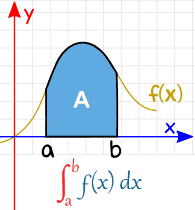
A real valued function being evaluated (integrated) over the closed interval [a, b] is written as :
\(\int_{a}^{b}f(x)dx\)
Definite integrals have a lot of applications. Its main application is that it is used to find out the area under the curve of a function, as shown below: