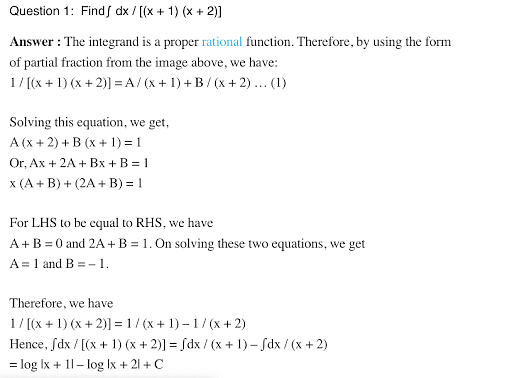
Integrate the rational function: \(\frac {(x^2+1)(x^2+2)}{(x^2+3)(x^2+4)}\)

Solution and Explanation
\(\frac {(x^2+1)(x^2+2)}{(x^2+3)(x^2+4)}\) = \(1- \frac {(4x^2+10)}{(x^2+3)(x^2+4)}\)
Let \(\frac {(4x^2+10)}{(x^2+3)(x^2+4)}\) = \(\frac {Ax+B}{(x^2+3)}+\frac {Cx+D}{(x^2+4)}\)
\(4x^2+10 = (Ax+B)(x^2+4)+(Cx+D)(x^2+3)\)
\(4x^2+10 = Ax^3+4Ax+Bx^2+4B+Cx^3+3Cx+Dx^2+3D\)
\(4x^2+10 = (A+C)x^3+(B+D)x^2+(4A+3C)x+(4B+3D)\)
\(Equating\ the\ coefficients\ of\ x^3, x^2, x,\ and\ constant \ term,\ we\ obtain\)
\(A + C = 0\)
\(B + D = 4\)
\(4A + 3C = 0\)
\(4B + 3D = 10\)
\(On\ solving\ these \ equations,\ we \ obtain\)
\(A = 0, B = −2, C = 0, \ and\ D = 6\)
∴ \(\frac {(4x^2+10)}{(x^2+3)(x^2+4)}\) =\(-\frac {2}{(x^2+3)}+\frac {6}{(x^2+4)}\)
\(\frac {(x^2+1)(x^2+2)}{(x^2+3)(x^2+4)}\) = 1\(-\frac {2}{(x^2+3)}+\frac {6}{(x^2+4)}\)
⇒ \(∫\)\(\frac {(x^2+1)(x^2+2)}{(x^2+3)(x^2+4)}\ dx\) = \(∫[{1+\frac {2}{(x^2+3)}-\frac {6}{(x^2+4)}}]dx\)
= \(∫{1+\frac {2}{x^2+(\sqrt 3)^2}-\frac {6}{x^2+2^2}}dx\)
= \(x+2(\frac {1}{\sqrt 3}tan^{-1}\frac {x}{\sqrt 3})-6(\frac 12 tan^{-1}\frac x2)+C\)
= \(x+\frac {2}{\sqrt 3}tan^{-1}\frac { x}{\sqrt 3}-3tan^{-1}\frac x2+C\)
Top Questions on integral
Let \( f : (0, \infty) \to \mathbb{R} \) be a twice differentiable function. If for some \( a \neq 0 \), } \[ \int_0^a f(x) \, dx = f(a), \quad f(1) = 1, \quad f(16) = \frac{1}{8}, \quad \text{then } 16 - f^{-1}\left( \frac{1}{16} \right) \text{ is equal to:}\]
- Let $ f(x) $ be a positive function and $I_1 = \int_{-\frac{1}{2}}^1 2x \, f\left(2x(1-2x)\right) dx$ and $I_2 = \int_{-1}^2 f\left(x(1-x)\right) dx.$ Then the value of $\frac{I_2}{I_1}$ is equal to ____
- Evaluate the integral: \[ \int \frac{x^2 + 2x}{\sqrt{x^2 + 1}} \, dx \]
- Evaluate the integral: \[ \int \sqrt{x^2 + 3x} \, dx \]
- The value of the integral \( \int_0^1 x^2 \, dx \) is:
Questions Asked in CBSE CLASS XII exam
- If $y = a \cos(\log x) + b \sin(\log x)$, then $x^2y'' + xy'1$ is:
- CBSE CLASS XII - 2025
- Continuity and differentiability

A ladder of fixed length \( h \) is to be placed along the wall such that it is free to move along the height of the wall.
Based upon the above information, answer the following questions:(iii) (b) If the foot of the ladder, whose length is 5 m, is being pulled towards the wall such that the rate of decrease of distance \( y \) is \( 2 \, \text{m/s} \), then at what rate is the height on the wall \( x \) increasing when the foot of the ladder is 3 m away from the wall?
- CBSE CLASS XII - 2025
- Application of derivatives
- A meeting will be held only if all three members A, B and C are present. The probability that member A does not turn up is 0.10, member B does not turn up is 0.20 and member C does not turn up is 0.05. The probability of the meeting being cancelled is:
- CBSE CLASS XII - 2025
- Probability
- Vishesh, Manik and Amit were partners in the ratio 5 : 4 : 1. Amit retired on 31st March, 2024. Vishesh and Manik decided to share Amit’s share in the ratio 2 : 3. What will be the new profit sharing ratio between Vishesh and Manik?
- CBSE CLASS XII - 2025
- Retirement and Death of a Partner
- The electric field in a region is given by \( \vec{E} = 40x \hat{i} \, \text{N/C}. \) Find the amount of work done in taking a unit positive charge from a point (0, 3m) to the point (5m, 0).
- CBSE CLASS XII - 2025
- Electrostatics
Concepts Used:
Integration by Partial Fractions
The number of formulas used to decompose the given improper rational functions is given below. By using the given expressions, we can quickly write the integrand as a sum of proper rational functions.
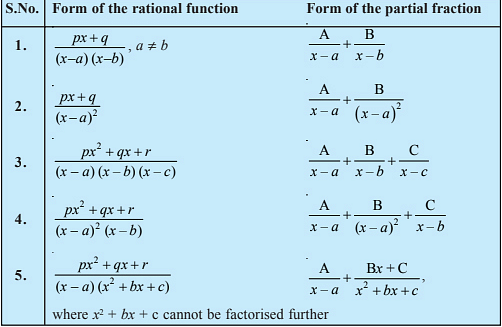
For examples,