The integral $\int sec^{2/3} x cosec^{4/3}x\, dx$ is equal to (Hence $C$ is a constant of integration)
- $3 tan^{-1/3}x + C$
- $-\frac{3}{4} tan^{-4/3} x +C$
- $-3 cot^{-1/3}x +c$
- $-3 tan^{-1/3}x +C$

The Correct Option is D
Solution and Explanation
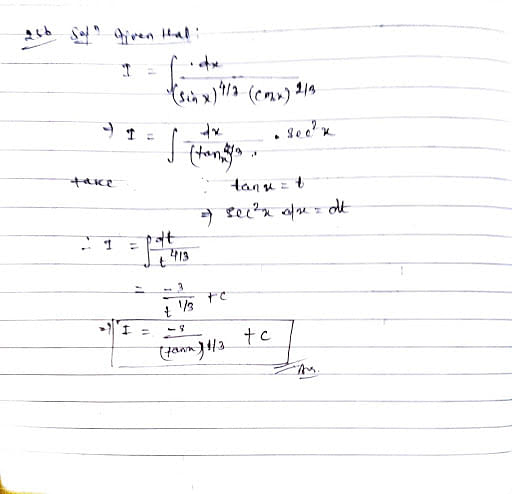
\(I = \int \frac{dx}{(sin x)^{4/3} . (cos x)^{2/3}}\)
\(I = \int \frac{dx}{\bigg(\frac{sin x}{cos x}\bigg)^{4/3} . cos^2 x}\)
\(\Rightarrow \, I = \int \frac{sec^2 x}{(tan x)^{4/3}} dx\)
put tanx = t \(\Rightarrow \, \, sec^2 x dx = dt\)
\(\therefore \, \, I = \int \frac{dt}{t^{4/3}} \Rightarrow \, I = \frac{-3}{t^{1/3}} +c\)
\(\Rightarrow \, \, \, I = \frac{-3}{(tan x)^{1/3}}+c\)
Top Questions on General and Particular Solutions of a Differential Equation
- Let \( \alpha, \beta (\alpha \neq \beta) \) be the values of m, for which the equations \(x + y + z = 1\), \(x + 2y + 4z = m\), and \(x + 4y + 10z = m^2\) have infinitely many solutions. Then the value of \(\sum_{n=1}^{10} (n^4 + n^8)\) is equal to:
- JEE Main - 2025
- Mathematics
- General and Particular Solutions of a Differential Equation
- If y = f(x) is solution of differential equation \((x^2 - 1) dy = ((x^3 + 1) + \sqrt{(1 - x^2)}dx \) and \(y(0) = 2\) then find \(y(\frac{1}2)\)
- JEE Main - 2024
- Mathematics
- General and Particular Solutions of a Differential Equation
If the roots of $\sqrt{\frac{1 - y}{y}} + \sqrt{\frac{y}{1 - y}} = \frac{5}{2}$ are $\alpha$ and $\beta$ ($\beta > \alpha$) and the equation $(\alpha + \beta)x^4 - 25\alpha \beta x^2 + (\gamma + \beta - \alpha) = 0$ has real roots, then a possible value of $y$ is:
- AP EAMCET - 2024
- Mathematics
- General and Particular Solutions of a Differential Equation
- Find the integrating factor of the differential equation \( \sin x \frac{dy}{dx} - y \cos x = 1 \):
- AP EAMCET - 2024
- Mathematics
- General and Particular Solutions of a Differential Equation
- If five-digit numbers are formed from the digits 0, 1, 2, 3, 4 using every digit exactly only once, then the probability that a randomly chosen number from those numbers is divisible by 4 is
- AP EAMCET - 2024
- Mathematics
- General and Particular Solutions of a Differential Equation
Questions Asked in JEE Main exam
- A 20 m long uniform copper wire held horizontally is allowed to fall under the gravity (g = 10 m/s²) through a uniform horizontal magnetic field of 0.5 Gauss perpendicular to the length of the wire. The induced EMF across the wire when it travels a vertical distance of 200 m is_______ mV.}
- JEE Main - 2026
- Thermodynamics
- If the end points of chord of parabola \(y^2 = 12x\) are \((x_1, y_1)\) and \((x_2, y_2)\) and it subtend \(90^\circ\) at the vertex of parabola then \((x_1x_2 - y_1y_2)\) equals :
- JEE Main - 2026
- Probability
- The sum of all possible values of \( n \in \mathbb{N} \), so that the coefficients of \(x, x^2\) and \(x^3\) in the expansion of \((1+x^2)^2(1+x)^n\) are in arithmetic progression is :
- JEE Main - 2026
- Integration
- In a microscope of tube length $10\,\text{cm}$ two convex lenses are arranged with focal lengths $2\,\text{cm}$ and $5\,\text{cm}$. Total magnification obtained with this system for normal adjustment is $(5)^k$. The value of $k$ is ___.
- JEE Main - 2026
- Optical Instruments
Which one of the following graphs accurately represents the plot of partial pressure of CS₂ vs its mole fraction in a mixture of acetone and CS₂ at constant temperature?


- JEE Main - 2026
- Organic Chemistry
Concepts Used:
General Solutions to Differential Equations
A relation between involved variables, which satisfy the given differential equation is called its solution. The solution which contains as many arbitrary constants as the order of the differential equation is called the general solution and the solution free from arbitrary constants is called particular solution.
For example,
Read More: Formation of a Differential Equation