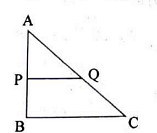
In the given figure, \(PQ||BC\). If AP=3 cm, BP=2 cm and CQ=3 cm, then AQ=
- 4 cm
- 4.5 cm
- 3.5 cm
- 5 cm

The Correct Option is B
Solution and Explanation
To solve the problem, we need to find the length of segment $AQ$ using the concept of similar triangles formed by a line parallel to one side of a triangle.
1. Understanding the Geometry:
In the given triangle, $PQ \parallel BC$, so triangles $APQ$ and $ABC$ are similar by Basic Proportionality Theorem (Thales' Theorem).
2. Given Information:
$AP = 3 \, \text{cm}$
$BP = 2 \, \text{cm}$
$CQ = 3 \, \text{cm}$
3. Use of Similar Triangles:
Since $PQ \parallel BC$, we write the similarity condition:
$ \frac{AP}{PB} = \frac{AQ}{QC} $
4. Substituting the Known Values:
$ \frac{3}{2} = \frac{AQ}{3} $
5. Cross Multiplying to Solve for $AQ$:
$ 3 \times 3 = 2 \times AQ $
$ 9 = 2AQ \Rightarrow AQ = \frac{9}{2} = 4.5 \, \text{cm} $
Final Answer:
The length of $AQ$ is $ 4.5 \, \text{cm} $.
Top Questions on Triangles
In the adjoining figure, \(PQ \parallel XY \parallel BC\), \(AP=2\ \text{cm}, PX=1.5\ \text{cm}, BX=4\ \text{cm}\). If \(QY=0.75\ \text{cm}\), then \(AQ+CY =\)

- Assertion (A) : \(\triangle ABC \sim \triangle PQR\) such that \(\angle A = 65^\circ\), \(\angle C = 60^\circ\). Hence \(\angle Q = 55^\circ\).
Reason (R) : Sum of all angles of a triangle is \(180^\circ\). - If the orthocentre of the triangle formed by the lines $ y = x + 1 $, $ y = 4x - 8 $, and $ y = mx + c $ is at $ (3, -1) $, then $ m - c $ is:
In the adjoining figure, \( \triangle CAB \) is a right triangle, right angled at A and \( AD \perp BC \). Prove that \( \triangle ADB \sim \triangle CDA \). Further, if \( BC = 10 \text{ cm} \) and \( CD = 2 \text{ cm} \), find the length of } \( AD \).

If a line drawn parallel to one side of a triangle intersecting the other two sides in distinct points divides the two sides in the same ratio, then it is parallel to the third side. State and prove the converse of the above statement.
Questions Asked in TS POLYCET exam
- The number of elements present in the fifth period of the modern periodic table:
- TS POLYCET - 2025
- Modern Periodic Law And The Present Form Of The Periodic Table
- The volume of CO\(_2\) liberated in litres at STP when 25 g of CaCO\(_3\) is treated with dilute HCl containing 14.6 g of HCl is:
- TS POLYCET - 2025
- Chemical Reactions
- Which one of the following processes involves chemical change?
- TS POLYCET - 2025
- Chemical Reactions
- If \( A \) is the set of odd numbers less than 6 and \( B \) is the set of prime factors of 30, then:
- TS POLYCET - 2025
- Magnetic Field
- If \( A = \{1, 2, 3, 4, 5\} \) and \( B = \{1, 3, 5, 7\} \), then \( n(A \cap B) = \dots \):
- TS POLYCET - 2025
- Magnetic Field