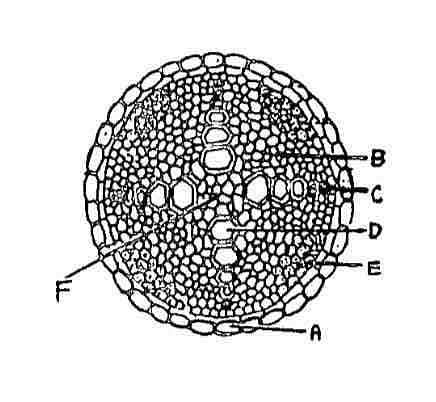
In the diagram of T.S. of Stele of Dicot Root, the different parts have been indicated by alphabets; choose the answer in which these alphabets correctly match with the parts they indicate:
A = Pericycle; B = Conjunctive tissue; C = Metaxylem; D = Protoxylem; E = Phloem; F = Pith
A = Endodermis; B = Conjunctive tissue; C = Protoxylem; D = Metaxylem; E = Phloem; F = Pith
A = Endodermis; B = Conjunctive tissue; C = Metaxylem; D = Protoxylem; E = Phloem; F = Pith
A = Endodermis; B = Pith; C = Protoxylem; D = Metaxylem; E = Phloem; F = Conjunctive tissue
Hide Solution
Verified By Collegedunia
The Correct Option isB
Solution and Explanation
The correct answer is: A = Endodermis; B = Conjunctive tissue; C = Protoxylem; D = Metaxylem; E = Phloem; F = Pith
In the T.S. of stele of dicot plants, the xylem and phloem are arranged in an X-shape. The parenchyma tissue present between xylem and phloem is called conjunctive tissue.
Endodermis - These are cells seen in the T.S. of stele of a dicot root without any intercellular spaces.
Conjunctive Tissue - It separates xylem from phloem.
Protoxylem - In dicot plants, it is present away from the center.
Metaxylem - It is situated towards the center.
Phloem - In dicot roots, xylem and phloem are arranged radially i.e. they are present in different radii.
Pith - At the center of the dicot roots, a small pith can be seen.
Was this answer helpful?
0
0
Top Questions on Anatomy of Dicotyledonous and Monocotyledonous Plants
Anatomy of Dicotyledonous and Monocotyledonous Plants
Dicot Root:
Dicot plants have the taproot system.
The outermost layer is called the epidermis. The epidermal cells sometimes project out which appear as the root hairs.
The epidermis is followed by the multi-layered cortex, loosely made of the parenchyma cells with intercellular spaces.
The inner layer of the cortex is called endodermis, which is tightly packed by the barrel shaped-cells.
Endodermis is followed by pericycle, which are a few layers of thick-walled parenchyma cells.
In dicots, the central pith is not distinct.
There are two to four xylem and phloem.
The xylem and phloem are remarked by a layer of parenchymatous cells known as conjunctive tissue.
Monocot Root:
Monocot roots do not show much difference in the anatomy from that of the dicot roots.
Monocot plants possess an adventitious root system.
As in the dicots, the epidermis forms the outermost layer, followed by cortex, pericycle, endodermis, vascular bundles (xylem and phloem) and pith (random order).
Pith is conspicuous and large.
The number of xylem in a monocot is six or more.
Secondary growth is not seen in the monocot plants.