If a line intercepted between the coordinate axes is trisected at a point $A(4, 3)$, which is nearer to $x$-axis, then its equation is :
- $4x ?3y = 7$
- $3x + 2y = 18$
- $3x + 8y = 36$
- $x + 3y = 13$

The Correct Option is B
Solution and Explanation
$\Rightarrow a=6 \Rightarrow$ coordinate of $B$ is $B \left(6, 0\right)$
$3=\left(\frac{1\times a+2\times 0}{1+2}\right)=\frac{b}{3}$
$\Rightarrow b=9$ and $C\left(0, 9\right)$
Slope of line passing through $\left(6,0\right), \left(0,9\right)$
slope, $m=\frac{9}{-6}=-\frac{3}{2}$
Equation of line $y-0= \frac{-3}{2}\left(x- 6\right)$
$2y = -3x + 18$
$3x + 2y = 18$
Top Questions on Straight lines
- Rhombus vertices A(1,2), C(-3,-6). Line AD parallel to $7x-y=14$. Find $|\alpha+\beta+\gamma+\delta|$.
- JEE Main - 2026
- Mathematics
- Straight lines
- Let the angles made with the positive $x$-axis by two straight lines drawn from the point $P(2,3)$ and meeting the line $x+y=6$ at a distance $\sqrt{\frac{2}{3}}$ from the point $P$ be $\theta_1$ and $\theta_2$. Then the value of $(\theta_1+\theta_2)$ is
- JEE Main - 2026
- Mathematics
- Straight lines
- If two lines drawn from a point $P(2,3)$ intersect the line $x+y=6$ at a distance $\sqrt{\dfrac{2}{3}}$, then the angle between the lines is
- JEE Main - 2026
- Mathematics
- Straight lines
- If two lines drawn from a point $P(2,3)$ intersect the line $x+y=6$ at a distance $\sqrt{\dfrac{2}{3}}$, then the angle between the lines is
- JEE Main - 2026
- Mathematics
- Straight lines
- The equation of a straight line is given by \( y = 3x + 4 \). What is the slope of the line?
- BITSAT - 2025
- Mathematics
- Straight lines
Questions Asked in JEE Main exam
- The sum of all possible values of \( n \in \mathbb{N} \), so that the coefficients of \(x, x^2\) and \(x^3\) in the expansion of \((1+x^2)^2(1+x)^n\) are in arithmetic progression is :
- JEE Main - 2026
- Integration
- In a microscope of tube length $10\,\text{cm}$ two convex lenses are arranged with focal lengths $2\,\text{cm}$ and $5\,\text{cm}$. Total magnification obtained with this system for normal adjustment is $(5)^k$. The value of $k$ is ___.
- JEE Main - 2026
- Optical Instruments
Which one of the following graphs accurately represents the plot of partial pressure of CS₂ vs its mole fraction in a mixture of acetone and CS₂ at constant temperature?


- JEE Main - 2026
- Organic Chemistry
- Let \( ABC \) be an equilateral triangle with orthocenter at the origin and the side \( BC \) lying on the line \( x+2\sqrt{2}\,y=4 \). If the coordinates of the vertex \( A \) are \( (\alpha,\beta) \), then the greatest integer less than or equal to \( |\alpha+\sqrt{2}\beta| \) is:
- JEE Main - 2026
- Coordinate Geometry
- Three charges $+2q$, $+3q$ and $-4q$ are situated at $(0,-3a)$, $(2a,0)$ and $(-2a,0)$ respectively in the $x$-$y$ plane. The resultant dipole moment about origin is ___.
- JEE Main - 2026
- Electromagnetic waves
Concepts Used:
Straight lines
A straight line is a line having the shortest distance between two points.
A straight line can be represented as an equation in various forms, as show in the image below:
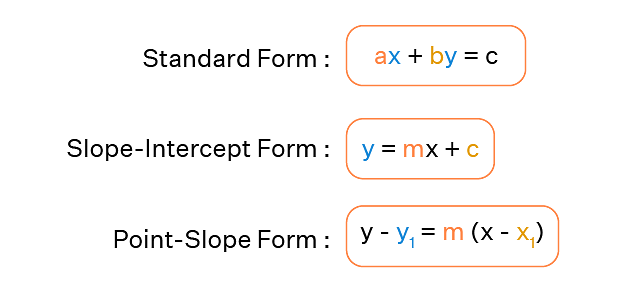
The following are the many forms of the equation of the line that are presented in straight line-
1. Slope – Point Form
Assume P0(x0, y0) is a fixed point on a non-vertical line L with m as its slope. If P (x, y) is an arbitrary point on L, then the point (x, y) lies on the line with slope m through the fixed point (x0, y0) if and only if its coordinates fulfil the equation below.
y – y0 = m (x – x0)
2. Two – Point Form
Let's look at the line. L crosses between two places. P1(x1, y1) and P2(x2, y2) are general points on L, while P (x, y) is a general point on L. As a result, the three points P1, P2, and P are collinear, and it becomes
The slope of P2P = The slope of P1P2 , i.e.
\(\frac{y-y_1}{x-x_1} = \frac{y_2-y_1}{x_2-x_1}\)
Hence, the equation becomes:
y - y1 =\( \frac{y_2-y_1}{x_2-x_1} (x-x1)\)
3. Slope-Intercept Form
Assume that a line L with slope m intersects the y-axis at a distance c from the origin, and that the distance c is referred to as the line L's y-intercept. As a result, the coordinates of the spot on the y-axis where the line intersects are (0, c). As a result, the slope of the line L is m, and it passes through a fixed point (0, c). The equation of the line L thus obtained from the slope – point form is given by
y – c =m( x - 0 )
As a result, the point (x, y) on the line with slope m and y-intercept c lies on the line, if and only if
y = m x +c