Archaeal cell membranes contain lipids that are
- Ether linked
- Ester linked
- Branched alkyl chain
- Linear alkyl chain

The Correct Option is A, C
Solution and Explanation
To answer the question correctly, we need to understand the unique characteristics of archaeal cell membranes compared to those of bacteria and eukaryotes.
Archaeal cell membranes are noteworthy for two main features:
- Ether-linked lipids: Unlike bacteria and eukaryotes, which have ester-linked fatty acids in their phospholipids, archaea have ether linkages. These ether bonds occur between the glycerol backbone and the isoprenoid chains. The stability offered by ether bonds is advantageous because it allows archaea to survive in extreme environments, often with high temperatures or harsh chemical conditions.
- Branched alkyl chains: The lipids in archaeal membranes often have branched isoprenoid chains rather than the linear chains found in bacterial and eukaryotic membranes. These branched chains lead to more compact and less permeable membranes, increasing resistance to extreme environmental conditions, such as high salinity and temperature.
Now, let's evaluate the given options:
-
Ether linked:This is correct as archaeal membrane lipids feature ether bonds.
-
Ester linked:This option refers to bacterial and eukaryotic membranes, not archaeal.
-
Branched alkyl chain:This is correct, as archaeal lipids have branched isoprenoid chains.
-
Linear alkyl chain:This is incorrect for archaea, but characteristic of bacterial and eukaryotic membranes.
Hence, the correct characteristics of archaeal cell membrane lipids are:
- Ether linked
- Branched alkyl chain
These adaptations contribute to the ability of archaea to thrive in extreme environments, distinguishing them from bacteria and eukaryotes.
Top Questions on Lipids
- A patient presents with xanthomas on the Achilles tendon. Which of the following is the most likely diagnosis?
- A patient with multiple tendon xanthomas is found to have a serum cholesterol level of 398 mg/dL and an LDL level of 220 mg/dL. What is the most likely defect?
- Which of the following has the lowest melting point?
- Ceramides are
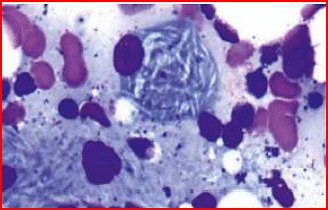
- A child presents with bone pain and hepatosplenomegaly. A trephine biopsy and aspirate show the following finding. Which of the following is the most likely enzyme deficient in this condition?
Questions Asked in IIT JAM BT exam
- The wavelength of a photon emitted during a transition from \( n = 3 \) to \( n = 2 \) state in the H atom is .............. nm. (answer in integer).
- IIT JAM BT - 2025
- Biotechnology
- The porphyrin ring (tetrapyrrole structure) is NOT found in functional
- IIT JAM BT - 2025
- Biotechnology
Identify the taxa that constitute a paraphyletic group in the given phylogenetic tree.

- IIT JAM BT - 2025
- Genetics
The vector, shown in the figure, has promoter and RBS sequences in the 300 bp region between the restriction sites for enzymes X and Y. There are no other sites for X and Y in the vector. The promoter is directed towards the Y site. The insert containing only an ORF provides 3 fragments after digestion with both enzymes X and Y. The ORF is cloned in the correct orientation in the vector using the single restriction enzyme Y. The size of the largest fragment of the recombinant plasmid expressing the ORF upon digestion with enzyme X is ........... bp. (answer in integer)

- IIT JAM BT - 2025
- Biotechnology
- Match the animals in Group I with the major form of excreted nitrogen metabolite in Group II. \[ \begin{array}{c|c} \text{Group I} & \text{Group II} \\ \hline P:\; \text{Bony fishes} & 3:\; \text{Ammonia} \\ Q:\; \text{Lions} & 1:\; \text{Urea} \\ R:\; \text{Birds} & 2:\; \text{Uric acid} \\ \end{array} \]
- IIT JAM BT - 2025
- Metabolism