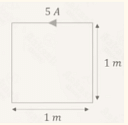
The current of 5 A flows in a square loop of sides 1 m placed in air. The magnetic field at the center of the loop is \(X\sqrt{2} \times 10^{-7} \, T\). The value of X = _________.

Correct Answer: 40
Solution and Explanation
This problem requires us to calculate the magnetic field at the center of a square current-carrying loop and then determine the value of a constant \( X \) from the given expression for the magnetic field.
Concept Used:
The magnetic field \( B \) at a point P, due to a straight wire of finite length carrying a current \( I \), at a perpendicular distance \( d \) from the wire is given by the Biot-Savart law application:
\[ B = \frac{\mu_0 I}{4\pi d} (\sin\theta_1 + \sin\theta_2) \]where \( \theta_1 \) and \( \theta_2 \) are the angles subtended by the ends of the wire at point P. For a square loop, the total magnetic field at the center is the sum of the magnetic fields due to its four sides. By symmetry, the field from each side is identical in magnitude and direction.
\[ B_{\text{center}} = 4 \times B_{\text{one side}} \]Step-by-Step Solution:
Step 1: Identify the given parameters.
Current in the loop, \( I = 5 \, \text{A} \).
Side length of the square loop, \( L = 1 \, \text{m} \).
The loop is in air, so we use the permeability of free space, \( \mu_0 = 4\pi \times 10^{-7} \, \text{T}\cdot\text{m/A} \).
Step 2: Determine the geometry for calculating the field from one side.
The perpendicular distance \( d \) from the center of the square to the midpoint of any side is half the side length.
\[ d = \frac{L}{2} = \frac{1}{2} = 0.5 \, \text{m} \]The angles \( \theta_1 \) and \( \theta_2 \) subtended by the ends of a side at the center are equal. The diagonals of a square bisect at \( 90^\circ \), so the lines from the center to the vertices of a side make angles of \( 45^\circ \) with the perpendicular from the center to that side.
\[ \theta_1 = \theta_2 = 45^\circ \]Step 3: Calculate the magnetic field due to one side of the square loop.
Using the formula for a finite wire:
\[ B_{\text{one side}} = \frac{\mu_0 I}{4\pi d} (\sin 45^\circ + \sin 45^\circ) \]Substitute the values:
\[ B_{\text{one side}} = \frac{(4\pi \times 10^{-7}) \times 5}{4\pi \times 0.5} \left(\frac{1}{\sqrt{2}} + \frac{1}{\sqrt{2}}\right) \] \[ B_{\text{one side}} = \frac{5 \times 10^{-7}}{0.5} \left(\frac{2}{\sqrt{2}}\right) \] \[ B_{\text{one side}} = 10 \times 10^{-7} \times \sqrt{2} = \sqrt{2} \times 10^{-6} \, \text{T} \]Step 4: Calculate the total magnetic field at the center of the loop.
The total magnetic field is four times the field from a single side.
\[ B_{\text{center}} = 4 \times B_{\text{one side}} \] \[ B_{\text{center}} = 4 \times (\sqrt{2} \times 10^{-6}) = 4\sqrt{2} \times 10^{-6} \, \text{T} \]To match the given format, we can write this as:
\[ B_{\text{center}} = 40\sqrt{2} \times 10^{-7} \, \text{T} \]Step 5: Compare the calculated magnetic field with the given expression to find X.
The problem states that the magnetic field at the center is \( X\sqrt{2} \times 10^{-7} \, \text{T} \).
\[ X\sqrt{2} \times 10^{-7} = 40\sqrt{2} \times 10^{-7} \]By comparing both sides of the equation, we find:
\[ X = 40 \]The value of X is 40.
Top Questions on Magnetic Force
- A square loop MNPK of side \( l \) carrying a current \( I_2 \) is kept close to a long straight wire in the same plane and the wire carries a steady current \( I_1 \) as shown in the figure. Obtain the magnitude of magnetic force exerted by the wire on the loop.

- CBSE CLASS XII - 2025
- Physics
- Magnetic Force
- A particle with charge \( q \) moving with velocity \( \vec{v} = v_0 \hat{i} \) enters a region with magnetic field \( \vec{B} = B_1 \hat{j} + B_2 \hat{k} \). The magnitude of force experienced by the particle is:
- CBSE CLASS XII - 2025
- Physics
- Magnetic Force
- A straight conductor is carrying a current of 2 A in the \( +x \) direction along it. A uniform magnetic field \( \vec{B} = (0.6 \hat{j} + 0.8 \hat{k}) \) T is switched on in the region. The force acting on 10 cm length of the conductor is:
- CBSE CLASS XII - 2025
- Physics
- Magnetic Force
- Two thin long parallel wires separated by a distance \( r \) from each other in vacuum carry a current of 1 ampere in opposite directions. Then, they will
- KCET - 2025
- Physics
- Magnetic Force
- A long straight wire carries a current of 10 A. A proton moves parallel to the wire at a distance of 0.05 m with a velocity of \( 2 \times 10^5 \, \text{m/s} \) in the same direction as the current. Find the magnitude of the magnetic force acting on the proton. (Given: Charge of proton \( q = 1.6 \times 10^{-19} \, \text{C} \), permeability of free space \( \mu_0 = 4\pi \times 10^{-7} \, \text{Tm/A} \)).
- MHT CET - 2025
- Physics
- Magnetic Force
Questions Asked in JEE Main exam
- The sum of all possible values of \( n \in \mathbb{N} \), so that the coefficients of \(x, x^2\) and \(x^3\) in the expansion of \((1+x^2)^2(1+x)^n\) are in arithmetic progression is :
- JEE Main - 2026
- Integration
- In a microscope of tube length $10\,\text{cm}$ two convex lenses are arranged with focal lengths $2\,\text{cm}$ and $5\,\text{cm}$. Total magnification obtained with this system for normal adjustment is $(5)^k$. The value of $k$ is ___.
- JEE Main - 2026
- Optical Instruments
Which one of the following graphs accurately represents the plot of partial pressure of CS₂ vs its mole fraction in a mixture of acetone and CS₂ at constant temperature?


- JEE Main - 2026
- Organic Chemistry
- Let \( ABC \) be an equilateral triangle with orthocenter at the origin and the side \( BC \) lying on the line \( x+2\sqrt{2}\,y=4 \). If the coordinates of the vertex \( A \) are \( (\alpha,\beta) \), then the greatest integer less than or equal to \( |\alpha+\sqrt{2}\beta| \) is:
- JEE Main - 2026
- Coordinate Geometry
- Three charges $+2q$, $+3q$ and $-4q$ are situated at $(0,-3a)$, $(2a,0)$ and $(-2a,0)$ respectively in the $x$-$y$ plane. The resultant dipole moment about origin is ___.
- JEE Main - 2026
- Electromagnetic waves
Concepts Used:
Magnetic Force
Magnetic force is the attraction or repulsion force that results from the motion of electrically charged particles. The magnets are attracted or repellent to one another due to this force. A compass, a motor, the magnets that hold the refrigerator door, train tracks, and modern roller coasters are all examples of magnetic power.
A magnetic field is generated by all moving charges, and the charges that pass through its regions feel a force. Depending on whether the force is attractive or repulsive, it may be positive or negative. The magnetism force is determined by the object's charge, velocity, and magnetic field.
Read More: Magnetic Force and Magnetic Field
The magnitude of the magnetic force depends on how much charge is in how much motion in each of the objects and how far apart they are.
Mathematically, we can write magnetic force as:
A charge will feel a force as it passes through a magnetic field at an angle. This force is given by the equation:

A force acts on the motion of charge q traveling with velocity v in a Magnetism field, and this force is:
- Perpendicular to both v and B.
- Perpendicular to sinθ (where θ is the angle between v and B).
- Proportional to the charge q.
- Proportional to the velocity v.