2sin(\(\frac{\pi}{22}\))sin(\(\frac{3\pi}{22}\))sin(\(\frac{5\pi}{22}\))sin(\(\frac{7\pi}{22}\))sin(\(\frac{9\pi}{22}\)) is equal to
2sin(\(\frac{\pi}{22}\))sin(\(\frac{3\pi}{22}\))sin(\(\frac{5\pi}{22}\))sin(\(\frac{7\pi}{22}\))sin(\(\frac{9\pi}{22}\)) is equal to
\(\frac{3}{16}\)
\(\frac{1}{16}\)
\(\frac{1}{32}\)
\(\frac{9}{32}\)

The Correct Option is B
Approach Solution - 1
To solve the problem, we need to evaluate the expression:
\(2 \cdot \sin\left(\frac{\pi}{22}\right)\sin\left(\frac{3\pi}{22}\right)\sin\left(\frac{5\pi}{22}\right)\sin\left(\frac{7\pi}{22}\right)\sin\left(\frac{9\pi}{22}\right)\).
This expression is a classic problem involving the product of sine terms that can be solved using trigonometric identities and symmetry properties of the sine function.
We can use a trigonometric identity known as the multiple angle identity for sine, which states:
\(\prod_{k=1}^{n} \sin\left(\frac{k\pi}{2n+1}\right) = \frac{1}{2^n}\), for \(n = 5\).
Applying this identity to our problem, the product of sine terms:
\(\sin\left(\frac{\pi}{22}\right)\sin\left(\frac{3\pi}{22}\right)\sin\left(\frac{5\pi}{22}\right)\sin\left(\frac{7\pi}{22}\right)\sin\left(\frac{9\pi}{22}\right)\)
results in:
\(\frac{1}{2^5}\) which simplifies to \(\frac{1}{32}\).
Since the expression is multiplied by 2, we have:
\(2 \times \frac{1}{32} = \frac{1}{16}\).
Hence, the evaluated expression is \(\frac{1}{16}\).
Therefore, the correct answer is \(\frac{1}{16}\), which matches option B.
Approach Solution -2
\[ 2 \sin \left( \frac{\pi}{22} \right) \sin \left( \frac{3\pi}{22} \right) \sin \left( \frac{5\pi}{22} \right) \sin \left( \frac{7\pi}{22} \right) \sin \left( \frac{9\pi}{22} \right) \]
Using the symmetry of angles: \[ = 2 \sin \left( \frac{11\pi - 10\pi}{22} \right) \sin \left( \frac{11\pi - 8\pi}{22} \right) \sin \left( \frac{11\pi - 6\pi}{22} \right) \sin \left( \frac{11\pi - 4\pi}{22} \right) \sin \left( \frac{11\pi - 2\pi}{22} \right) \]
Simplifying: \[ = 2 \cdot \frac{\cos \pi}{11} \cdot \frac{2\cos \pi}{11} \cdot \frac{\cos 3\pi}{11} \cdot \frac{\cos 4\pi}{11} \cdot \frac{\cos 5\pi}{11} \]
\[ = \frac{2 \sin \left( \frac{32\pi}{11} \right)}{2^5 \sin \left( \frac{\pi}{11} \right)} \]
Finally: \[ = \frac{1}{16} \]
Top Questions on Integration by Partial Fractions
If \[ \int (\sin x)^{-\frac{11}{2}} (\cos x)^{-\frac{5}{2}} \, dx \] is equal to \[ -\frac{p_1}{q_1}(\cot x)^{\frac{9}{2}} -\frac{p_2}{q_2}(\cot x)^{\frac{5}{2}} -\frac{p_3}{q_3}(\cot x)^{\frac{1}{2}} +\frac{p_4}{q_4}(\cot x)^{-\frac{3}{2}} + C, \] where \( p_i, q_i \) are positive integers with \( \gcd(p_i,q_i)=1 \) for \( i=1,2,3,4 \), then the value of \[ \frac{15\,p_1 p_2 p_3 p_4}{q_1 q_2 q_3 q_4} \] is ___________.
- JEE Main - 2026
- Mathematics
- Integration by Partial Fractions
- Let for \( f(x) = 7\tan^8 x + 7\tan^6 x - 3\tan^4 x - 3\tan^2 x \), \( I_1 = \int_0^{\frac{\pi}{4}} f(x)dx \) and \( I_2 = \int_0^{\frac{\pi}{4}} x f(x)dx \). Then \( 7I_1 + 12I_2 \) is equal to:
- JEE Main - 2025
- Mathematics
- Integration by Partial Fractions
- Let {an}n=0∞ be a sequence such that a0=a1=0 and an+2=3an+1−2an+1,∀ n≥0. Then a25a23−2a25a22−2a23a24+4a22a24 is equal to
- JEE Main - 2025
- Mathematics
- Integration by Partial Fractions
- Find the value of \( \frac{5}{6} + \frac{3}{4} \).
- MHT CET - 2025
- Mathematics
- Integration by Partial Fractions
- If ∫ (2x + 3)/((x - 1)(x^2 + 1)) dx = log_x {(x - 1)^(5/2)(x^2 + 1)^a} - (1/2) tan^(-1)x + C, then the value of a is:
- MHT CET - 2025
- Mathematics
- Integration by Partial Fractions
Questions Asked in JEE Main exam
Two circular discs of radius \(10\) cm each are joined at their centres by a rod, as shown in the figure. The length of the rod is \(30\) cm and its mass is \(600\) g. The mass of each disc is also \(600\) g. If the applied torque between the two discs is \(43\times10^{-7}\) dyne·cm, then the angular acceleration of the system about the given axis \(AB\) is ________ rad s\(^{-2}\).

- JEE Main - 2026
- Rotational motion
- If \[ \frac{\tan(A-B)}{\tan A}+\frac{\sin^2 C}{\sin^2 A}=1, \quad A,B,C\in\left(0,\frac{\pi}{2}\right), \] then:
- JEE Main - 2026
- Trigonometry
Match the LIST-I with LIST-II for an isothermal process of an ideal gas system.

Choose the correct answer from the options given below:
- JEE Main - 2026
- Thermodynamics and Work Done
- A bag contains 10 balls out of which \( k \) are red and \( (10-k) \) are black, where \( 0 \le k \le 10 \). If three balls are drawn at random without replacement and all of them are found to be black, then the probability that the bag contains 1 red and 9 black balls is:
- JEE Main - 2026
- Probability
Which one of the following graphs accurately represents the plot of partial pressure of CS₂ vs its mole fraction in a mixture of acetone and CS₂ at constant temperature?


- JEE Main - 2026
- Organic Chemistry
Concepts Used:
Types of Differential Equations
There are various types of Differential Equation, such as:
Ordinary Differential Equations:
Ordinary Differential Equations is an equation that indicates the relation of having one independent variable x, and one dependent variable y, along with some of its other derivatives.
\(F(\frac{dy}{dt},y,t) = 0\)
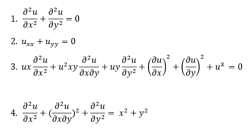
Partial Differential Equations:
A partial differential equation is a type, in which the equation carries many unknown variables with their partial derivatives.
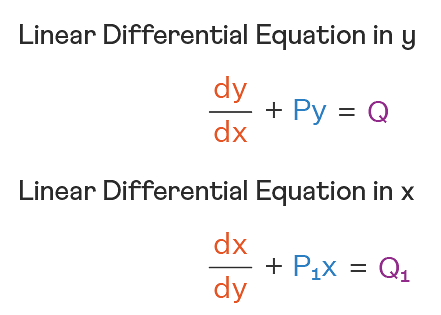
Linear Differential Equations:
It is the linear polynomial equation in which derivatives of different variables exist. Linear Partial Differential Equation derivatives are partial and function is dependent on the variable.
Homogeneous Differential Equations:
When the degree of f(x,y) and g(x,y) is the same, it is known to be a homogeneous differential equation.
\(\frac{dy}{dx} = \frac{a_1x + b_1y + c_1}{a_2x + b_2y + c_2}\)
Read More: Differential Equations