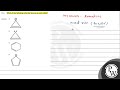
Which of the following molecule/species is most stable?


The Correct Option is C
Solution and Explanation
Step 1. Identify Aromatic Stability: The most stable species among the options will be the one that is aromatic as aromatic compounds exhibit additional stability due to delocalized π-electrons.
Step 2. Analyze Each Structure: Option (1): This structure satisfies Huckel’s rule (4n + 2) for aromaticity and has a planar conjugated ring structure, making it aromatic and stable. Other Options: Do not satisfy Huckel’s rule or are non-aromatic.
Step 3. Conclusion: Option (3) is the most stable due to its aromaticity.
Learn with videos:
Top Questions on Hydrocarbons
Consider the following reaction sequence.

- JEE Main - 2026
- Chemistry
- Hydrocarbons
- $\text{C}_3\text{H}_6\text{Cl}_2$ (X) $\xrightarrow[\Delta]{\text{NaNH}_2 (2 \text{eq})}$ (Y) $\xrightarrow[\text{(ii) NaBH}_4]{\text{(i) Hg(OAc)}_2/\text{H}_2\text{O}}$ $\text{CH}_3\text{COCH}_3$. (Y) $\xrightarrow[\Delta]{\text{Fe/tube}}$ (Z).
Statement-I : Y gives yellow ppt. with $\text{NaOH}/\text{I}_2$.
Statement-II : Two types of H-atoms and one aromatic ring is present in Z and ratio of Z and X is 1 : 3.
Choose the correct option.- JEE Main - 2026
- Chemistry
- Hydrocarbons
- Ph-CH=CH$_2 \xrightarrow[\text{(PhCOO)}_2]{\text{HBr}}$ Product.
Correct statement(s) regarding product :
(a) Ph-CH(Br)-CH$_3$ is minor product
(b) Benzene is also form a bi product
(c) Reaction follow free radical mechanism
(d) In absence of peroxide carbocation mechanism is followed- JEE Main - 2026
- Chemistry
- Hydrocarbons
- Correct stability order of alkene ::

- JEE Main - 2026
- Chemistry
- Hydrocarbons
- Hydroxy compound ($\text{A}$) with molecular mass $= 122$ react with excess of acetic anhydride and gives compound ($\text{X}$) with molecular mass $= 290$, then find the no. of hydroxy groups in given compound ($\text{A}$).
- JEE Main - 2026
- Chemistry
- Hydrocarbons
Questions Asked in JEE Main exam
In the given figure, the blocks $A$, $B$ and $C$ weigh $4\,\text{kg}$, $6\,\text{kg}$ and $8\,\text{kg}$ respectively. The coefficient of sliding friction between any two surfaces is $0.5$. The force $\vec{F}$ required to slide the block $C$ with constant speed is ___ N.
(Given: $g = 10\,\text{m s}^{-2}$)
- JEE Main - 2026
- Rotational Mechanics
- The reading of the ammeter (\(A\)) in steady state in the following circuit (assuming negligible internal resistance of the ammeter) is ________ A.
- JEE Main - 2026
- Current electricity
- Electric field in a region is given by \[ \vec{E} = A x\,\hat{i} + B y\,\hat{j}, \] where \( A = 10 \,\text{V/m}^2 \) and \( B = 5 \,\text{V/m}^2 \). If the electric potential at a point \( (10, 20) \) is \(500\ \text{V}\), then the electric potential at origin is __________ V.
- JEE Main - 2026
- Electric Potential And Potential Difference
Let $\alpha,\beta\in\mathbb{R}$ be such that the function \[ f(x)= \begin{cases} 2\alpha(x^2-2)+2\beta x, & x<1 \\ (\alpha+3)x+(\alpha-\beta), & x\ge1 \end{cases} \] is differentiable at all $x\in\mathbb{R}$. Then $34(\alpha+\beta)$ is equal to}
- JEE Main - 2026
- Continuity and differentiability
- A conducting rod of mass \( m \) and length \( l \) is moving on an infinite pair of conducting rails as shown. Conducting rails are connected to a resistance \( R \) at one end. Motion is in the vertical plane and horizontal magnetic field in the region is \( B \). Find the terminal speed of the rod.

- JEE Main - 2026
- Electromagnetic induction