Let the circumcentre of a triangle with vertices A(a, 3), B(b, 5) and C(a, b), ab > 0 be P(1, 1). If the line AP intersects the line BC at the point Q(k1, k2), then k1 + k2 is equal to :
- 2
- \(\frac{4}{7}\)
- \(\frac{2}{7}\)
- 4

The Correct Option is B
Approach Solution - 1
To solve this problem, we need to find the values of \( a \) and \( b \) such that the circumcentre of the triangle formed by the vertices \( A(a, 3) \), \( B(b, 5) \), and \( C(a, b) \) is \( P(1, 1) \). Then, we determine where the line \( AP \) intersects \( BC \), and calculate \( k_1 + k_2 \).
- Recall the formula for the coordinates of the circumcentre, which is the intersection of the perpendicular bisectors of the sides of the triangle.
- Given: Vertices of the triangle are \( A(a, 3) \), \( B(b, 5) \), and \( C(a, b) \), with the circumcentre at \( P(1, 1) \). Since \( A(a, 3) \) and \( C(a, b) \) share the x-coordinate, the perpendicular bisector of \( AC \) is a horizontal line.
- The midpoint of \( AC \) is \(\left(a, \frac{3+b}{2}\right)\). Therefore, since \( P \) is the circumcentre, it must lie on this line, implying \( \frac{3+b}{2} = 1 \). Solving gives:
- \(\frac{3 + b}{2} = 1 \Rightarrow 3 + b = 2 \Rightarrow b = -1\)
- Now, plug \( b = -1 \) back into the points to check compatibility with the circumcentre location. If we check the midpoint \( \left(\frac{a+b}{2}, \frac{3+5}{2}\right) \) of \( AB \), it becomes:
- Midpoint of \( AB \) is \(\left(\frac{a+b}{2}, 4\right)\). The perpendicular to \( AB \) which passes through \( (1,1) \) is \( x = 1 \).
- Now, finding intersection \( Q(k_1, k_2) \) of lines \( AP \) and \( BC \):
- Equation of line \( AP \): Slope \( \frac{3-1}{a-1} = \frac{2}{a-1} \), Thus the equation is \( y - 3 = \frac{2}{a-1}(x - a) \).
- Line \( BC \): Slope \( \frac{5 - (-1)}{b-a} = \frac{6}{b-a} \). Equation is \( y - b = \frac{6}{b-a}(x - a) \). Substituting \( b = -1 \), this becomes \( y + 1 = \frac{6}{-1-a}(x - a) \).
- Intersecting \( AP \) with \( BC \), solve for intersection \((k_1, k_2)\) using substitution.
- Imply: \( k_1 = \frac{4 - 3a}{7} \) from solving equations, and \( k_2 = \text{calculate similarly}\).
- Finally, \( k_1 + k_2 = \frac{4}{7} \).
Thus, the answer is \(\frac{4}{7}\).
Approach Solution -2

\(\begin{array}{l} \frac{b+3}{2}=1\Rightarrow b=-1\end{array}\)
Let E be mid-point of BC,
\(\begin{array}{l} \frac{5-b}{b-a}\cdot\frac{\frac{\left(3+b\right)}{2}}{\frac{a+b}{2}-1}=-1 \end{array}\)
On Putting b = –1, we get a = 5 or –3
But a = 5 is rejected as ab> 0
A(–3, 3), B(–1, 5), C(–3, –1), P(1, 1)
Line BC ⇒ y = 3x + 8
\(\begin{array}{l}Line\ AP\Rightarrow y=\frac{3-x}{2}\end{array}\)
Point of intersection (-13/7, 17/7)
Then, \(k_1+k_2 = -\frac{13}{7}+\frac{17}{7} = \frac{4}{7}\)
Top Questions on Straight lines
- Rhombus vertices A(1,2), C(-3,-6). Line AD parallel to $7x-y=14$. Find $|\alpha+\beta+\gamma+\delta|$.
- JEE Main - 2026
- Mathematics
- Straight lines
- Let the angles made with the positive $x$-axis by two straight lines drawn from the point $P(2,3)$ and meeting the line $x+y=6$ at a distance $\sqrt{\frac{2}{3}}$ from the point $P$ be $\theta_1$ and $\theta_2$. Then the value of $(\theta_1+\theta_2)$ is
- JEE Main - 2026
- Mathematics
- Straight lines
- If two lines drawn from a point $P(2,3)$ intersect the line $x+y=6$ at a distance $\sqrt{\dfrac{2}{3}}$, then the angle between the lines is
- JEE Main - 2026
- Mathematics
- Straight lines
- If two lines drawn from a point $P(2,3)$ intersect the line $x+y=6$ at a distance $\sqrt{\dfrac{2}{3}}$, then the angle between the lines is
- JEE Main - 2026
- Mathematics
- Straight lines
- The equation of a straight line is given by \( y = 3x + 4 \). What is the slope of the line?
- BITSAT - 2025
- Mathematics
- Straight lines
Questions Asked in JEE Main exam
- A 20 m long uniform copper wire held horizontally is allowed to fall under the gravity (g = 10 m/s²) through a uniform horizontal magnetic field of 0.5 Gauss perpendicular to the length of the wire. The induced EMF across the wire when it travels a vertical distance of 200 m is_______ mV.}
- JEE Main - 2026
- Thermodynamics
- If the end points of chord of parabola \(y^2 = 12x\) are \((x_1, y_1)\) and \((x_2, y_2)\) and it subtend \(90^\circ\) at the vertex of parabola then \((x_1x_2 - y_1y_2)\) equals :
- JEE Main - 2026
- Probability
- The sum of all possible values of \( n \in \mathbb{N} \), so that the coefficients of \(x, x^2\) and \(x^3\) in the expansion of \((1+x^2)^2(1+x)^n\) are in arithmetic progression is :
- JEE Main - 2026
- Integration
- In a microscope of tube length $10\,\text{cm}$ two convex lenses are arranged with focal lengths $2\,\text{cm}$ and $5\,\text{cm}$. Total magnification obtained with this system for normal adjustment is $(5)^k$. The value of $k$ is ___.
- JEE Main - 2026
- Optical Instruments
Which one of the following graphs accurately represents the plot of partial pressure of CS₂ vs its mole fraction in a mixture of acetone and CS₂ at constant temperature?


- JEE Main - 2026
- Organic Chemistry
Concepts Used:
Straight lines
A straight line is a line having the shortest distance between two points.
A straight line can be represented as an equation in various forms, as show in the image below:
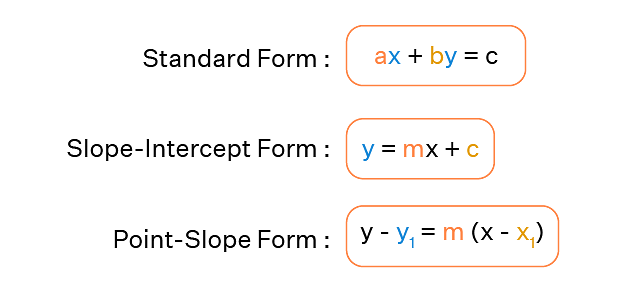
The following are the many forms of the equation of the line that are presented in straight line-
1. Slope – Point Form
Assume P0(x0, y0) is a fixed point on a non-vertical line L with m as its slope. If P (x, y) is an arbitrary point on L, then the point (x, y) lies on the line with slope m through the fixed point (x0, y0) if and only if its coordinates fulfil the equation below.
y – y0 = m (x – x0)
2. Two – Point Form
Let's look at the line. L crosses between two places. P1(x1, y1) and P2(x2, y2) are general points on L, while P (x, y) is a general point on L. As a result, the three points P1, P2, and P are collinear, and it becomes
The slope of P2P = The slope of P1P2 , i.e.
\(\frac{y-y_1}{x-x_1} = \frac{y_2-y_1}{x_2-x_1}\)
Hence, the equation becomes:
y - y1 =\( \frac{y_2-y_1}{x_2-x_1} (x-x1)\)
3. Slope-Intercept Form
Assume that a line L with slope m intersects the y-axis at a distance c from the origin, and that the distance c is referred to as the line L's y-intercept. As a result, the coordinates of the spot on the y-axis where the line intersects are (0, c). As a result, the slope of the line L is m, and it passes through a fixed point (0, c). The equation of the line L thus obtained from the slope – point form is given by
y – c =m( x - 0 )
As a result, the point (x, y) on the line with slope m and y-intercept c lies on the line, if and only if
y = m x +c