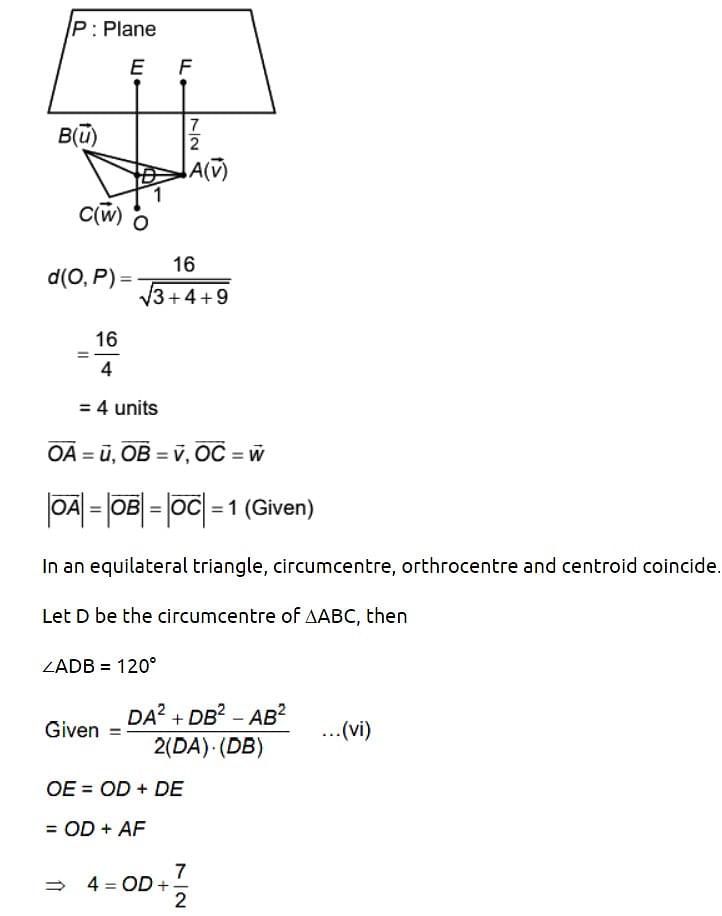
Let P be the plane √3x+2y+3z =16 and let and let S = {\(\alpha \hat{i}+\beta \hat{j}+\gamma\hat{k}:\alpha^2+\beta^2+\gamma^2=1\) and the distance of (α, β, γ) from the plane P is \(\frac{7}{2}\) }. Let u, v, and w be three distinct vectors in s such that |\(\vec{u}-\vec{v}\)| = |\(\vec{v}-\vec{w}\)| = |\(\vec{w}-\vec{u}\)|. Let V be the volume of the parallelepiped determined by vectors \(\vec{u},\vec{v},\vec{w}\). Then the value of \(\frac{80}{\sqrt3}\)V is

Correct Answer: 45
Approach Solution - 1
The distance of a point \( (x, y, z) \) from a plane \( Ax + By + Cz = D \) is given by the formula:
\(\text{Distance} = \frac{|Ax_1 + By_1 + Cz_1 - D|}{\sqrt{A^2 + B^2 + C^2}}\)
In this case, the point is \( (\alpha, \beta, \gamma) \) and the plane equation is \( \sqrt{3}x + 2y + 3z = 16 \). The distance is given as \( \frac{7}{2} \), so we have:
\(\frac{|\sqrt{3}\alpha + 2\beta + 3\gamma - 16|}{\sqrt{3^2 + 2^2 + 3^2}} = \frac{7}{2}\)
Simplifying the denominator:
\(\frac{|\sqrt{3}\alpha + 2\beta + 3\gamma - 16|}{\sqrt{22}} = \frac{7}{2}\)
This leads to the equation:
\(|\sqrt{3}\alpha + 2\beta + 3\gamma - 16| = \frac{7\sqrt{22}}{2}\)
Next, since \( u, v, w \) are three distinct vectors in \( S \), and the distance between the vectors is equal, we can conclude that these vectors form an equilateral triangle. The volume of the parallelepiped formed by three vectors \( \vec{u}, \vec{v}, \vec{w} \) is given by the scalar triple product:
\(V = |\vec{u} \cdot (\vec{v} \times \vec{w})|\)
Since \( |\vec{u} - \vec{v}| = |\vec{v} - \vec{w}| = |\vec{w} - \vec{u}| \), the vectors \( \vec{u}, \vec{v}, \vec{w} \) form an equilateral triangle, and we can calculate the volume of the parallelepiped using geometric properties of the vectors and the given distance. The final result for the volume \( V \) is:
The value of \( \frac{80}{\sqrt{3}} V \) is 45.
Approach Solution -2
The correct answer is 45



Top Questions on Plane
- The distance between the two planes $2x + 3y + 4z = 4$ and $4x + 6y + 8z = 12$ is:
- If one of the lines given by \( 6x^2 - xy + 4cy^2 = 0 \) is \( 3x + 4y = 0 \), then \( c \) equals
- The equation of the plane passing through the point \( (1, 1, 1) \) and perpendicular to the planes \( 2x + y - 2z = 5 \) and \( 3x - 6y - 2z = 7 \) is:
- Let the foot of perpendicular from a point \( P(1,2,-1) \) to the straight line \( L : \frac{x}{1} = \frac{y}{0} = \frac{z}{-1} \) be \( N \). Let a line be drawn from \( P \) parallel to the plane \( x + y + 2z = 0 \) which meets \( L \) at point \( Q \). If \( \alpha \) is the acute angle between the lines \( PN \) and \( PQ \), then \( \cos \alpha \) is equal to:
- Let the acute angle bisector of the two planes \( x - 2y - 2z + 1 = 0 \) and \( 2x - 3y - 6z + 1 = 0 \) be the plane \( P \). Then which of the following points lies on \( P \)?
Questions Asked in JEE Advanced exam
- Let $ x_0 $ be the real number such that $ e^{x_0} + x_0 = 0 $. For a given real number $ \alpha $, define $$ g(x) = \frac{3xe^x + 3x - \alpha e^x - \alpha x}{3(e^x + 1)} $$ for all real numbers $ x $. Then which one of the following statements is TRUE?
- JEE Advanced - 2025
- Fundamental Theorem of Calculus
- A linear octasaccharide (molar mass = 1024 g mol$^{-1}$) on complete hydrolysis produces three monosaccharides: ribose, 2-deoxyribose and glucose. The amount of 2-deoxyribose formed is 58.26 % (w/w) of the total amount of the monosaccharides produced in the hydrolyzed products. The number of ribose unit(s) present in one molecule of octasaccharide is _____.
Use: Molar mass (in g mol$^{-1}$): ribose = 150, 2-deoxyribose = 134, glucose = 180; Atomic mass (in amu): H = 1, O = 16- JEE Advanced - 2025
- Biomolecules
Let $ P(x_1, y_1) $ and $ Q(x_2, y_2) $ be two distinct points on the ellipse $$ \frac{x^2}{9} + \frac{y^2}{4} = 1 $$ such that $ y_1 > 0 $, and $ y_2 > 0 $. Let $ C $ denote the circle $ x^2 + y^2 = 9 $, and $ M $ be the point $ (3, 0) $. Suppose the line $ x = x_1 $ intersects $ C $ at $ R $, and the line $ x = x_2 $ intersects $ C $ at $ S $, such that the $ y $-coordinates of $ R $ and $ S $ are positive. Let $ \angle ROM = \frac{\pi}{6} $ and $ \angle SOM = \frac{\pi}{3} $, where $ O $ denotes the origin $ (0, 0) $. Let $ |XY| $ denote the length of the line segment $ XY $. Then which of the following statements is (are) TRUE?
- JEE Advanced - 2025
- Conic sections
- Adsorption of phenol from its aqueous solution on to fly ash obeys Freundlich isotherm. At a given temperature, from 10 mg g$^{-1}$ and 16 mg g$^{-1}$ aqueous phenol solutions, the concentrations of adsorbed phenol are measured to be 4 mg g$^{-1}$ and 10 mg g$^{-1}$, respectively. At this temperature, the concentration (in mg g$^{-1}$) of adsorbed phenol from 20 mg g$^{-1}$ aqueous solution of phenol will be ____. Use: $\log_{10} 2 = 0.3$
- JEE Advanced - 2025
- Adsorption
- At 300 K, an ideal dilute solution of a macromolecule exerts osmotic pressure that is expressed in terms of the height (h) of the solution (density = 1.00 g cm$^{-3}$) where h is equal to 2.00 cm. If the concentration of the dilute solution of the macromolecule is 2.00 g dm$^{-3}$, the molar mass of the macromolecule is calculated to be $X \times 10^{4}$ g mol$^{-1}$. The value of $X$ is ____. Use: Universal gas constant (R) = 8.3 J K$^{-1}$ mol$^{-1}$ and acceleration due to gravity (g) = 10 m s$^{-2}\}$
- JEE Advanced - 2025
- Colligative Properties
Concepts Used:
Plane
A surface comprising all the straight lines that join any two points lying on it is called a plane in geometry. A plane is defined through any of the following uniquely:
- Using three non-collinear points
- Using a point and a line not on that line
- Using two distinct intersecting lines
- Using two separate parallel lines
Properties of a Plane:
- In a three-dimensional space, if there are two different planes than they are either parallel to each other or intersecting in a line.
- A line could be parallel to a plane, intersects the plane at a single point or is existing in the plane.
- If there are two different lines that are perpendicular to the same plane then they must be parallel to each other.
- If there are two separate planes which are perpendicular to the same line then they must be parallel to each other.