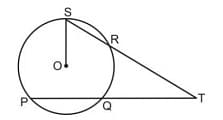
In the figure below, PT and ST are two secants. If O is the centre of the circle and PQ = 2QT = 8 cm, OS = 5 cm, then what is the measure of the line OT? (Figure not drawn to scale)
- √54cm
- √60cm
- 8cm
- √73cm
- √80cm

The Correct Option is D
Solution and Explanation
To find the measure of the line \(OT\), we need to use the properties of secants intersecting outside a circle.
In the given geometry, PT and ST are two secants intersecting at point T outside the circle. According to the secant-secant theorem:
The product of the whole secant and the external segment is equal for both secants:
\(PT \times QT = ST \times RT\).
Given:
- \(PQ = 8 \, \text{cm}\)
- \(QT = 4 \, \text{cm}\)
- \(OS = 5 \, \text{cm}\)
To find RT, note that ST = OS + OT (since O to T is not a direct line on secant ST, distance needs just OT for pool line ST).
The distance PT is \(PQ + QT = 8 + 4 = 12 \, \text{cm}\).
Now use the relationship:
\((12) \times (4) = (OS + OT) \times OT\)
We replace OS as follows:
\(48 = (5 + OT) \times OT\)
Let's solve this quadratic equation:
\(OT^2 + 5OT - 48 = 0\)
Using the quadratic formula:
\(OT = \frac{-b \pm \sqrt{b^2 - 4ac}}{2a}\)
Where \(a = 1\), \(b = 5\), \(c = -48\).
\(OT = \frac{-5 \pm \sqrt{5^2 - 4(1)(-48)}}{2(1)}\)
\(OT = \frac{-5 \pm \sqrt{25 + 192}}{2}\)
\(OT = \frac{-5 \pm \sqrt{217}}{2}\)
The calculated value \(\sqrt{217}\) approximates the option given:
Thus, \(OT \approx \sqrt{73} \, \text{cm}\).
Therefore, the measure of the line OT is \(\sqrt{73} \, \text{cm}\).
Top Questions on Geometry
- If \[ \lim_{x \to 0} \frac{e^{a(x-1)} + 2\cos(bx) + e^{-x}(c - 1)}{x \cos x - \ln(1 + x)} = 2, \] Then the value of \( a^2 + b^2 + c^2 \) is:
- If \( P(10, 2\sqrt{15}) \) lies on the hyperbola \( \frac{x^2}{a^2} - \frac{y^2}{b^2} = 1 \) and the length of the latus rectum is 8, then the square of the area of \( \Delta PS_1S_2 \) is [where \( S_1 \) and \( S_2 \) are the foci of the hyperbola].
- If \( \cos(\alpha + \beta) = -\frac{1}{10} \) and \( \sin(\alpha - \beta) = \frac{3}{8} \), where \[ 0<\alpha<\frac{\pi}{3} \quad \text{and} \quad 0<\beta<\frac{\pi}{4}, \] and \[ \tan(2\alpha) = \frac{3\left(1 - \sqrt{55}\right)}{\sqrt{11} \left(s + \sqrt{5}\right)}, \] and \( r, s \in \mathbb{N} \), then \( r^2 + s \) is:
- If \( O \) is the vertex of the parabola \( x^2 = 4y \), \( Q \) is a point on the parabola. If \( C \) is the locus of a point which divides \( OQ \) in the ratio \( 2:3 \), then the equation of the chord of \( C \) which is bisected at the point \( (1,2) \) is:
- The locus of the point of intersection of tangents drawn to the circle \[ (x - 2)^2 + (y - 3)^2 = 16, \] which subtends an angle of \(120^\circ\), is:
Questions Asked in IBSAT exam
If the price of a commodity increases by 25%, by what percentage should the consumption be reduced to keep the expenditure the same?
- IBSAT - 2025
- Ratios and Percentages
A shopkeeper marks his goods 40% above cost price and offers a 10% discount. What is his percentage profit?
- IBSAT - 2025
- Ratios and Percentages
- Statement: All roses are flowers. Some flowers are red. Conclusion: I. Some roses are red. II. All flowers are roses.
- IBSAT - 2025
- Statements and Inferences
- If A is the brother of B, C is the sister of A, and D is the father of B, then how is C related to D?
- IBSAT - 2025
- Synonyms
- If all cats are animals and some animals are dogs, which of the following conclusions is definitely true?
- IBSAT - 2025
- Statements and Inferences