If the solution curve of the differential equation \(\frac{dy}{dx} = \frac{x + y - 2}{x - y}\) passes through the points \((2, 1)\) and (k + 1, 2), k > 0, then
\(2\tan^{-1}\left(\frac{1}{k}\right) = \log_e(k^2 + 1)\)
\(\tan^{-1}\left(\frac{1}{k}\right) = \log_e(k^2 + 1)\)
\(2\tan^{-1}\left(\frac{1}{k+1}\right) = \log_e(k^2 + 2k + 2)\)
\(2\tan^{-1}\left(\frac{1}{k}\right) = \log_e\left(k^2 + \frac{1}{k^2}\right)\)

The Correct Option is A
Approach Solution - 1
Let's solve the differential equation given by:
\(\frac{dy}{dx} = \frac{x + y - 2}{x - y}\)
We are provided that the solution curve passes through the points \((2, 1)\) and \((k + 1, 2)\), where \( k > 0 \).
Step 1: Solve the Differential Equation
We can use the variable separable method to solve this differential equation.
Rearrange the given equation:
\((x - y) \, dy = (x + y - 2) \, dx\)
Separating variables, we have:
\(\int (x - y) \, dy = \int (x + y - 2) \, dx\)
Integrating both sides:
\(\frac{1}{2}y^2 - xy = \frac{1}{2}x^2 + x \cdot y - 2x + C\)
Step 2: Put the initial point
The curve passes through the point \((2, 1)\). Substitute \(x = 2\) and \(y = 1\) into the equation to find the constant \(C\):
\(\frac{1}{2}(1)^2 - 2(1) = \frac{1}{2}(2)^2 + 2 \cdot 1 - 2 \cdot 2 + C\)
Solving gives:
\(-1.5 = 1 + C\)
Hence, \(C = -2.5\).
Step 3: Check the condition at \((k+1, 2)\)
Now, the solution curve passes through \((k+1, 2)\), so substitute \(x = k+1\) and \(y = 2\):
\(\frac{1}{2}(2)^2 - (k+1) \cdot 2 = \frac{1}{2}(k+1)^2 + (k+1) \cdot 2 - 2(k+1) - 2.5\)
After simplifying both sides, you get the condition:
\(2\tan^{-1}\left(\frac{1}{k}\right) = \log_e(k^2 + 1)\)
This matches the correct option given in the question.
Conclusion: The correct answer is:
\(2\tan^{-1}\left(\frac{1}{k}\right) = \log_e(k^2 + 1)\)
Approach Solution -2
\(\frac{dY}{dX}=\frac{X+Y}{X−Y}\)
\(Let Y=tX\)
\(\frac{dY}{dX} = t + X\frac{dt}{dX}\)
\(t + X\frac{dt}{dX} = 1 + \frac{t}{1 - t}\)
\(X\frac{dt}{dX} = 1 + \frac{t}{1 - t} - t = 1 + \frac{t^2}{1 - t}\)
\(\int \frac{1 - t}{1 + t^2} \, dt = \int \frac{dX}{X}\)
\(\tan^{-1}(t - 1) - \frac{1}{2}\ln(1 + t^2) = \ln|X| + C\)
\(\tan^{-1}\left(\frac{y-1}{x-1}\right) - \frac{1}{2}\ln\left(1+\left(\frac{y-1}{x-1}\right)^2\right) = \ln|x-1| + C\)
Curve passes through \((2, 1)\)
\(0–0=0+c⇒c=0\)
If \((k + 1, 2)\) also satisfies the curve
\(\tan^{-1}\left(\frac{1}{k}\right) - \frac{1}{2}\ln\left(\frac{1 + k^2}{k^2}\right) = \ln k\)
\(2\tan^{-1}\left(\frac{1}{k}\right) = \ln(1+k^2)\)
So, the correct option is (A): \(2\tan^{-1}\left(\frac{1}{k}\right) = \ln(k^2 + 1)\)
Top Questions on Area under Simple Curves
- The area of the region enclosed between the circles $x^2 + y^2 = 4$ and $x^2 + (y - 2)^2 = 4$ is:
- JEE Main - 2026
- Mathematics
- Area under Simple Curves
If the area of the region \[ \{(x, y) : |4 - x^2| \leq y \leq x^2, y \leq 4, x \geq 0\} \] is \( \frac{80\sqrt{2}}{\alpha - \beta} \), where \( \alpha, \beta \in \mathbb{N} \), then \( \alpha + \beta \) is equal to:
- JEE Main - 2025
- Mathematics
- Area under Simple Curves
- Let the area enclosed between the curves \( |y| = 1 - x^2 \) and \( x^2 + y^2 = 1 \) be \( \alpha \). If \( 9\alpha = \beta\pi + \gamma \); \( \beta, \gamma \) are integers, then the value of \( |\beta - \gamma| \) equals:
- JEE Main - 2025
- Mathematics
- Area under Simple Curves
Let the area of the region \( \{(x, y) : 2y \leq x^2 + 3, \, y + |x| \leq 3, \, y \geq |x - 1|\} \) be \( A \). Then \( 6A \) is equal to:
- JEE Main - 2025
- Mathematics
- Area under Simple Curves
- The area of the region, inside the circle \((x-2\sqrt{3})^2 + y^2 = 12\) and outside the parabola \(y^2 = 2\sqrt{3}x\) is:
- JEE Main - 2025
- Mathematics
- Area under Simple Curves
Questions Asked in JEE Main exam
- In a microscope of tube length $10\,\text{cm}$ two convex lenses are arranged with focal lengths $2\,\text{cm}$ and $5\,\text{cm}$. Total magnification obtained with this system for normal adjustment is $(5)^k$. The value of $k$ is ___.
- JEE Main - 2026
- Optical Instruments
Which one of the following graphs accurately represents the plot of partial pressure of CS₂ vs its mole fraction in a mixture of acetone and CS₂ at constant temperature?


- JEE Main - 2026
- Organic Chemistry
- Let \( ABC \) be an equilateral triangle with orthocenter at the origin and the side \( BC \) lying on the line \( x+2\sqrt{2}\,y=4 \). If the coordinates of the vertex \( A \) are \( (\alpha,\beta) \), then the greatest integer less than or equal to \( |\alpha+\sqrt{2}\beta| \) is:
- JEE Main - 2026
- Coordinate Geometry
- Three charges $+2q$, $+3q$ and $-4q$ are situated at $(0,-3a)$, $(2a,0)$ and $(-2a,0)$ respectively in the $x$-$y$ plane. The resultant dipole moment about origin is ___.
- JEE Main - 2026
- Electromagnetic waves
Let \( \alpha = \dfrac{-1 + i\sqrt{3}}{2} \) and \( \beta = \dfrac{-1 - i\sqrt{3}}{2} \), where \( i = \sqrt{-1} \). If
\[ (7 - 7\alpha + 9\beta)^{20} + (9 + 7\alpha - 7\beta)^{20} + (-7 + 9\alpha + 7\beta)^{20} + (14 + 7\alpha + 7\beta)^{20} = m^{10}, \] then the value of \( m \) is ___________.- JEE Main - 2026
- Complex Numbers and Quadratic Equations
Concepts Used:
Types of Differential Equations
There are various types of Differential Equation, such as:
Ordinary Differential Equations:
Ordinary Differential Equations is an equation that indicates the relation of having one independent variable x, and one dependent variable y, along with some of its other derivatives.
\(F(\frac{dy}{dt},y,t) = 0\)
Partial Differential Equations:
A partial differential equation is a type, in which the equation carries many unknown variables with their partial derivatives.
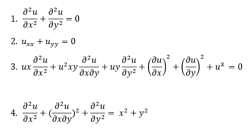
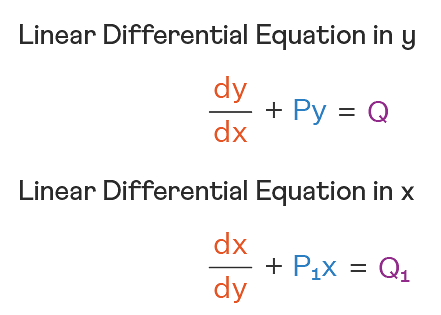
Linear Differential Equations:
It is the linear polynomial equation in which derivatives of different variables exist. Linear Partial Differential Equation derivatives are partial and function is dependent on the variable.
Homogeneous Differential Equations:
When the degree of f(x,y) and g(x,y) is the same, it is known to be a homogeneous differential equation.
\(\frac{dy}{dx} = \frac{a_1x + b_1y + c_1}{a_2x + b_2y + c_2}\)
Read More: Differential Equations