A $12.5\, eV$ electron beam is used to bombard gaseous hydrogen at room temperature. It will emit :
- 2 lines in the Lyman series and 1 line in the Balmar series
- 3 lines in the Lyman series
- 1 line in the Lyman series and 2 lines in the Balmar series
- 3 lines in the Balmer series

The Correct Option is A
Solution and Explanation
$=993 A?$
$\frac{1}{\lambda}= R \left(\frac{1}{n_{1}^{2}}-\frac{1}{n_{2^{2}}}\right)$
(where Rydberg constant ,R= 1.097 x $10^{7}$)
$or, \, \frac{1}{993\times10^{-10}}=1.097\times10^{7} \left(\frac{1}{1^{2}}-\frac{1}{n_{2^{2}}}\right)$
Solving we get $n_{2}$ = 3
Spectral lines Total number of spectral lines = 3
Two lines in Lyman series for $n_{1}=1, n_{2} =2$
and $n_{1}=1, n_{2} =3$ and one in Balmer series
for $n_{1} =2, n_{2} =3$
Top Questions on Atoms
- Prove that, in the Bohr model of the hydrogen atom, the time period of revolution of an electron in the \( n \)-th orbit is proportional to \( n^3 \).
- Assertion (A): The potential energy of an electron revolving in any stationary orbit in a hydrogen atom is positive.
Reason (R): The total energy of a charged particle is always positive. - The distance of closest approach of an alpha particle from a nucleus when the alpha particle moves towards a nucleus with a kinetic energy 'E' is 'x'. The distance of closest approach when the alpha particle approaches the same nucleus with kinetic energy 0.4E is
- The ratio of frequencies of second line of Lyman series and third line of Balmer series of hydrogen atom is:
- The ratio of wavelengths of second line in Balmer series and the first line in Lyman series of hydrogen atom is
Questions Asked in JEE Main exam
- For two identical cells each having emf \(E\) and internal resistance \(r\), the current through an external resistor of \(6\,\Omega\) is the same when the cells are connected in series as well as in parallel. The value of the internal resistance \(r\) is ________ \(\Omega\).
- JEE Main - 2026
- Current electricity
- For three unit vectors \( \vec a, \vec b, \vec c \) satisfying \[ |\vec a-\vec b|^2 + |\vec b-\vec c|^2 + |\vec c-\vec a|^2 = 9 \] and \[ |2\vec a + k\vec b + k\vec c| = 3, \] the positive value of \( k \) is:
- JEE Main - 2026
- Vector Algebra
In the given figure, the blocks $A$, $B$ and $C$ weigh $4\,\text{kg}$, $6\,\text{kg}$ and $8\,\text{kg}$ respectively. The coefficient of sliding friction between any two surfaces is $0.5$. The force $\vec{F}$ required to slide the block $C$ with constant speed is ___ N.
(Given: $g = 10\,\text{m s}^{-2}$)
- JEE Main - 2026
- Rotational Mechanics
- The system of linear equations
$x + y + z = 6$
$2x + 5y + az = 36$
$x + 2y + 3z = b$
has- JEE Main - 2026
- Matrices and Determinants
Method used for separation of mixture of products (B and C) obtained in the following reaction is:

- JEE Main - 2026
- p -Block Elements
Concepts Used:
Atoms
- The smallest unit of matter indivisible by chemical means is known as an atom.
- The fundamental building block of a chemical element.
- The smallest possible unit of an element that still has all the chemical properties of that element.
- An atom is consisting of a nucleus surrounded by one or more shells of electrons.
- Word origin: from the Greek word atomos, which means uncuttable, something that cannot be divided further.
All matter we encounter in everyday life consists of smallest units called atoms – the air we breath consists of a wildly careening crowd of little groups of atoms, my computer’s keyboard of a tangle of atom chains, the metal surface it rests on is a crystal lattice of atoms. All the variety of matter consists of less than hundred species of atoms (in other words: less than a hundred different chemical elements).
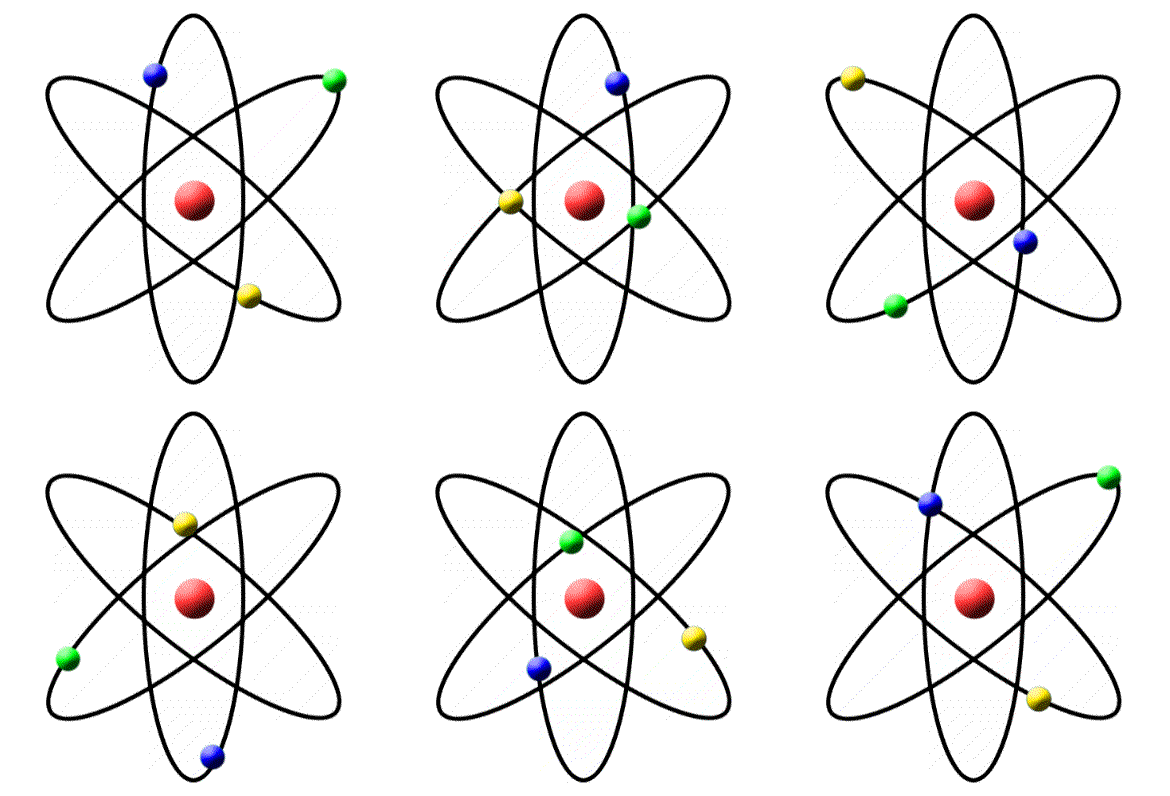
Every atom consists of an nucleus surrounded by a cloud of electrons. Nearly all of the atom’s mass is concentrated in its nucleus, while the structure of the electron cloud determines how the atom can bind to other atoms (in other words: its chemical properties). Every chemical element can be defined via a characteristic number of protons in its nucleus. Atoms that have lost some of their usual number of electrons are called ions. Atoms are extremely small (typical diameters are in the region of tenths of a billionth of a metre = 10-10 metres), and to describe their properties and behaviour, one has to resort to quantum theory.