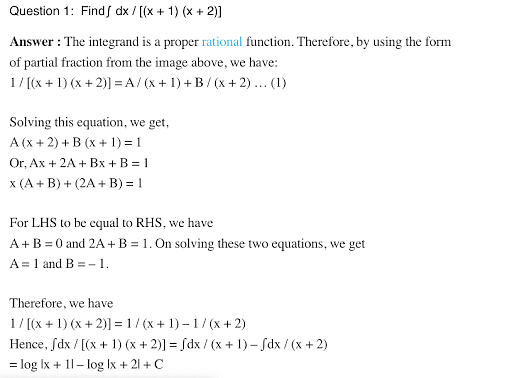
Integrate the function: \(xsin\ 3x\)

Solution and Explanation
\(Let\ I=∫xsin\ 3xdx\)
Taking x as first function and \(sin\ 3x\) as second function and integrating by parts, we obtain
\(I= x∫sin\ 3x dx-∫{(\frac {d}{dx}x)∫sin\ 3x dx}\)
\(I = x(\frac {-cos\ 3x}{3})-∫1.(\frac {-cos\ 3x}{3})dx\)
\(I = \frac {-xcos\ 3x}{3}+\frac 13∫cos\ 3x dx\)
\(I = \frac {-xcos \ 3x}{3}+\frac 19sin\ 3x+C\)
Top Questions on integral
Let \( f : (0, \infty) \to \mathbb{R} \) be a twice differentiable function. If for some \( a \neq 0 \), } \[ \int_0^a f(x) \, dx = f(a), \quad f(1) = 1, \quad f(16) = \frac{1}{8}, \quad \text{then } 16 - f^{-1}\left( \frac{1}{16} \right) \text{ is equal to:}\]
- Let $ f(x) $ be a positive function and $I_1 = \int_{-\frac{1}{2}}^1 2x \, f\left(2x(1-2x)\right) dx$ and $I_2 = \int_{-1}^2 f\left(x(1-x)\right) dx.$ Then the value of $\frac{I_2}{I_1}$ is equal to ____
- Evaluate the integral: \[ \int \frac{x^2 + 2x}{\sqrt{x^2 + 1}} \, dx \]
- Evaluate the integral: \[ \int \sqrt{x^2 + 3x} \, dx \]
- The value of the integral \( \int_0^1 x^2 \, dx \) is:
Questions Asked in CBSE CLASS XII exam
- A proton moving with velocity \( V \) in a non-uniform magnetic field traces a path as shown in the figure. The path followed by the proton is always in the plane of the paper. What is the direction of the magnetic field in the region near points P, Q, and R? What can you say about relative magnitude of magnetic fields at these points?

- CBSE CLASS XII - 2025
- Motion of charged particles in a magnetic field
- Assertion (A): In a first order reaction, if the concentration of the reactant is doubled, its half-life is also doubled.
Reason (R): The half-life of a reaction does not depend upon the initial concentration of the reactant in a first order reaction.- CBSE CLASS XII - 2025
- Chemical Kinetics
Rishika and Shivika were partners in a firm sharing profits and losses in the ratio of 3 : 2. Their Balance Sheet as at 31st March, 2024 stood as follows:
Balance Sheet of Rishika and Shivika as at 31st March, 2024Liabilities Amount (₹) Assets Amount (₹) Capitals: Equipment 45,00,000 Rishika – ₹30,00,000
Shivika – ₹20,00,00050,00,000 Investments 5,00,000 Shivika’s Husband’s Loan 5,00,000 Debtors 35,00,000 Creditors 40,00,000 Stock 8,00,000 Cash at Bank 2,00,000 Total 95,00,000 Total 95,00,000 The firm was dissolved on the above date and the following transactions took place:
(i) Equipements were given to creditors in full settlement of their account.
(ii) Investments were sold at a profit of 20% on its book value.
(iii) Full amount was collected from debtors.
(iv) Stock was taken over by Rishika at 50% discount.
(v) Actual expenses of realisation amounted to ₹ 2,00,000 which were paid by the firm. Prepare Realisation Account.- CBSE CLASS XII - 2025
- Dissolution of Partnership Firm
- Your school is organizing an Inter-House Science Model-Making Competition. As President of the Science Club, draft a notice to inform all House members from IX – XII about the competition and specify the number of registrations invited per house. Include other necessary details. You are Mitali/Mukesh. Put your notice in a box.
- CBSE CLASS XII - 2025
- Letter Writing
- The work function of a material is 2.21 eV. Which of the following cannot produce photoelectrons from it?
- CBSE CLASS XII - 2025
- Photoelectric Effect
Concepts Used:
Integration by Partial Fractions
The number of formulas used to decompose the given improper rational functions is given below. By using the given expressions, we can quickly write the integrand as a sum of proper rational functions.
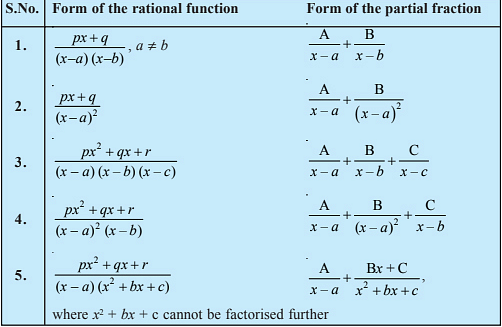
For examples,