The vacant space in bcc lattice unit cell is:
The vacant space in bcc lattice unit cell is:
Show Hint
BCC unit cell includes eight atoms at the corner of the cube and one atom at the center of the unit cell. We can find % vacant space by following the equation.
% Vacant space = 100 - % Volume occupied by atoms in a unit cell
- 0.23
- 0.32
- 0.26
- 0.48

The Correct Option is B
Solution and Explanation
The vacant space in bcc lattice unit cell is 0.32.
BCC stands for body-centered cubic lattice, which is one of the specific arrangements of atoms in the crystalline state. Eight atoms occupy the corners of the cube in the BCC unit cell. There is one atom at the center of the cube as well.
Packing efficiency in bcc lattice = \(68\%\)
\(\therefore\) vacant space in bcc lattice = \(100 - 68 = 32\%\)
Therefore, the correct answer is option B.
Top Questions on The solid state
- What are the constituents of Natalite?
- JEE Main - 2026
- Chemistry
- The solid state
- Consider all the structural isomers with molecular formula C₃H₅Br are separately treated with KOH(aq) to give respective substitution products, without any rearrangement. The number of products which can exhibit optical isomerism from these is_______.
- JEE Main - 2026
- Chemistry
- The solid state
- A colloidal solution is subjected to an electric field. The colloidal particles move toward the anode. In the coagulation of this solution using NaCl, BaCl2, and AlCl3 separately, which one is the correct order of coagulation power?
- OJEE - 2025
- Chemistry
- The solid state
- Gold crystallizes in a face-centered cubic lattice with unit cell length of 4.07 Å. Relative atomic mass of gold is 197.0. The density of gold will be
- OJEE - 2025
- Chemistry
- The solid state
- For which of the following is the adsorption theory applicable?
- OJEE - 2025
- Chemistry
- The solid state
Questions Asked in NEET exam
- Two cities X and Y are connected by a regular bus service with a bus leaving in either direction every T min. A girl is driving scooty with a speed of 60 km/h in the direction X to Y. She notices that a bus goes past her every 30 minutes in the direction of her motion, and every 10 minutes in the opposite direction. Choose the correct option for the period T of the bus service and the speed (assumed constant) of the buses.
- NEET (UG) - 2025
- Relative Velocity
- A physical quantity P is related to four observations a, b, c, and d as follows: P = a3 b2 (c / √d) The percentage errors of measurement in a, b, c, and d are 1%, 3%, 2%, and 4% respectively. The percentage error in the quantity P is:
- NEET (UG) - 2025
- Dimensional analysis and its applications
What is Microalbuminuria ?
- NEET (UG) - 2025
- Human physiology
The output (Y) of the given logic implementation is similar to the output of an/a …………. gate.

- NEET (UG) - 2025
- Logic gates
- An oxygen cylinder of volume 30 litre has 18.20 moles of oxygen. After some oxygen is withdrawn from the cylinder, its gauge pressure drops to 11 atmospheric pressure at temperature \(27^\circ\)C. The mass of the oxygen withdrawn from the cylinder is nearly equal to: [Given, \(R = \frac{100}{12} \text{ J mol}^{-1} \text{K}^{-1}\), and molecular mass of \(O_2 = 32 \text{ g/mol}\), 1 atm pressure = \(1.01 \times 10^5 \text{ N/m}^2\)]
- NEET (UG) - 2025
- Ideal-gas equation and absolute temperature
Concepts Used:
Solid State
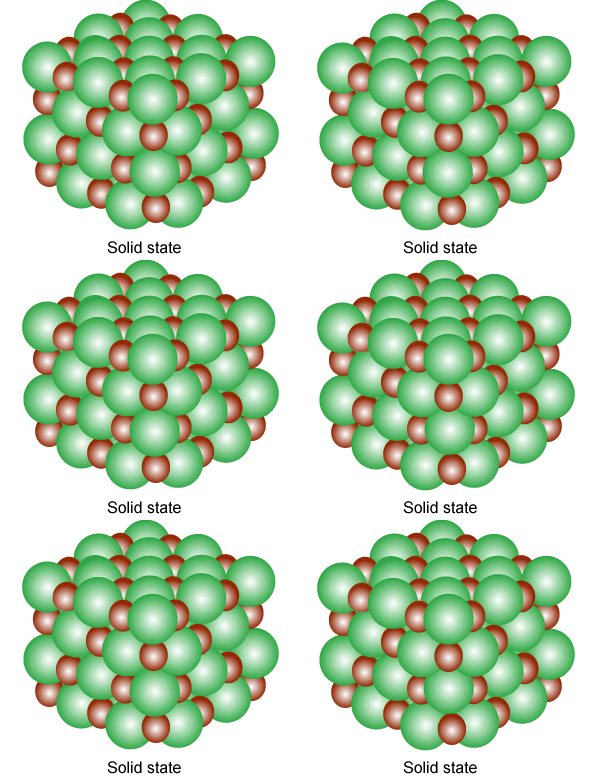
Solids are substances that are featured by a definite shape, volume, and high density. In the solid-state, the composed particles are arranged in several manners. Solid-state, in simple terms, means "no moving parts." Thus solid-state electronic devices are the ones inclusive of solid components that don’t change their position. Solid is a state of matter where the composed particles are arranged close to each other. The composed particles can be either atoms, molecules, or ions.
Types of Solids:
Based on the nature of the order that is present in the arrangement of their constituent particles solids can be divided into two types;
- Amorphous solids behave the same as super cool liquids due to the arrangement of constituent particles in short-range order. They are isotropic and have a broad melting point (range is about greater than 5°C).
- Crystalline solids have a fixed shape and the constituent particles are arranged in a long-range order.