The truth table for the combination of logical gates
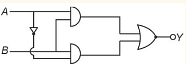


The Correct Option is C
Solution and Explanation
The correct option is (C): 
Top Questions on Logic gates
- For the given logic gate, find the output function.

- JEE Main - 2026
- Physics
- Logic gates
- Which logic gate is given in the figure?

- JEE Main - 2026
- Physics
- Logic gates
- In the figure the LED will glow for input \(A,B,C,D\) (\(0\) is low potential and \(1\) is high potential).

- JEE Main - 2026
- Physics
- Logic gates
- Let \( p \) and \( q \) be any two propositions. Consider the following propositional statements.
S1: \( p \rightarrow q \), S2: \( \neg p \land q \), S3: \( \neg p \lor q \), S4: \( \neg p \lor \neg q \)
where \( \land \) denotes conjunction (AND operation), \( \lor \) denotes disjunction (OR operation), and \( \neg \) denotes negation (NOT operation).
(Note: \( \equiv \) denotes logical equivalence)
Which one of the following options is correct? Which of the following circuits has the same output as that of the given circuit?

- JEE Main - 2025
- Physics
- Logic gates
Questions Asked in JEE Main exam
- The sum of all possible values of \( n \in \mathbb{N} \), so that the coefficients of \(x, x^2\) and \(x^3\) in the expansion of \((1+x^2)^2(1+x)^n\) are in arithmetic progression is :
- JEE Main - 2026
- Integration
- In a microscope of tube length $10\,\text{cm}$ two convex lenses are arranged with focal lengths $2\,\text{cm}$ and $5\,\text{cm}$. Total magnification obtained with this system for normal adjustment is $(5)^k$. The value of $k$ is ___.
- JEE Main - 2026
- Optical Instruments
Which one of the following graphs accurately represents the plot of partial pressure of CS₂ vs its mole fraction in a mixture of acetone and CS₂ at constant temperature?


- JEE Main - 2026
- Organic Chemistry
- Let \( ABC \) be an equilateral triangle with orthocenter at the origin and the side \( BC \) lying on the line \( x+2\sqrt{2}\,y=4 \). If the coordinates of the vertex \( A \) are \( (\alpha,\beta) \), then the greatest integer less than or equal to \( |\alpha+\sqrt{2}\beta| \) is:
- JEE Main - 2026
- Coordinate Geometry
- Three charges $+2q$, $+3q$ and $-4q$ are situated at $(0,-3a)$, $(2a,0)$ and $(-2a,0)$ respectively in the $x$-$y$ plane. The resultant dipole moment about origin is ___.
- JEE Main - 2026
- Electromagnetic waves
Concepts Used:
Logic Gates
AND Gate
It is the gate, where a circuit performs an AND operation. It has n number of input where (n >= 2) and one output.
OR Gate
It is the gate, where a circuit performs an OR operation. It has n number of input where (n >= 2) and one output.
NOT Gate
An inverter is also called NOT Gate. It has one input and one output where the input is A and the output is Y.
NAND Gate
A NAND operation is also called a NOT-AND operation. It has n number of input where (n >= 2) and one output.
NOR Gate
A NOR operation is also called a NOT-OR operation. It has n number of input where (n >= 2) and one output.
XOR Gate
XOR or Ex-OR gate is a specific type of gate that can be used in the half adder, full adder, and subtractor.
XNOR Gate
XNOR gate is a specific type of gate, which can be used in the half adder, full adder, and subtractor. The exclusive-NOR gate is flattened as an EX-NOR gate or sometimes as an X-NOR gate. It has n number of input (n >= 2) and one output.