The figure represents the momentum time (p-t) curve for a particle moving along an axis under the influence of the force Identify the regions on the graph where the magnitude of the force is maximum and minimum respectively ?If $\left(t_3-t_2\right) < t_1$
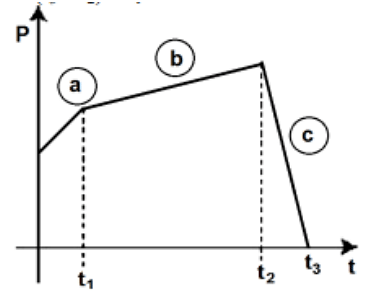
- $c$ and $b$
- $a$ and $b$
- $b$ and $c$
- $c$ and $a$

The Correct Option is A
Solution and Explanation
max slope (c)
min slope (b)
Top Questions on Rotational motion
Two circular discs of radius \(10\) cm each are joined at their centres by a rod, as shown in the figure. The length of the rod is \(30\) cm and its mass is \(600\) g. The mass of each disc is also \(600\) g. If the applied torque between the two discs is \(43\times10^{-7}\) dyne·cm, then the angular acceleration of the system about the given axis \(AB\) is ________ rad s\(^{-2}\).

- JEE Main - 2026
- Physics
- Rotational motion
Two point charges 2q and q are placed at vertex A and centre of face CDEF of the cube as shown in figure. The electric flux passing through the cube is :

- JEE Main - 2026
- Physics
- Rotational motion
- A solid sphere of radius \(10\) cm is rotating about an axis which is at a distance \(15\) cm from its centre. The radius of gyration about this axis is \( \sqrt{n} \) cm. Find the value of \( n \).
- JEE Main - 2026
- Physics
- Rotational motion
- A simple pendulum made of mass 10 g and a metallic wire of length 10 cm is suspended vertically in a uniform magnetic field of 2 T. The magnetic field direction is perpendicular to the plane of oscillations of the pendulum. If the pendulum is released from an angle of 60° with vertical, then maximum induced EMF between the point of suspension and point of oscillation is_______ mV. (Take g = 10 m/s²)}
- JEE Main - 2026
- Physics
- Rotational motion
Suppose there is a uniform circular disc of mass M kg and radius r m shown in figure. The shaded regions are cut out from the disc. The moment of inertia of the remainder about the axis A of the disc is given by $\frac{x{256} Mr^2$. The value of x is ___.

- JEE Main - 2026
- Physics
- Rotational motion
Questions Asked in JEE Main exam
- In a microscope of tube length $10\,\text{cm}$ two convex lenses are arranged with focal lengths $2\,\text{cm}$ and $5\,\text{cm}$. Total magnification obtained with this system for normal adjustment is $(5)^k$. The value of $k$ is ___.
- JEE Main - 2026
- Optical Instruments
Which one of the following graphs accurately represents the plot of partial pressure of CS₂ vs its mole fraction in a mixture of acetone and CS₂ at constant temperature?


- JEE Main - 2026
- Organic Chemistry
- Let \( ABC \) be an equilateral triangle with orthocenter at the origin and the side \( BC \) lying on the line \( x+2\sqrt{2}\,y=4 \). If the coordinates of the vertex \( A \) are \( (\alpha,\beta) \), then the greatest integer less than or equal to \( |\alpha+\sqrt{2}\beta| \) is:
- JEE Main - 2026
- Coordinate Geometry
- Three charges $+2q$, $+3q$ and $-4q$ are situated at $(0,-3a)$, $(2a,0)$ and $(-2a,0)$ respectively in the $x$-$y$ plane. The resultant dipole moment about origin is ___.
- JEE Main - 2026
- Electromagnetic waves
Let \( \alpha = \dfrac{-1 + i\sqrt{3}}{2} \) and \( \beta = \dfrac{-1 - i\sqrt{3}}{2} \), where \( i = \sqrt{-1} \). If
\[ (7 - 7\alpha + 9\beta)^{20} + (9 + 7\alpha - 7\beta)^{20} + (-7 + 9\alpha + 7\beta)^{20} + (14 + 7\alpha + 7\beta)^{20} = m^{10}, \] then the value of \( m \) is ___________.- JEE Main - 2026
- Complex Numbers and Quadratic Equations
Concepts Used:
Rotational Motion
Rotational motion can be defined as the motion of an object around a circular path, in a fixed orbit.
Rotational Motion Examples:
The wheel or rotor of a motor, which appears in rotation motion problems, is a common example of the rotational motion of a rigid body.
Other examples:
- Moving by Bus
- Sailing of Boat
- Dog walking
- A person shaking the plant.
- A stone falls straight at the surface of the earth.
- Movement of a coin over a carrom board
Types of Motion involving Rotation:
- Rotation about a fixed axis (Pure rotation)
- Rotation about an axis of rotation (Combined translational and rotational motion)
- Rotation about an axis in the rotation (rotating axis)