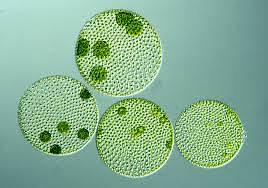
The common mode of sexual reproduction in Chlamydomonas is
- isogamous
- anisogamous
- oogamous
- hologamous.

The Correct Option is A
Solution and Explanation
Top Questions on algae
- In which group of algae are food materials stored in pyrenoids?
- Which of the following algae produce Carrageen?
- Which of the following plants is monoecious?
- Syngamy can occur outside the body of the organism in
- The walking fern is so named because
Questions Asked in NEET exam
- Two cities X and Y are connected by a regular bus service with a bus leaving in either direction every T min. A girl is driving scooty with a speed of 60 km/h in the direction X to Y. She notices that a bus goes past her every 30 minutes in the direction of her motion, and every 10 minutes in the opposite direction. Choose the correct option for the period T of the bus service and the speed (assumed constant) of the buses.
- NEET (UG) - 2025
- Relative Velocity
- A physical quantity P is related to four observations a, b, c, and d as follows: P = a3 b2 (c / √d) The percentage errors of measurement in a, b, c, and d are 1%, 3%, 2%, and 4% respectively. The percentage error in the quantity P is:
- NEET (UG) - 2025
- Dimensional analysis and its applications
What is Microalbuminuria ?
- NEET (UG) - 2025
- Human physiology
The output (Y) of the given logic implementation is similar to the output of an/a …………. gate.

- NEET (UG) - 2025
- Logic gates
- An oxygen cylinder of volume 30 litre has 18.20 moles of oxygen. After some oxygen is withdrawn from the cylinder, its gauge pressure drops to 11 atmospheric pressure at temperature \(27^\circ\)C. The mass of the oxygen withdrawn from the cylinder is nearly equal to: [Given, \(R = \frac{100}{12} \text{ J mol}^{-1} \text{K}^{-1}\), and molecular mass of \(O_2 = 32 \text{ g/mol}\), 1 atm pressure = \(1.01 \times 10^5 \text{ N/m}^2\)]
- NEET (UG) - 2025
- Ideal-gas equation and absolute temperature
Concepts Used:
Algae
An Algae is a term mentioning a group of photosynthetic eukaryotic organisms. It has chlorophyll and nucleus but no root, stem, leaves and many features like normal land plants. Algae is both unicellular (e.g. Euglenophyta) and multicellular (e.g. seaweeds). Algae do photosynthesis and help in oxygen production
Algae can live in various habitats like moist rocks, soils, water bodies (both freshwater and marine) and in some animals (e.g. Sloth). Unicellular Algae belong to the Protista Kingdom and Multicellular algae belong to the Plantae Kingdom, but formerly all algae are categorized under kingdom Plantae for their photosynthetic nature.
Also Read: Difference Between Algae and Fungi