Question:
Tertiary structure of a protein consisting of $\alpha$-helices and $\beta$-strands can be determined by:
Tertiary structure of a protein consisting of $\alpha$-helices and $\beta$-strands can be determined by:
Show Hint
CD tells you "how much helix/sheet"; NMR tells you "how the whole protein folds in 3D".
Updated On: Jan 2, 2026
- circular dichroism spectroscopy
- mass spectrometry
- nuclear magnetic resonance spectroscopy
- UV spectroscopy
Hide Solution

Verified By Collegedunia
The Correct Option is C
Solution and Explanation
Tertiary structure describes the full 3D folding of a protein, including spatial arrangement of α-helices, β-strands, and loops. Determining this structure requires a method that can provide atomic-level information.
Step 1: Evaluate each technique.
- Circular dichroism (CD) spectroscopy provides secondary structure content (how much α-helix or β-sheet), but cannot resolve the 3D arrangement.
- Mass spectrometry identifies molecular mass and modifications, but not 3D folding.
- UV spectroscopy detects aromatic amino acids but provides no structural detail.
- Nuclear magnetic resonance (NMR) spectroscopy can determine the full tertiary structure of proteins in solution at atomic resolution.
Step 2: Conclusion.
Only NMR spectroscopy is capable of resolving the tertiary structure of proteins.
Was this answer helpful?
0
0
Top Questions on Principles of spectroscopy
- Given below are two statements, one is labelled as Assertion and the other is labelled as Reason
Assertion (A): The disadvantage of atomic absorption spectroscopy is the need for each element to be analysed.
Reason (R): As atomic absorption spectrophotometer uses different halocathode lamp for each element, it is very specific for an individual element under test.
In light of the above statements, choose the correct answer from the options given below:- GPAT - 2023
- Pharmaceutical Analysis
- Principles of spectroscopy
- Identify what is not a continuum source of radiation for use in absorption and fluorescentspectrophotometers?
- GPAT - 2023
- Pharmaceutical Analysis
- Principles of spectroscopy
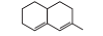
- Predict the wavelength of absorption band in the UV spectrum of the below shown structure:
- GPAT - 2023
- Pharmaceutical Analysis
- Principles of spectroscopy
- In atomic absorption spectroscopy, back ground correction performed using a single hollow cathode lamp pulsed first with a low current and then with a high current is called:
- GPAT - 2023
- Pharmaceutical Analysis
- Principles of spectroscopy
- Match the stationary phase (Column I) with its corresponding chromatography technique (Column II).

- GATE BT - 2022
- Biotechnology Tools and Techniques
- Principles of spectroscopy
View More Questions
Questions Asked in GATE BT exam
- Which enzyme is responsible for synthesis of RNA from a DNA template?
- GATE BT - 2026
- Molecular Biology
- Which parameter is most commonly controlled in a bioreactor?
- GATE BT - 2026
- Bioprocess Engineering
- The most commonly used technique for separation of proteins is:
- GATE BT - 2026
- Downstream Processing
- Which of the following is a recessive genetic disorder?
- GATE BT - 2026
- Genetics
- Which antibody class is most abundant in human serum?
- GATE BT - 2026
- Immunology
View More Questions