Prove the following identities, where the angles involved are acute angles for which the expressions are defined:\( (\text{cosec θ}-\text{cot θ})²=\frac{(1-\text{cos θ})}{(1 +\text{cos θ})}\)

Solution and Explanation
\( (\text{cosec θ}-\text{cot θ})²=\frac{(1-\text{cos θ})}{(1 +\text{cos θ})}\)
L.H.S =\( (\text{cosec θ - cot θ})²\)
\(= \left(\frac{1}{\text{sin θ}} - \frac{\text{cos θ}}{\text{sin θ}}\right)^²\)
\(= \frac{(1 - \text{cos θ})²}{(\text{sin θ})²}\)
\(= \frac{(1 - \text{cos θ})²}{\text{sin² θ}}\)
\(=\frac{ (1 - \text{cos θ})²}{(1 - \text{cos²θ})} \) (By Identity sin A + cos A = 1 Hence, 1 - cos A= sin A)
\(= \frac{(1 - \text{cos θ})²}{ (1 - \text{cos θ})(1 + \text{cos θ})} \) [Using a² - b² = (a + b) (a - b)]
\(=\frac{ (1 -\text{ cos θ})}{(1 + \text{cos θ})}\)
= RHS
Top Questions on Trigonometric Identities
The value of \(\dfrac{\sqrt{3}\cosec 20^\circ - \sec 20^\circ}{\cos 20^\circ \cos 40^\circ \cos 60^\circ \cos 80^\circ}\) is equal to
- JEE Main - 2026
- Mathematics
- Trigonometric Identities
If $\cot x=\dfrac{5}{12}$ for some $x\in(\pi,\tfrac{3\pi}{2})$, then \[ \sin 7x\left(\cos \frac{13x}{2}+\sin \frac{13x}{2}\right) +\cos 7x\left(\cos \frac{13x}{2}-\sin \frac{13x}{2}\right) \] is equal to
- JEE Main - 2026
- Mathematics
- Trigonometric Identities
- The minimum value of \( \cos^2\theta + 6\sin\theta\cos\theta + 3\sin^2\theta \) is:
- JEE Main - 2026
- Mathematics
- Trigonometric Identities
If \[ \frac{\cos^2 48^\circ - \sin^2 12^\circ}{\sin^2 24^\circ - \sin^2 6^\circ} = \frac{\alpha + \beta\sqrt{5}}{2}, \] where \( \alpha, \beta \in \mathbb{N} \), then the value of \( \alpha + \beta \) is ___________.
- JEE Main - 2026
- Mathematics
- Trigonometric Identities
- If \( \cot\theta = -\dfrac{1}{2\sqrt{2}} \), where \( \theta \in \left( \dfrac{3\pi}{2}, 2\pi \right) \), then the value of \[ \sin\left(\dfrac{15\theta}{2}\right)(\sin 8\theta + \cos 8\theta) + \cos\left(\dfrac{15\theta}{2}\right)(\cos 8\theta - \sin 8\theta) \] is:
- JEE Main - 2026
- Mathematics
- Trigonometric Identities
Questions Asked in CBSE X exam
- If the sum of first n terms of an A.P. is given by \( S_n = \frac{n}{2}(3n+1) \), then the first term of the A.P. is
- CBSE Class X - 2025
- Arithmetic Progression
- Find 'mean' and 'mode' of the following data : Frequency Distribution Table
Class 0 – 15 15 – 30 30 – 45 45 – 60 60 – 75 75 – 90 Frequency 11 8 15 7 10 9 - CBSE Class X - 2025
- Statistics
Leaves of the sensitive plant move very quickly in response to ‘touch’. How is this stimulus of touch communicated and explain how the movement takes place?
- CBSE Class X - 2025
- Plant Biology
- Rama is a farmer. She needs loan for agriculture work. Which of the following sources of loan will be beneficial for Rama? Choose the most appropriate option. I. Bank
II. Agricultural Trader
III. Self-Help Group
IV. Government- CBSE Class X - 2025
- Money and Credit
- Rama is a farmer. She needs loan for agriculture work. Which of the following sources of loan will be beneficial for Rama? Choose the most appropriate option:
I. Bank
II. Agricultural Trader
III. Self-Help Group
IV. Government- CBSE Class X - 2025
- Money and Credit
Concepts Used:
Trigonometric Functions
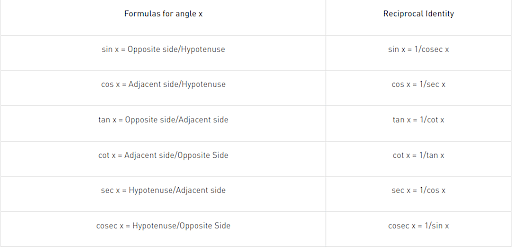
The relationship between the sides and angles of a right-angle triangle is described by trigonometry functions, sometimes known as circular functions. These trigonometric functions derive the relationship between the angles and sides of a triangle. In trigonometry, there are three primary functions of sine (sin), cosine (cos), tangent (tan). The other three main functions can be derived from the primary functions as cotangent (cot), secant (sec), and cosecant (cosec).
Six Basic Trigonometric Functions:
- Sine Function: The ratio between the length of the opposite side of the triangle to the length of the hypotenuse of the triangle.
sin x = a/h
- Cosine Function: The ratio between the length of the adjacent side of the triangle to the length of the hypotenuse of the triangle.
cos x = b/h
- Tangent Function: The ratio between the length of the opposite side of the triangle to the adjacent side length.
tan x = a/b
Tan x can also be represented as sin x/cos x
- Secant Function: The reciprocal of the cosine function.
sec x = 1/cosx = h/b
- Cosecant Function: The reciprocal of the sine function.
cosec x = 1/sinx = h/a
- Cotangent Function: The reciprocal of the tangent function.
cot x = 1/tan x = b/a
Formulas of Trigonometric Functions: