Polar molecules are the molecules:
- having zero dipole moment
- acquire a dipole moment only in the presence of electric field due to displacement of charges
- acquire a dipole moment only when magnetic field is absent
- having a permanent electric dipole moment

The Correct Option is D
Solution and Explanation
To determine the correct answer, we need to understand the concept of polar molecules in the realm of physics and chemistry.
Polar Molecules: A polar molecule is characterized by having a molecular structure where the distribution of electrons between the covalently bonded atoms is uneven. This happens because of differences in electronegativity. Thus, polar molecules possess a permanent electric dipole moment.
Let's evaluate the given options:
- Option 1: Having zero dipole moment
- This describes non-polar molecules. Therefore, this is incorrect for polar molecules.
- Option 2: Acquire a dipole moment only in the presence of an electric field due to the displacement of charges
- This describes induced dipoles, not inherent polar molecules. Hence, this is incorrect.
- Option 3: Acquire a dipole moment only when the magnetic field is absent
- This is unrelated to the behavior of electric dipoles in molecules; magnetic fields generally do not define polarity in chemistry. Thus, it is incorrect.
- Option 4: Having a permanent electric dipole moment
- This precisely defines polar molecules, making this the correct choice.
Conclusion: The correct answer is that polar molecules are those having a permanent electric dipole moment.
Top Questions on Atoms
- Prove that, in the Bohr model of the hydrogen atom, the time period of revolution of an electron in the \( n \)-th orbit is proportional to \( n^3 \).
- Assertion (A): The potential energy of an electron revolving in any stationary orbit in a hydrogen atom is positive.
Reason (R): The total energy of a charged particle is always positive. - The distance of closest approach of an alpha particle from a nucleus when the alpha particle moves towards a nucleus with a kinetic energy 'E' is 'x'. The distance of closest approach when the alpha particle approaches the same nucleus with kinetic energy 0.4E is
- The ratio of frequencies of second line of Lyman series and third line of Balmer series of hydrogen atom is:
- The ratio of wavelengths of second line in Balmer series and the first line in Lyman series of hydrogen atom is
Questions Asked in NEET exam
- Two cities X and Y are connected by a regular bus service with a bus leaving in either direction every T min. A girl is driving scooty with a speed of 60 km/h in the direction X to Y. She notices that a bus goes past her every 30 minutes in the direction of her motion, and every 10 minutes in the opposite direction. Choose the correct option for the period T of the bus service and the speed (assumed constant) of the buses.
- NEET (UG) - 2025
- Relative Velocity
- A physical quantity P is related to four observations a, b, c, and d as follows: P = a3 b2 (c / √d) The percentage errors of measurement in a, b, c, and d are 1%, 3%, 2%, and 4% respectively. The percentage error in the quantity P is:
- NEET (UG) - 2025
- Dimensional analysis and its applications
What is Microalbuminuria ?
- NEET (UG) - 2025
- Human physiology
The output (Y) of the given logic implementation is similar to the output of an/a …………. gate.

- NEET (UG) - 2025
- Logic gates
- An oxygen cylinder of volume 30 litre has 18.20 moles of oxygen. After some oxygen is withdrawn from the cylinder, its gauge pressure drops to 11 atmospheric pressure at temperature \(27^\circ\)C. The mass of the oxygen withdrawn from the cylinder is nearly equal to: [Given, \(R = \frac{100}{12} \text{ J mol}^{-1} \text{K}^{-1}\), and molecular mass of \(O_2 = 32 \text{ g/mol}\), 1 atm pressure = \(1.01 \times 10^5 \text{ N/m}^2\)]
- NEET (UG) - 2025
- Ideal-gas equation and absolute temperature
Concepts Used:
Atoms
- The smallest unit of matter indivisible by chemical means is known as an atom.
- The fundamental building block of a chemical element.
- The smallest possible unit of an element that still has all the chemical properties of that element.
- An atom is consisting of a nucleus surrounded by one or more shells of electrons.
- Word origin: from the Greek word atomos, which means uncuttable, something that cannot be divided further.
All matter we encounter in everyday life consists of smallest units called atoms – the air we breath consists of a wildly careening crowd of little groups of atoms, my computer’s keyboard of a tangle of atom chains, the metal surface it rests on is a crystal lattice of atoms. All the variety of matter consists of less than hundred species of atoms (in other words: less than a hundred different chemical elements).
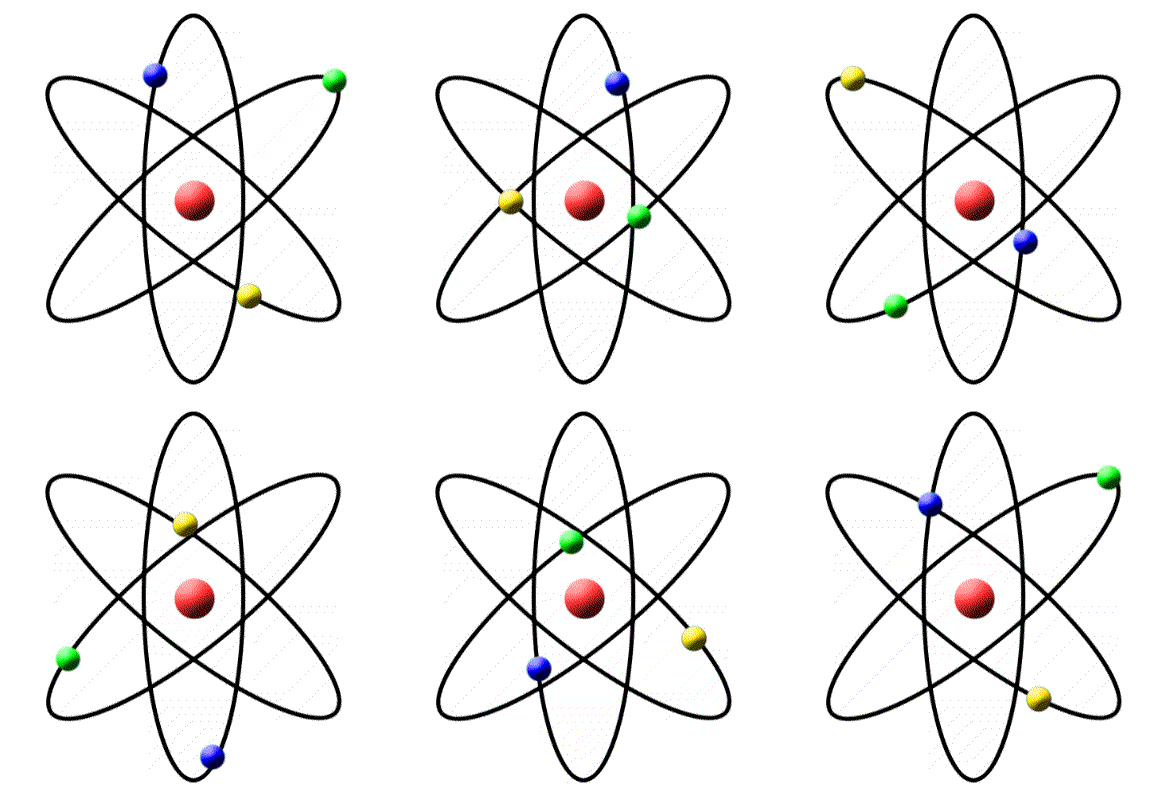
Every atom consists of an nucleus surrounded by a cloud of electrons. Nearly all of the atom’s mass is concentrated in its nucleus, while the structure of the electron cloud determines how the atom can bind to other atoms (in other words: its chemical properties). Every chemical element can be defined via a characteristic number of protons in its nucleus. Atoms that have lost some of their usual number of electrons are called ions. Atoms are extremely small (typical diameters are in the region of tenths of a billionth of a metre = 10-10 metres), and to describe their properties and behaviour, one has to resort to quantum theory.