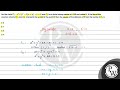
Let the circle $C_{1}: x^{2}+y^{2}-2(x+y)+1=0$ and $C_{2}$ be a circle having centre at $(-1, 0)$ and radius 2. If the line of the common chord of $C_{1}$ and $C_{2}$ intersects the y-axis at the point P, then the square of the distance of P from the centre of $C_{1}$ is:
- 2
- 1
- 6
- 4

The Correct Option is A
Solution and Explanation
The equations of the circles are given as:
\[ S_1 : x^2 + y^2 - 2x - 2y + 1 = 0, \] \[ S_2 : x^2 + y^2 + 2x - 3 = 0. \]
The equation of the common chord is obtained by subtracting \( S_2 \) from \( S_1 \):
\[ S_1 - S_2 = 0, \] \[ -4x - 2y + 4 = 0. \]
Simplifying, we get:
\[ 2x + y = 2 \quad \implies \quad y = 2 - 2x. \]
Intersection with the y-axis To find the intersection point \( P \) with the y-axis, set \( x = 0 \):
\[ y = 2 \quad \implies \quad P(0, 2). \]
Distance Calculation Let \( C_1, \text{centre} = (1, 1) \). The square of the distance between \( P(0, 2) \) and the centre of \( C_1 \) is given by:
\[ d^2(C_1, P) = (1 - 0)^2 + (2 - 1)^2 = 1 + 1 = 2. \]
Therefore, the correct answer is Option (1).
Learn with videos:
Top Questions on Circles
- Let the circle \(x^2+y^2=4\) intersect the \(x\)-axis at points \(A(a,0)\) and \(B(b,0)\). Let \(P(2\cos\alpha,2\sin\alpha)\), \(0<\alpha<\frac{\pi}{2}\), and \(Q(2\cos\beta,2\sin\beta)\) be two points on the circle such that \((\alpha-\beta)=\frac{\pi}{2}\). Then the point of intersection of lines \(AQ\) and \(BP\) lies on:
- Let PQ and MN be two straight lines touching the circle \(x^2+y^2-4x-6y-3=0\) at the points A and B respectively. Let O be the centre of the circle and \(\angle AOB = \pi/3\). Then the locus of the point of intersection of the lines PQ and MN is:
- If the sum of the diameters of two circles is 40 cm and the difference of their radii is 6 cm, then the ratio of the area of the smaller circle to that of the bigger circle is:
- The absolute difference between the squares of the radii of the two circles passing through the point \( (-9, 4) \) and touching the lines \( x + y = 3 \) and \( x - y = 3 \), is equal to:
- Let $ ABC $ be the triangle such that the equations of lines $ AB $ and $ AC $ are: $ 3y - x = 2 \quad \text{and} \quad x + y = 2, $ respectively, and the points $ B $ and $ C $ lie on the x-axis. If $ P $ is the orthocentre of the triangle $ ABC $, then the area of the triangle $ PBC $ is equal to:
Questions Asked in JEE Main exam
Which one of the following graphs accurately represents the plot of partial pressure of CS₂ vs its mole fraction in a mixture of acetone and CS₂ at constant temperature?


- JEE Main - 2026
- Organic Chemistry
- Let \( ABC \) be an equilateral triangle with orthocenter at the origin and the side \( BC \) lying on the line \( x+2\sqrt{2}\,y=4 \). If the coordinates of the vertex \( A \) are \( (\alpha,\beta) \), then the greatest integer less than or equal to \( |\alpha+\sqrt{2}\beta| \) is:
- JEE Main - 2026
- Coordinate Geometry
- Three charges $+2q$, $+3q$ and $-4q$ are situated at $(0,-3a)$, $(2a,0)$ and $(-2a,0)$ respectively in the $x$-$y$ plane. The resultant dipole moment about origin is ___.
- JEE Main - 2026
- Electromagnetic waves
Let \( \alpha = \dfrac{-1 + i\sqrt{3}}{2} \) and \( \beta = \dfrac{-1 - i\sqrt{3}}{2} \), where \( i = \sqrt{-1} \). If
\[ (7 - 7\alpha + 9\beta)^{20} + (9 + 7\alpha - 7\beta)^{20} + (-7 + 9\alpha + 7\beta)^{20} + (14 + 7\alpha + 7\beta)^{20} = m^{10}, \] then the value of \( m \) is ___________.- JEE Main - 2026
- Complex Numbers and Quadratic Equations
- The work functions of two metals ($M_A$ and $M_B$) are in the 1 : 2 ratio. When these metals are exposed to photons of energy 6 eV, the kinetic energy of liberated electrons of $M_A$ : $M_B$ is in the ratio of 2.642 : 1. The work functions (in eV) of $M_A$ and $M_B$ are respectively.
- JEE Main - 2026
- Dual nature of matter