Question:
Lampbrush chromosomes are
Lampbrush chromosomes are
Updated On: Jun 21, 2022
- salivary gland cells of Drosophila
- oocytes of amphibians
- spermatocytes of amphibians
- gonads of man.
Hide Solution

Verified By Collegedunia
The Correct Option is B
Solution and Explanation
Lampbrush chromosomes were first observed by Flemming (1882), but were first described by Ruckert (1892). These chromosomes occur in the diplotene stage of meiotic prophase-I during oogenesis in amphibian oocytes. The chromosomes are highly elongated special kind of synapsed midprophase or diplotene chromosome bivalents (i.e. two pairs of sister chromatids held together by" chiasmata). These chromosomes are larger than even polytene chromosomes. In lampbrush chromosome, the strands of chromosome ( consisting of two double strands of DNA) are dotted with about 5000 chromomeres (dark staining irregular structures).Twin loops emerge from chromomeres. These loops are identical on both pairs of sister chromatids.
Was this answer helpful?
0
0
Top Questions on Cell: the unit of life
- Which organelle in a eukaryotic cell is primarily responsible for synthesizing proteins destined for secretion?
- MHT CET - 2025
- Biology
- Cell: the unit of life
- Which organelle is primarily responsible for producing ATP in a cell?
- MHT CET - 2025
- Biology
- Cell: the unit of life
- Which of the following organisms or organelles contain 70S ribosomes?
- MHT CET - 2025
- Biology
- Cell: the unit of life
- What is the movement of cytoplasm within a cell called?
- MHT CET - 2024
- Biology
- Cell: the unit of life
- Given below are two statements: Statement I: Cell wall is freely permeable.
Statement II: Plasma membrane is selectively permeable.
Choose the correct answer from the options given below with reference to the structure of root hair:- MHT CET - 2024
- Biology
- Cell: the unit of life
View More Questions
Questions Asked in COMEDK UGET exam
- Given that the freezing point of benzene is $ 5.48^\circ C $ and its $ K_f $ value is $ 5.12^\circ C/m $, what would be the freezing point of a solution of 20 g of propane in 400 g of benzene?
- COMEDK UGET - 2024
- Colligative Properties
200 ml of an aqueous solution contains 3.6 g of Glucose and 1.2 g of Urea maintained at a temperature equal to 27$^{\circ}$C. What is the Osmotic pressure of the solution in atmosphere units?
Given Data R = 0.082 L atm K$^{-1}$ mol$^{-1}$
Molecular Formula: Glucose = C$_6$H$_{12}$O$_6$, Urea = NH$_2$CONH$_2$- COMEDK UGET - 2024
- Colligative Properties
- An inorganic compound W undergoes the following reactions: $ W + \text{Na}_2\text{CO}_3 \xrightarrow{\text{O}_2 / \text{heat}} X + H^+ \xrightarrow{} Y(s) $ $ Y(aq) + \text{KCl} (aq) \xrightarrow{} Z(s) $ Z appears in the form of orange crystals and is used as an oxidising agent in acid medium. Identify the compound W.
- COMEDK UGET - 2024
- coordination compounds
- A current of 3.0 A is passed through 750 ml of 0.45 M solution of CuSO₄ for 2 hours with a current efficiency of 90\%. If the volume of the solution is assumed to remain constant, what would be the final molarity of CuSO₄ solution?
- COMEDK UGET - 2024
- Solutions
- For a reaction $ 5X + Y \to 3Z $, the rate of formation of Z is $ 2.4 \times 10^{-5} \, \text{mol L}^{-1} \text{s}^{-1} $. Calculate the average rate of disappearance of X.
- COMEDK UGET - 2024
- Stoichiometry and Stoichiometric Calculations
View More Questions
Concepts Used:
Cell: The Unit of Life
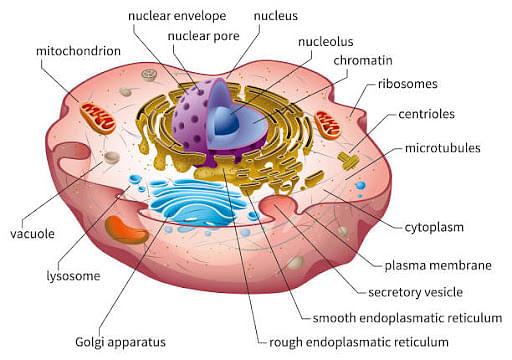
- A cell is derived as the functional and structural unit of life. Every cell is surrounded by a cell membrane that dissects the external and internal environments of the cell. The interior environment of a cell is called the cytoplasm.
- It carries cellular machinery and structural elements. The nucleus is present in the center of the cell, which includes all the hereditary information of an organism. Some of the molecules present in the cell are protein, carbohydrates, starch, and sugar.
Read More: Fundamental Unit of Life: Cell
Parts of Cell:
The different parts of a cell and their functions are as follows:
- Cell Membrane
- Cell Wall
- Nucleus
- Cytoplasm