In the hydrogen spectrum, λ be the wavelength of first transition line of Lyman series. The wavelength difference will be “aλ” between the wavelength of 3rd transition line of the Paschen series and that of 2nd transition line of Balmer series where a = ______.

Correct Answer: 5
Solution and Explanation
\(\frac 1λ=R_H(\frac {1}{1^2}−\frac {1}{2^2)}\)
\(\frac {1}{λ_3}=R_H(\frac {1}{3^2}−\frac {1}{6^2)}\)
\(\frac {1}{λ_2}=R_H(\frac {1}{2^2}−\frac {1}{4^2)}\)
Wavelength difference \(λ_3–λ_2=aλ\)
\(a=5\)
So, the answer is \(5\).
Top Questions on Atoms
- Prove that, in the Bohr model of the hydrogen atom, the time period of revolution of an electron in the \( n \)-th orbit is proportional to \( n^3 \).
- Assertion (A): The potential energy of an electron revolving in any stationary orbit in a hydrogen atom is positive.
Reason (R): The total energy of a charged particle is always positive. - The distance of closest approach of an alpha particle from a nucleus when the alpha particle moves towards a nucleus with a kinetic energy 'E' is 'x'. The distance of closest approach when the alpha particle approaches the same nucleus with kinetic energy 0.4E is
- The ratio of frequencies of second line of Lyman series and third line of Balmer series of hydrogen atom is:
- The ratio of wavelengths of second line in Balmer series and the first line in Lyman series of hydrogen atom is
Questions Asked in JEE Main exam
- A 20 m long uniform copper wire held horizontally is allowed to fall under the gravity (g = 10 m/s²) through a uniform horizontal magnetic field of 0.5 Gauss perpendicular to the length of the wire. The induced EMF across the wire when it travels a vertical distance of 200 m is_______ mV.}
- JEE Main - 2026
- Thermodynamics
- If the end points of chord of parabola \(y^2 = 12x\) are \((x_1, y_1)\) and \((x_2, y_2)\) and it subtend \(90^\circ\) at the vertex of parabola then \((x_1x_2 - y_1y_2)\) equals :
- JEE Main - 2026
- Probability
- The sum of all possible values of \( n \in \mathbb{N} \), so that the coefficients of \(x, x^2\) and \(x^3\) in the expansion of \((1+x^2)^2(1+x)^n\) are in arithmetic progression is :
- JEE Main - 2026
- Integration
- In a microscope of tube length $10\,\text{cm}$ two convex lenses are arranged with focal lengths $2\,\text{cm}$ and $5\,\text{cm}$. Total magnification obtained with this system for normal adjustment is $(5)^k$. The value of $k$ is ___.
- JEE Main - 2026
- Optical Instruments
Which one of the following graphs accurately represents the plot of partial pressure of CS₂ vs its mole fraction in a mixture of acetone and CS₂ at constant temperature?


- JEE Main - 2026
- Organic Chemistry
Concepts Used:
Atoms
- The smallest unit of matter indivisible by chemical means is known as an atom.
- The fundamental building block of a chemical element.
- The smallest possible unit of an element that still has all the chemical properties of that element.
- An atom is consisting of a nucleus surrounded by one or more shells of electrons.
- Word origin: from the Greek word atomos, which means uncuttable, something that cannot be divided further.
All matter we encounter in everyday life consists of smallest units called atoms – the air we breath consists of a wildly careening crowd of little groups of atoms, my computer’s keyboard of a tangle of atom chains, the metal surface it rests on is a crystal lattice of atoms. All the variety of matter consists of less than hundred species of atoms (in other words: less than a hundred different chemical elements).
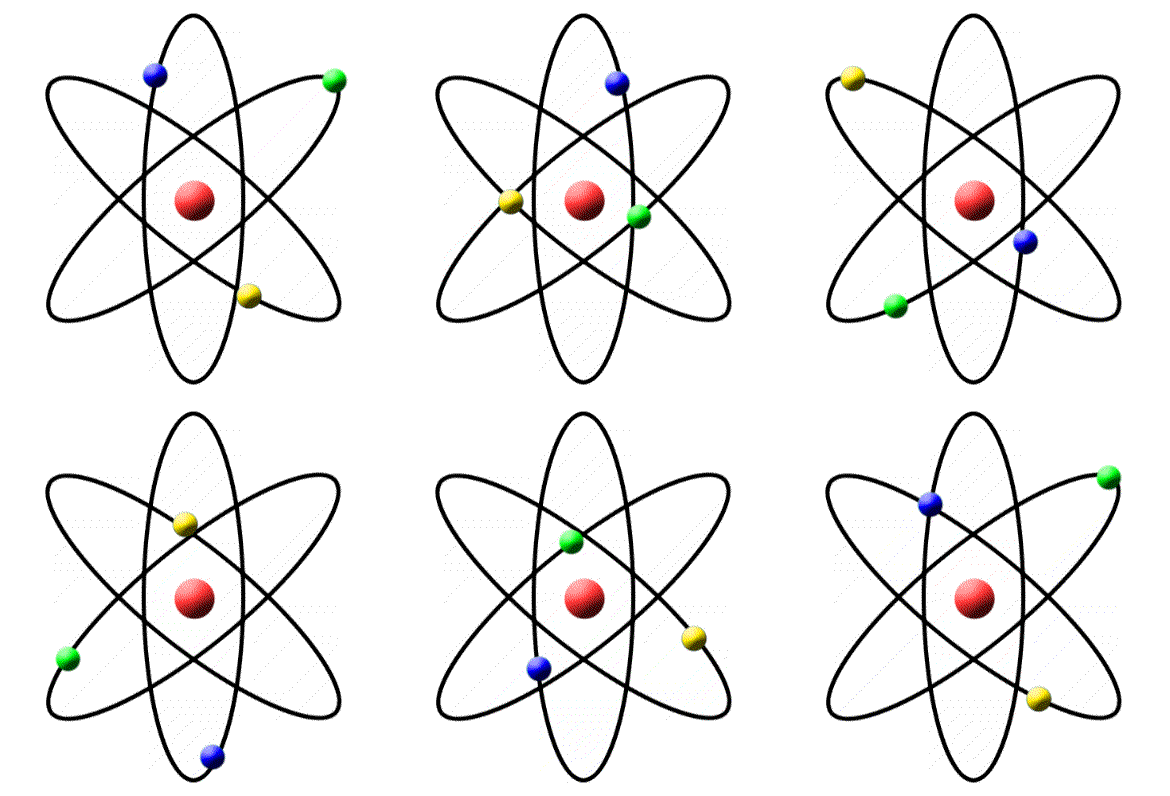
Every atom consists of an nucleus surrounded by a cloud of electrons. Nearly all of the atom’s mass is concentrated in its nucleus, while the structure of the electron cloud determines how the atom can bind to other atoms (in other words: its chemical properties). Every chemical element can be defined via a characteristic number of protons in its nucleus. Atoms that have lost some of their usual number of electrons are called ions. Atoms are extremely small (typical diameters are in the region of tenths of a billionth of a metre = 10-10 metres), and to describe their properties and behaviour, one has to resort to quantum theory.