In the circuit shown in the figure, the ratio of the quality factor and the band width is__s
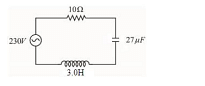

Correct Answer: 10
Solution and Explanation
Top Questions on work, energy and power
- Given below are two statements:
Statement I: An object moves from position \( \vec{r}_1 \) to position \( \vec{r}_2 \) under a conservative force field \( \vec{F} \). The work done by the force is \[ W = -\int_{\vec{r}_1}^{\vec{r}_2} \vec{F} \cdot d\vec{r}. \]
Statement II: Any object moving from one location to another location can follow infinite number of paths. Therefore, the amount of work done by the object changes with the path it follows for a conservative force.
In the light of the above statements, choose the correct answer from the options given below:- JEE Main - 2026
- Physics
- work, energy and power
- Two masses \(m\) and \(2m\) are connected by a light string going over a pulley (disc) of mass \(30m\) with radius \(r=0.1\,\text{m}\). The pulley is mounted in a vertical plane and is free to rotate about its axis. The \(2m\) mass is released from rest and its speed when it has descended through a height of \(3.6\,\text{m}\) is ____________ m/s. (Assume string does not slip and \(g=10\,\text{m s}^{-2}\)).
- JEE Main - 2026
- Physics
- work, energy and power
- A large drum having radius $R$ is spinning around its axis with angular velocity $\omega$, as shown in figure. The minimum value of $\omega$ so that a body of mass $M$ remains stuck to the inner wall of the drum, taking the coefficient of friction between the drum surface and mass $M$ as $\mu$, is :

- JEE Main - 2026
- Physics
- work, energy and power
Potential energy (V) versus distance (x) is given by the graph. Rank various regions as per the magnitudes of the force (F) acting on a particle from high to low.

- JEE Main - 2026
- Physics
- work, energy and power
- A body of mass 4 kg is placed on a plane at a point P having coordinate $(3,4)$ m. Under the action of force $\vec{F} = (2\hat{i} + 3\hat{j})$ N, it moves to a new point Q having coordinates $(6,10)$ m in 4 sec. The average power and instantaneous power at the end of 4 sec are in the ratio of:
- JEE Main - 2026
- Physics
- work, energy and power
Questions Asked in JEE Main exam
- In a microscope of tube length $10\,\text{cm}$ two convex lenses are arranged with focal lengths $2\,\text{cm}$ and $5\,\text{cm}$. Total magnification obtained with this system for normal adjustment is $(5)^k$. The value of $k$ is ___.
- JEE Main - 2026
- Optical Instruments
Which one of the following graphs accurately represents the plot of partial pressure of CS₂ vs its mole fraction in a mixture of acetone and CS₂ at constant temperature?


- JEE Main - 2026
- Organic Chemistry
- Let \( ABC \) be an equilateral triangle with orthocenter at the origin and the side \( BC \) lying on the line \( x+2\sqrt{2}\,y=4 \). If the coordinates of the vertex \( A \) are \( (\alpha,\beta) \), then the greatest integer less than or equal to \( |\alpha+\sqrt{2}\beta| \) is:
- JEE Main - 2026
- Coordinate Geometry
- Three charges $+2q$, $+3q$ and $-4q$ are situated at $(0,-3a)$, $(2a,0)$ and $(-2a,0)$ respectively in the $x$-$y$ plane. The resultant dipole moment about origin is ___.
- JEE Main - 2026
- Electromagnetic waves
Let \( \alpha = \dfrac{-1 + i\sqrt{3}}{2} \) and \( \beta = \dfrac{-1 - i\sqrt{3}}{2} \), where \( i = \sqrt{-1} \). If
\[ (7 - 7\alpha + 9\beta)^{20} + (9 + 7\alpha - 7\beta)^{20} + (-7 + 9\alpha + 7\beta)^{20} + (14 + 7\alpha + 7\beta)^{20} = m^{10}, \] then the value of \( m \) is ___________.- JEE Main - 2026
- Complex Numbers and Quadratic Equations
Concepts Used:
Ray Optics and Optical Instruments
Optics, deals with the determination of behaviour and the properties of light, along with its interactions with the matter and also with the instruments that are used to detect it.
Ray optics is also known as the geometrical optics and it is a branch of science which describes light propagation.
Reflection is the change in direction of light at an interface in-between two different media so that the wave-front returns into a medium from which it was originated.
Speed of light is the rate at which the light travels in free space.
A phenomenal change in image formed when the light is passed from one medium to another which is called Refraction.
Total Internal Reflection is the reflection of light when the light ray enters into a rarer medium from a denser medium and the angle of incidence is higher than the critical angle of incidence then that light ray will be reflected back to the denser medium.
Read More: Ray Optics and Optical Instruments