Question:
If two equal chords of a circle intersect within the circle, prove that the line joining the point of intersection to the centre makes equal angles with the chords.
If two equal chords of a circle intersect within the circle, prove that the line joining the point of intersection to the centre makes equal angles with the chords.
Updated On: Jan 20, 2026
Hide Solution

Verified By Collegedunia
Solution and Explanation

Let PQ and RS are two equal chords of a given circle and they are intersecting each other at point T.
Draw perpendiculars OV and OU on these chords.
In ∆OVT and ∆OUT,
OV = OU (Equal chords of a circle are equidistant from the centre)
∠OVT = ∠OUT (Each 90°)
OT = OT (Common)
∠∆OVT ≅ ∠∆OUT (RHS congruence rule)
∠OTV = ∠OTU (By CPCT)
Therefore, it is proved that the line joining the point of intersection to the centre makes equal angles with the chords.
Was this answer helpful?
0
0
Top Questions on Perpendicular from the Centre to a Chord
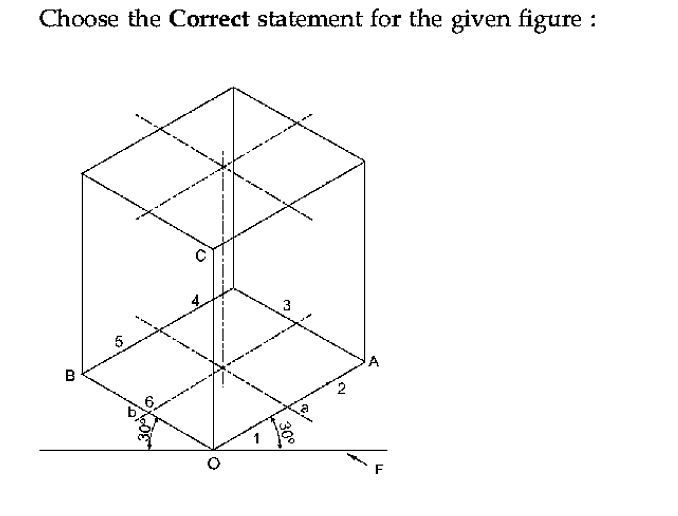
- Choose the Correct statement for the given figure:
- CUET (UG) - 2023
- Informatics Practices
- Perpendicular from the Centre to a Chord
- Identify the correct statements for the given figure :

(A) A triangular pyramid is resting on H.P. on its base.
(B) A triangular pyramid is resting on H.P. on its apex.
(C) Axis of pyramid is perpendicular to H.P.
(D) Axis of pyramid is parallel to H.P.
(E) Axis of pyramid is perpendicular to V.P.
Choose the correct answer from the options given below:
- CUET (UG) - 2023
- Engineering Graphics
- Perpendicular from the Centre to a Chord
- If two equal chords of a circle intersect within the circle, prove that the segments of one chord are equal to corresponding segments of the other chord.
- CBSE Class IX
- Mathematics
- Perpendicular from the Centre to a Chord
Questions Asked in CBSE Class IX exam
(i) The kind of person the doctor is (money, possessions)
(ii) The kind of person he wants to be (appearance, ambition)- CBSE Class IX
- The snake and the mirror
- Lushkoff is earning thirty five roubles a month. How is he obliged to Sergei for this?
- CBSE Class IX
- The beggar
ABCD is a quadrilateral in which AD = BC and ∠ DAB = ∠ CBA (see Fig. 7.17). Prove that
(i) ∆ ABD ≅ ∆ BAC
(ii) BD = AC
(iii) ∠ ABD = ∠ BAC.

- CBSE Class IX
- Congruence of Triangles
- Why does the author say that Iswaran seemed to more than make up for the absence of a TV in Mahendra’s living quarters?
- CBSE Class IX
- Iswaran the storyteller
- Here is your diary entry when you visited Agra. Read the points and try to write a travelogue describing your visit to Agra and the Taj Mahal. You may add more details.
January 2003 — rise before dawn — take the Shatabdi Express at 6.15 a.m. from Delhi — meet a newly-married couple on train — talk about Himachal Pradesh — get off the train — enter the once-grand city, Agra — twisted alleys — traffic dense — rickshaws, cars, people — vendors selling religious artifacts, plastic toys, spices and sweets — go to the Taj Mahal — constructed entirely of white marble — magical quality — colour changes with varying of light and shadow — marble with gemstones inside — reflection of the Taj Mahal in the pond — school-children, tourists — tourist guides following people.- CBSE Class IX
- Kathmandu
View More Questions