Copper crystallises in fcc with a unit length of $361\,pm$. What is the radius of copper atom ?
- 157 pm
- 128 pm
- 108 pm
- 181 pm

The Correct Option is B
Solution and Explanation
$r=\frac{\sqrt{2}a}{4}=\frac{a}{2 \sqrt{2}}=0.3535 a$
given $a = 361 \,pm$
$r=0.3535 \times361$
$= 128 \,pm$
Top Questions on The solid state
- What are the constituents of Natalite?
- JEE Main - 2026
- Chemistry
- The solid state
- Consider all the structural isomers with molecular formula C₃H₅Br are separately treated with KOH(aq) to give respective substitution products, without any rearrangement. The number of products which can exhibit optical isomerism from these is_______.
- JEE Main - 2026
- Chemistry
- The solid state
- A colloidal solution is subjected to an electric field. The colloidal particles move toward the anode. In the coagulation of this solution using NaCl, BaCl2, and AlCl3 separately, which one is the correct order of coagulation power?
- OJEE - 2025
- Chemistry
- The solid state
- Gold crystallizes in a face-centered cubic lattice with unit cell length of 4.07 Å. Relative atomic mass of gold is 197.0. The density of gold will be
- OJEE - 2025
- Chemistry
- The solid state
- For which of the following is the adsorption theory applicable?
- OJEE - 2025
- Chemistry
- The solid state
Questions Asked in JEE Main exam
- The sum of all possible values of \( n \in \mathbb{N} \), so that the coefficients of \(x, x^2\) and \(x^3\) in the expansion of \((1+x^2)^2(1+x)^n\) are in arithmetic progression is :
- JEE Main - 2026
- Integration
- In a microscope of tube length $10\,\text{cm}$ two convex lenses are arranged with focal lengths $2\,\text{cm}$ and $5\,\text{cm}$. Total magnification obtained with this system for normal adjustment is $(5)^k$. The value of $k$ is ___.
- JEE Main - 2026
- Optical Instruments
Which one of the following graphs accurately represents the plot of partial pressure of CS₂ vs its mole fraction in a mixture of acetone and CS₂ at constant temperature?


- JEE Main - 2026
- Organic Chemistry
- Let \( ABC \) be an equilateral triangle with orthocenter at the origin and the side \( BC \) lying on the line \( x+2\sqrt{2}\,y=4 \). If the coordinates of the vertex \( A \) are \( (\alpha,\beta) \), then the greatest integer less than or equal to \( |\alpha+\sqrt{2}\beta| \) is:
- JEE Main - 2026
- Coordinate Geometry
- Three charges $+2q$, $+3q$ and $-4q$ are situated at $(0,-3a)$, $(2a,0)$ and $(-2a,0)$ respectively in the $x$-$y$ plane. The resultant dipole moment about origin is ___.
- JEE Main - 2026
- Electromagnetic waves
Concepts Used:
Solid State
Solids are substances that are featured by a definite shape, volume, and high density. In the solid-state, the composed particles are arranged in several manners. Solid-state, in simple terms, means "no moving parts." Thus solid-state electronic devices are the ones inclusive of solid components that don’t change their position. Solid is a state of matter where the composed particles are arranged close to each other. The composed particles can be either atoms, molecules, or ions.
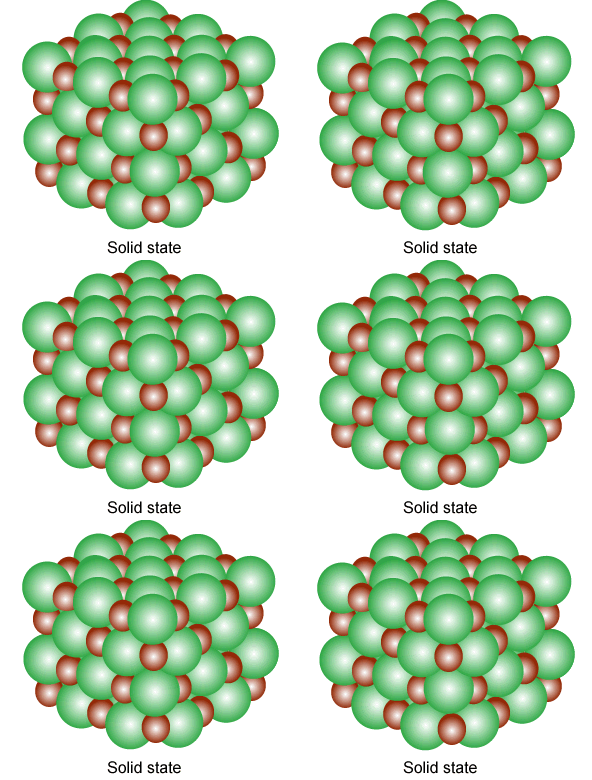
Types of Solids:
Based on the nature of the order that is present in the arrangement of their constituent particles solids can be divided into two types;
- Amorphous solids behave the same as super cool liquids due to the arrangement of constituent particles in short-range order. They are isotropic and have a broad melting point (range is about greater than 5°C).
- Crystalline solids have a fixed shape and the constituent particles are arranged in a long-range order.