Question:
The typical biasing of a silicon transistor is shown in the figure.
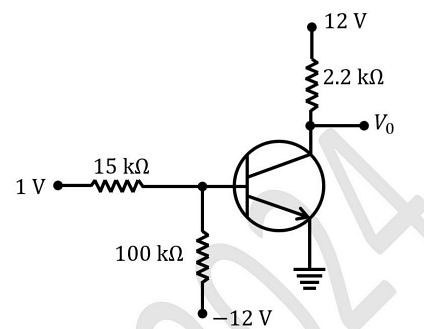
The value of the common-emitter current gain \( \beta \) for the transistor is 100. Ignore reverse saturation current. The output voltage \( V_o \) (in V) is ____ (in integer).
The typical biasing of a silicon transistor is shown in the figure.
The value of the common-emitter current gain \( \beta \) for the transistor is 100. Ignore reverse saturation current. The output voltage \( V_o \) (in V) is ____ (in integer).
The value of the common-emitter current gain \( \beta \) for the transistor is 100. Ignore reverse saturation current. The output voltage \( V_o \) (in V) is ____ (in integer).
Updated On: Jul 12, 2024
Hide Solution

Verified By Collegedunia
Correct Answer: 12
Solution and Explanation
The correct Answer is:12 or 12 Approx
Was this answer helpful?
0
0
Top Questions on Transistors
In the circuit shown, the identical transistors Q1 and Q2 are biased in the active region with \( \beta = 120 \). The Zener diode is in the breakdown region with \( V_Z = 5 \, V \) and \( I_Z = 25 \, mA \). If \( I_L = 12 \, mA \) and \( V_{EB1} = V_{EB2} = 0.7 \, V \), then the values of \( R_1 \) and \( R_2 \) (in \( k\Omega \), rounded off to one decimal place) are _________, respectively.

- The electron mobility \( \mu_n \) in a non-degenerate germanium semiconductor at 300 K is 0.38 m$^2$/Vs. The electron diffusivity \( D_n \) at 300 K (in cm$^2$/s, rounded off to the nearest integer) is _________.
- A square metal sheet of 4 m \( \times \) 4 m is placed on the x-y plane as shown in the figure below. If the surface charge density (in \( \mu \)C/m\(^2\)) on the sheet is \( \rho_s(x, y) = 4|y| \), then the total charge (in \( \mu \)C, rounded off to the nearest integer) on the sheet is _________.
- In amplitude modulation, if a message signal of 5 kHz is modulated by a carrier wave of frequency 900 kHz, then the frequencies of the side bands are
- AP EAPCET - 2025
- Physics
- Transistors
- In a common emitter transistor amplifier the resistance of collector is 3 kΩ. If the current amplification factor is 100 and the base resistance is 2 kΩ, then the power gain of the transistor is
- AP EAPCET - 2025
- Physics
- Transistors
View More Questions
Questions Asked in GATE PH exam
- For an ideal gas undergoing an adiabatic process, which quantity remains constant?
- GATE PH - 2026
- Thermodynamics
- Which of the following solids has a completely filled valence band and a large band gap?
- GATE PH - 2026
- Electro Dynamics
- Which particle is emitted during beta-minus decay?
- GATE PH - 2026
- Nuclear Physics
- Which of the following Maxwell’s equations represents Faraday’s law of electromagnetic induction?
- GATE PH - 2026
- Atomic Physics
- The eigenvalues of the Hamiltonian operator represent the:
- GATE PH - 2026
- Mechanics
View More Questions