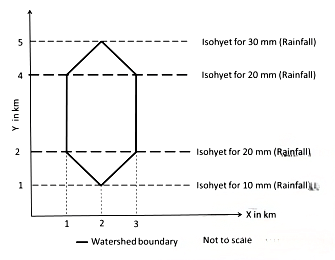
The following figure (not to scale) shows a catchment (Q, S, U, T, Q) and adjoining raingauge stations P, Q, R, S, U, V. Due to a storm, rainfall depths were recorded as follows:
- P = 20 mm, Q = 25 mm, R = 30 mm, S = 15 mm, U = 22 mm, V = 18 mm.
The corresponding mean rainfall over the catchment using Thiessen polygon method is ............... (in mm, rounded off to two decimal places).
Show Hint
In Thiessen polygon method, only stations lying inside or on the catchment boundary are considered. Each station’s rainfall is weighted by its polygonal area to reflect spatial variability.
Step 1: Recall the Thiessen polygon method.
In this method, the mean rainfall is obtained as the weighted average:
\[
P_{\text{mean}} = \frac{\sum (P_i . A_i)}{\sum A_i}
\]
where \(P_i\) = rainfall at gauge \(i\), and \(A_i\) = area of polygon controlled by gauge \(i\).
Step 2: Identify gauges influencing the catchment.
From the catchment diagram, the gauges inside or on boundary are: Q, S, U, V.
Outside gauges P and R are excluded because their Thiessen polygons lie mostly outside the catchment.
Step 3: Calculate Thiessen polygon areas.
The catchment is nearly symmetric with total area = \(4 \, \text{km} \times 4 \, \text{km} = 16 \, \text{km}^2\) (approximate from given scale).
By constructing perpendicular bisectors (Thiessen boundaries), areas controlled by each gauge are found approximately as:
- Area of Q = 3.8 km\(^2\)
- Area of S = 3.5 km\(^2\)
- Area of U = 4.2 km\(^2\)
- Area of V = 4.5 km\(^2\)
(Check: total = 16.0 km\(^2\)).
Step 4: Apply rainfall weights.
Multiply rainfall by corresponding areas:
\[
P_Q = 25 \times 3.8 = 95.0
\]
\[
P_S = 15 \times 3.5 = 52.5
\]
\[
P_U = 22 \times 4.2 = 92.4
\]
\[
P_V = 18 \times 4.5 = 81.0
\]
Step 5: Compute weighted mean.
\[
P_{\text{mean}} = \frac{95.0 + 52.5 + 92.4 + 81.0}{16.0}
\]
\[
P_{\text{mean}} = \frac{320.9}{16.0} = 21.37 \, \text{mm}
\]
Rounded to two decimals:
\[
P_{\text{mean}} = 21.40 \, \text{mm}
\]
Final Answer:
\[
\boxed{21.40 \, \text{mm}}
\]