The equation of the plane containing the lines $2x - 5y + z = 3, x + y + \, z = 5$ and parallel to the plane $x + 3 y+ 6 z = 1$ is
- $2x + 6y + 12z = 13$
- $x + 3y + 6z = - 7$
\(x + 3y + 6z = 27\)
- $2x + 6y + 12x = - 13$

The Correct Option is C
Solution and Explanation
The correct option is(C): x+3y+6z=27.
The given lines are:
- 2x - 5y + z = 3
- x + y + z = 5
A(x−x0)+B(y−y0)+C(z−z0)=0,
where (A, B, C) is the direction vector of the plane, and (x_0, y_0, z_0) is a point on the plane.
Plugging in the values, we get:
1(x−3)+3(y+2)+6(z−4)=0,
which simplifies to:
x+3y+6z=27.
So, the equation of the plane containing the lines 2x - 5y + z = 3 and x + y + z = 5, and parallel to the plane x + 3y + 6z = 1, is
x+3y+6z=27.
Top Questions on Three Dimensional Geometry
- If the distances of the point \( (1,2,a) \) from the line \[ \frac{x-1}{1}=\frac{y}{2}=\frac{z-1}{1} \] along the lines \[ L_1:\ \frac{x-1}{3}=\frac{y-2}{4}=\frac{z-a}{b} \quad \text{and} \quad L_2:\ \frac{x-1}{1}=\frac{y-2}{4}=\frac{z-a}{c} \] are equal, then \( a+b+c \) is equal to:
- JEE Main - 2026
- Mathematics
- Three Dimensional Geometry
- The value of the integral \( \int_{\frac{\pi}{24}}^{\frac{5\pi}{24}} \frac{dx}{1 + \sqrt[3]{\tan 2x}} \) is :
- JEE Main - 2026
- Mathematics
- Three Dimensional Geometry
Let the lines $L_1 : \vec r = \hat i + 2\hat j + 3\hat k + \lambda(2\hat i + 3\hat j + 4\hat k)$, $\lambda \in \mathbb{R}$ and $L_2 : \vec r = (4\hat i + \hat j) + \mu(5\hat i + + 2\hat j + \hat k)$, $\mu \in \mathbb{R}$ intersect at the point $R$. Let $P$ and $Q$ be the points lying on lines $L_1$ and $L_2$, respectively, such that $|PR|=\sqrt{29}$ and $|PQ|=\sqrt{\frac{47}{3}}$. If the point $P$ lies in the first octant, then $27(QR)^2$ is equal to}
- JEE Main - 2026
- Mathematics
- Three Dimensional Geometry
- Let a line $L$ passing through the point $P(1,1,1)$ be perpendicular to the lines \[ \frac{x-4}{4}=\frac{y-1}{1}=\frac{z-1}{1} \quad \text{and} \quad \frac{x-17}{1}=\frac{y-71}{1}=\frac{z}{0}. \] Let the line $L$ intersect the $yz$-plane at the point $Q$.
Another line parallel to $L$ and passing through the point $S(1,0,-1)$ intersects the $yz$-plane at the point $R$.
Then the square of the area of the parallelogram $PQRS$ is equal to
- JEE Main - 2026
- Mathematics
- Three Dimensional Geometry
- Let \( L \) be the line \[ \frac{x+1}{2} = \frac{y+1}{3} = \frac{z+3}{6} \] and let \( S \) be the set of all points \( (a,b,c) \) on \( L \), whose distance from the line \[ \frac{x+1}{2} = \frac{y+1}{3} = \frac{z-9}{0} \] along the line \( L \) is \( 7 \). Then \[ \sum_{(a,b,c)\in S} (a+b+c) \] is equal to
- JEE Main - 2026
- Mathematics
- Three Dimensional Geometry
Questions Asked in JEE Main exam
- In a microscope of tube length $10\,\text{cm}$ two convex lenses are arranged with focal lengths $2\,\text{cm}$ and $5\,\text{cm}$. Total magnification obtained with this system for normal adjustment is $(5)^k$. The value of $k$ is ___.
- JEE Main - 2026
- Optical Instruments
Which one of the following graphs accurately represents the plot of partial pressure of CS₂ vs its mole fraction in a mixture of acetone and CS₂ at constant temperature?


- JEE Main - 2026
- Organic Chemistry
- Let \( ABC \) be an equilateral triangle with orthocenter at the origin and the side \( BC \) lying on the line \( x+2\sqrt{2}\,y=4 \). If the coordinates of the vertex \( A \) are \( (\alpha,\beta) \), then the greatest integer less than or equal to \( |\alpha+\sqrt{2}\beta| \) is:
- JEE Main - 2026
- Coordinate Geometry
- Three charges $+2q$, $+3q$ and $-4q$ are situated at $(0,-3a)$, $(2a,0)$ and $(-2a,0)$ respectively in the $x$-$y$ plane. The resultant dipole moment about origin is ___.
- JEE Main - 2026
- Electromagnetic waves
Let \( \alpha = \dfrac{-1 + i\sqrt{3}}{2} \) and \( \beta = \dfrac{-1 - i\sqrt{3}}{2} \), where \( i = \sqrt{-1} \). If
\[ (7 - 7\alpha + 9\beta)^{20} + (9 + 7\alpha - 7\beta)^{20} + (-7 + 9\alpha + 7\beta)^{20} + (14 + 7\alpha + 7\beta)^{20} = m^{10}, \] then the value of \( m \) is ___________.- JEE Main - 2026
- Complex Numbers and Quadratic Equations
Concepts Used:
Three Dimensional Geometry
Mathematically, Geometry is one of the most important topics. The concepts of Geometry are derived w.r.t. the planes. So, Geometry is divided into three major categories based on its dimensions which are one-dimensional geometry, two-dimensional geometry, and three-dimensional geometry.
Direction Cosines and Direction Ratios of Line:
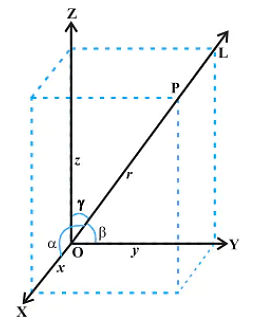
Consider a line L that is passing through the three-dimensional plane. Now, x,y and z are the axes of the plane and α,β, and γ are the three angles the line makes with these axes. These are commonly known as the direction angles of the plane. So, appropriately, we can say that cosα, cosβ, and cosγ are the direction cosines of the given line L.