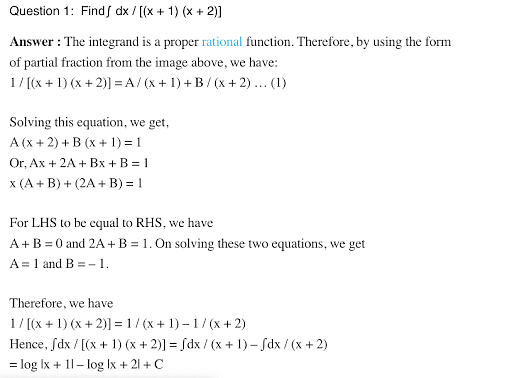
Integrate the function: \(tan^{-1}x\)

Solution and Explanation
The correct answer is: \(xtan^{-1}x-\frac{1}{2}log(1+x^2)+C\)
Let \(I=∫1.tan^{-1}x dx\)
Taking \(tan^{-1}x\) as first function and 1 as second function and integrating by parts,we
obtain
\(I=tan^{-1}x∫1dx-∫[{(\frac{d}{dx}tan^{-1}x)∫1.dx}]dx\)
\(=tan^{-1}x.x-∫\frac{1}{1+x^2}.x dx\)
\(=xtan^{-1}x-\frac{1}{2}∫\frac{2x}{1+x^2} dx\)
\(=xtan^{-1}x-\frac{1}{2}log|1+x^2|+C\)
\(=xtan^{-1}x-\frac{1}{2}log(1+x^2)+C\)
Top Questions on integral
Let \( f : (0, \infty) \to \mathbb{R} \) be a twice differentiable function. If for some \( a \neq 0 \), } \[ \int_0^a f(x) \, dx = f(a), \quad f(1) = 1, \quad f(16) = \frac{1}{8}, \quad \text{then } 16 - f^{-1}\left( \frac{1}{16} \right) \text{ is equal to:}\]
- Let $ f(x) $ be a positive function and $I_1 = \int_{-\frac{1}{2}}^1 2x \, f\left(2x(1-2x)\right) dx$ and $I_2 = \int_{-1}^2 f\left(x(1-x)\right) dx.$ Then the value of $\frac{I_2}{I_1}$ is equal to ____
- Evaluate the integral: \[ \int \frac{x^2 + 2x}{\sqrt{x^2 + 1}} \, dx \]
- Evaluate the integral: \[ \int \sqrt{x^2 + 3x} \, dx \]
- The value of the integral \( \int_0^1 x^2 \, dx \) is:
Questions Asked in CBSE CLASS XII exam
- Vishesh, Manik and Amit were partners in the ratio 5 : 4 : 1. Amit retired on 31st March, 2024. Vishesh and Manik decided to share Amit’s share in the ratio 2 : 3. What will be the new profit sharing ratio between Vishesh and Manik?
- CBSE CLASS XII - 2025
- Retirement and Death of a Partner
- The electric field in a region is given by \( \vec{E} = 40x \hat{i} \, \text{N/C}. \) Find the amount of work done in taking a unit positive charge from a point (0, 3m) to the point (5m, 0).
- CBSE CLASS XII - 2025
- Electrostatics
- Consider the Linear Programming Problem, where the objective function \[ Z = x + 4y \] needs to be minimized subject to the following constraints: \[ 2x + y \geq 1000, \] \[ x + 2y \geq 800, \] \[ x \geq 0, \quad y \geq 0. \] Draw a neat graph of the feasible region and find the minimum value of $Z$.
- CBSE CLASS XII - 2025
- Linear Programming Problem
- A rectangular glass slab ABCD (refractive index 1.5) is surrounded by a transparent liquid (refractive index 1.25) as shown in the figure. A ray of light is incident on face AB at an angle \(i\) such that it is refracted out grazing the face AD. Find the value of angle \(i\).

- CBSE CLASS XII - 2025
- Refraction
- Considering the case of magnetic field produced by air-filled current carrying solenoid, show that the magnetic energy density of a magnetic field \( B \) is \( \frac{B^2}{2\mu_0} \).
- CBSE CLASS XII - 2025
- Magnetic Field
Concepts Used:
Integration by Partial Fractions
The number of formulas used to decompose the given improper rational functions is given below. By using the given expressions, we can quickly write the integrand as a sum of proper rational functions.
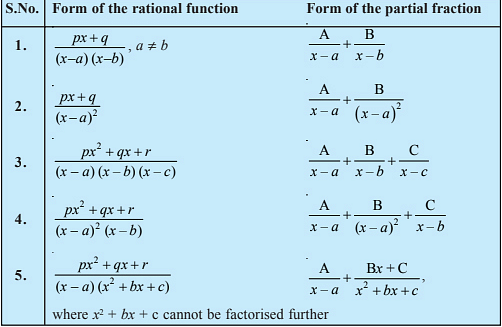
For examples,