Let the line
\(\frac{x - 3}{7} = \frac{y - 2}{-1} = \frac{z - 3}{-4}\)
intersect the plane containing the lines
\(\frac{x - 4}{1} = \frac{y + 1}{-2} = \frac{z}{1}\) and \(4ax-y+5z-7a = 0 = 2x-5y-z-3, a∈R\)
at the point P(α, β, γ). Then the value of α + β + γ equals _____.
Let the line
\(\frac{x - 3}{7} = \frac{y - 2}{-1} = \frac{z - 3}{-4}\)
intersect the plane containing the lines
\(\frac{x - 4}{1} = \frac{y + 1}{-2} = \frac{z}{1}\) and \(4ax-y+5z-7a = 0 = 2x-5y-z-3, a∈R\)
at the point P(α, β, γ). Then the value of α + β + γ equals _____.

Correct Answer: 12
Approach Solution - 1
To find the point P(α, β, γ) where the line intersects the plane, we first express the parametric form of the line:
\(x = 7t + 3\),\(y = -t + 2\),\(z = -4t + 3\).
The plane contains the lines given by:
\(L_1: \frac{x - 4}{1} = \frac{y + 1}{-2} = \frac{z}{1}\) as \(x = u + 4\), \(y = -2u - 1\), \(z = u\), and
\(L_2: 4ax - y + 5z - 7a = 0\) and \(2x - 5y - z - 3 = 0\).
We solve the equations for \(L_2\) simultaneously to find the plane equation:
Substitute \(x = u + 4\), \(y = -2u - 1\), \(z = u\) into:
\(4a(u+4) - (-2u-1) + 5u - 7a = 0\)
Simplifying gives:
\(4au + 16a + 2u + 1 + 5u - 7a = 0\)
\(11u + 9a + 1 = 0\)
The second equation:
\(2x - 5y - z - 3 = 0\), substituting gives:
\(2(u+4) + 10u + 5 - u - 3 = 0\)
Simplifying gives:
\(11u + 5 = 0\) which is independent of \(a\).
The intersection occurs by plugging into plane equations:
\(x = 7t + 3, y = -t + 2, z = -4t + 3\) satisfies:
Equation of plane through points implies:
\(11(7t+3) + 5 = 0\)\)
\(77t + 38 = 0 \rightarrow 77t = -38 \rightarrow t = -\frac{38}{77}\).\)
Substitute this value of \(t\) back:
α = \(7\left(-\frac{38}{77}\right) + 3\), β = \(-\left(-\frac{38}{77}\right) + 2\), γ = \(-4\left(-\frac{38}{77}\right) + 3\).
Calculate each:
α = \(-\frac{266}{77} + 3\), β = 2 + \frac{38}{77}\), γ = 3 + \frac{152}{77}\)
α + β + γ = \(\frac{77(\text{-266}) + 77(\text{154}) + 114}{77}\), giving 12\).
Thus, α + β + γ = 12, verifying it fits the range (12,12).
Approach Solution -2
Equation of plane containing the line
4ax – y + 5z – 7a = 0 = 2x – 5y – z – 3 can be written as
4ax-y+5z-7a+λ(2x-5y-z-3) = 0
(4a+2λ)x-(1+5λ)y+(5-λ)z-(7a+3λ) = 0
Which i coplanar with the line
x-4/1 = y+1/-2 = z/1
4(4a+2λ)+(1+5λ)-(7a+3λ) = 0
9a+10λ+1 = 0....(1)
(4a+2λ)1+(1+5λ)2+5-λ = 0
4a+11λ+7 = 0....(2)
a = 1, λ = -1
Equation of plane is x + 2y + 3z – 2 = 0
Intersection with the line
\(\frac{x - 3}{7} = \frac{y - 2}{-1} = \frac{z - 3}{-4}\)
(7t + 3) + 2 (–t + 2) + 3 (– 4t + 3) – 2 = 0
–7t + 14 = 0
t = 2
So, the required point is (17, 0, –5)
α+β+γ = 12
Top Questions on Three Dimensional Geometry
- If the distances of the point \( (1,2,a) \) from the line \[ \frac{x-1}{1}=\frac{y}{2}=\frac{z-1}{1} \] along the lines \[ L_1:\ \frac{x-1}{3}=\frac{y-2}{4}=\frac{z-a}{b} \quad \text{and} \quad L_2:\ \frac{x-1}{1}=\frac{y-2}{4}=\frac{z-a}{c} \] are equal, then \( a+b+c \) is equal to:
- JEE Main - 2026
- Mathematics
- Three Dimensional Geometry
- The value of the integral \( \int_{\frac{\pi}{24}}^{\frac{5\pi}{24}} \frac{dx}{1 + \sqrt[3]{\tan 2x}} \) is :
- JEE Main - 2026
- Mathematics
- Three Dimensional Geometry
Let the lines $L_1 : \vec r = \hat i + 2\hat j + 3\hat k + \lambda(2\hat i + 3\hat j + 4\hat k)$, $\lambda \in \mathbb{R}$ and $L_2 : \vec r = (4\hat i + \hat j) + \mu(5\hat i + + 2\hat j + \hat k)$, $\mu \in \mathbb{R}$ intersect at the point $R$. Let $P$ and $Q$ be the points lying on lines $L_1$ and $L_2$, respectively, such that $|PR|=\sqrt{29}$ and $|PQ|=\sqrt{\frac{47}{3}}$. If the point $P$ lies in the first octant, then $27(QR)^2$ is equal to}
- JEE Main - 2026
- Mathematics
- Three Dimensional Geometry
- Let a line $L$ passing through the point $P(1,1,1)$ be perpendicular to the lines \[ \frac{x-4}{4}=\frac{y-1}{1}=\frac{z-1}{1} \quad \text{and} \quad \frac{x-17}{1}=\frac{y-71}{1}=\frac{z}{0}. \] Let the line $L$ intersect the $yz$-plane at the point $Q$.
Another line parallel to $L$ and passing through the point $S(1,0,-1)$ intersects the $yz$-plane at the point $R$.
Then the square of the area of the parallelogram $PQRS$ is equal to
- JEE Main - 2026
- Mathematics
- Three Dimensional Geometry
- Let \( L \) be the line \[ \frac{x+1}{2} = \frac{y+1}{3} = \frac{z+3}{6} \] and let \( S \) be the set of all points \( (a,b,c) \) on \( L \), whose distance from the line \[ \frac{x+1}{2} = \frac{y+1}{3} = \frac{z-9}{0} \] along the line \( L \) is \( 7 \). Then \[ \sum_{(a,b,c)\in S} (a+b+c) \] is equal to
- JEE Main - 2026
- Mathematics
- Three Dimensional Geometry
Questions Asked in JEE Main exam
- When a light of a given wavelength falls on a metallic surface the stopping potential for photoelectrons is \(3.2\ \text{V}\). If a second light having wavelength twice of the first light is used, the stopping potential drops to \(0.7\ \text{V}\). The wavelength of the first light is ________ m.
- JEE Main - 2026
- Photoelectric Effect
- An infinitely long straight wire carrying current $I$ is bent in a planar shape as shown in the diagram. The radius of the circular part is $r$. The magnetic field at the centre $O$ of the circular loop is :

- JEE Main - 2026
- Current electricity
- Identify the correct statements: The presence of –NO\(_2\) group in benzene ring A. activates the ring towards electrophilic substitutions. B. deactivates the ring towards electrophilic substitutions. C. activates the ring towards nucleophilic substitutions. D. deactivates the ring towards nucleophilic substitutions. Choose the correct answer from the options given below:
- JEE Main - 2026
- General Chemistry
Two circular discs of radius \(10\) cm each are joined at their centres by a rod, as shown in the figure. The length of the rod is \(30\) cm and its mass is \(600\) g. The mass of each disc is also \(600\) g. If the applied torque between the two discs is \(43\times10^{-7}\) dyne·cm, then the angular acceleration of the system about the given axis \(AB\) is ________ rad s\(^{-2}\).

- JEE Main - 2026
- Rotational motion
- In an experiment, a set of readings are obtained as follows: \[ 1.24~\text{mm},\ 1.25~\text{mm},\ 1.23~\text{mm},\ 1.21~\text{mm}. \] The expected least count of the instrument used in recording these readings is _______ mm.
- JEE Main - 2026
- General Physics
Concepts Used:
Three Dimensional Geometry
Mathematically, Geometry is one of the most important topics. The concepts of Geometry are derived w.r.t. the planes. So, Geometry is divided into three major categories based on its dimensions which are one-dimensional geometry, two-dimensional geometry, and three-dimensional geometry.
Direction Cosines and Direction Ratios of Line:
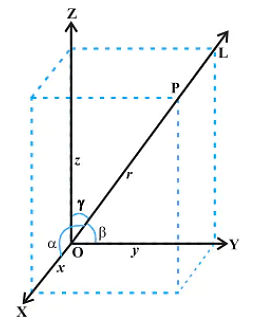
Consider a line L that is passing through the three-dimensional plane. Now, x,y and z are the axes of the plane and α,β, and γ are the three angles the line makes with these axes. These are commonly known as the direction angles of the plane. So, appropriately, we can say that cosα, cosβ, and cosγ are the direction cosines of the given line L.