Question:
Hall-Heroult's process is given by :
Hall-Heroult's process is given by :
Updated On: Jun 23, 2024
- ${Cr2O3 + 2Al -> Al2O3 + 2Cr}$
- ${Cu^{2+} (a) + H_2(g) \to Cu(s) + 2H^{+} (aq)}$
- ${ZnO + C ->[Coke, 1673 K] Zn + CO}$
- ${2 Al_2 O_3 + 3C \to 4Al + 3CO_2 }$
Hide Solution

Verified By Collegedunia
The Correct Option is D
Solution and Explanation
In Hall-Heroult's process is given by
${2Al2O3 + 3C -> 4Al + 3CO2}$
${2Al2O3(\ell) <=> 4Al^{3+}(\ell) + 6O^{2 \ominus}(\ell)}$
${At \; cathode :- 4Al^{3 +}_{(\ell)} + 12 e^{ominus} -> 4Al(\ell)}$
${At \; Anode : 6O^{2 \ominus}_{(\ell)} -> 3O_2 (g) + 12e^{\ominus}}$
${3C + 3O_2 -> 3CO_1 (^)}$
${2Al2O3 + 3C -> 4Al + 3CO2}$
${2Al2O3(\ell) <=> 4Al^{3+}(\ell) + 6O^{2 \ominus}(\ell)}$
${At \; cathode :- 4Al^{3 +}_{(\ell)} + 12 e^{ominus} -> 4Al(\ell)}$
${At \; Anode : 6O^{2 \ominus}_{(\ell)} -> 3O_2 (g) + 12e^{\ominus}}$
${3C + 3O_2 -> 3CO_1 (^)}$
Was this answer helpful?
0
0
Top Questions on General Principles and Processes of Isolation of Elements
- In the extraction of iron using blast furnace to remove the impurity (X), chemical (Y) is added to the ore. X and Y are respectively
- TS EAMCET - 2025
- Chemistry
- General Principles and Processes of Isolation of Elements
- What is used for the Thermite Reaction?
- BCECE - 2025
- Chemistry
- General Principles and Processes of Isolation of Elements
- Which of the following compounds is used to cover the surface of a metallic object to prevent corrosion?
- KEAM - 2025
- Chemistry
- General Principles and Processes of Isolation of Elements
- The incorrect statement about the Hall-Heroult process is:
- KCET - 2024
- Chemistry
- General Principles and Processes of Isolation of Elements
- Select the correct statement:
- KCET - 2024
- Chemistry
- General Principles and Processes of Isolation of Elements
View More Questions
Questions Asked in JEE Main exam
- Consider the following three statements for the function $f : (0,\infty) \rightarrow \mathbb{R}$ defined by
\[ f(x) = \left| \log_e x \right| - |x - 1| : \]
(I) $f$ is differentiable at all $x>0$.
(II) $f$ is increasing in $(0,1)$.
(III) $f$ is decreasing in $(1,\infty)$.
Then,
- JEE Main - 2026
- Application of derivatives
- In parallax method for the determination of focal length of a concave mirror, the object should always be placed:
- JEE Main - 2026
- Ray optics and optical instruments
If a random variable \( x \) has the probability distribution

then \( P(3<x \leq 6) \) is equal to- JEE Main - 2026
- Conditional Probability
- Let \( L \) be the line \[ \frac{x+1}{2} = \frac{y+1}{3} = \frac{z+3}{6} \] and let \( S \) be the set of all points \( (a,b,c) \) on \( L \), whose distance from the line \[ \frac{x+1}{2} = \frac{y+1}{3} = \frac{z-9}{0} \] along the line \( L \) is \( 7 \). Then \[ \sum_{(a,b,c)\in S} (a+b+c) \] is equal to
- JEE Main - 2026
- Three Dimensional Geometry
- Hydroxy compound ($\text{A}$) with molecular mass $= 122$ react with excess of acetic anhydride and gives compound ($\text{X}$) with molecular mass $= 290$, then find the no. of hydroxy groups in given compound ($\text{A}$).
- JEE Main - 2026
- Hydrocarbons
View More Questions
Concepts Used:
General Principles and Processes of Isolation of Elements
What are Ores and Minerals?
Minerals are the naturally occurring, homogeneous inorganic solid substances. They are having a definite chemical composition and crystalline structure, hardness and color. For example, copper pyrite, calamine, etc.
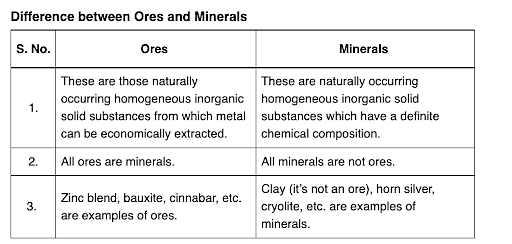
Impurities in an ore are called gauge. The removal of a gauge from the ore is called concentration ore.
Several steps are involved in the extraction of pure metal from ores. Major steps are as follows –
- Concentration of the ore
- Isolation of the metal from its concentrated ore
- Purification of the metal