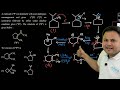
A molecule (P) on treatment with acid undergoes rearrangement and gives (Q). (Q) on ozonolysis followed by reflux under alkaline condition gives (R). The structure of (R) is given below. The structure of (P) is:

A molecule (P) on treatment with acid undergoes rearrangement and gives (Q). (Q) on ozonolysis followed by reflux under alkaline condition gives (R). The structure of (R) is given below. The structure of (P) is:
Show Hint


- Both Option 2 and 3 are correct.

The Correct Option is A
Solution and Explanation
The first reaction on 'P' is treatment with acid which causes a rearrangement giving 'Q'. Then 'Q' undergoes ozonolysis followed by reflux with alkali to produce 'R'. Ozonolysis will cleave the double bond so let's label the side to add at ketone. Ozonolysis followed by reflux with alkali gives the ketone functionality is. The given product can undergo aldol condensation
If the product given here after reflux with alkali would produce
Given product means Q after ozonolysis with alkaline treatment gave. The first reaction involves acid that give is that the alcohol give alkylene as show n by structure.
Hence, Both Option 2 and 3 are Correct.

Learn with videos:
Top Questions on Organic Chemistry
Which one of the following graphs accurately represents the plot of partial pressure of CS₂ vs its mole fraction in a mixture of acetone and CS₂ at constant temperature?


- JEE Main - 2026
- Chemistry
- Organic Chemistry
Consider the following two reactions A and B:

The numerical value of [molar mass of $x$ + molar mass of $y$] is ___.
- JEE Main - 2026
- Chemistry
- Organic Chemistry
- Given below are two statements:
Statement I: $CH_3)_3C^+$ is more stable than $CH_3CH_2^+$ as nine hyperconjugation interactions are possible in $(CH_3)_3C^+$.
Statement II: $CH_3^+$ is less stable than $(CH_3)_3C^+$ as only three hyperconjugation interactions are possible in $CH_3^+$.
In the light of the above statements, choose the correct answer...- JEE Main - 2026
- Chemistry
- Organic Chemistry
- \(0.53\ \text{g}\) of an organic compound \(X\) when heated with excess concentrated nitric acid and then with silver nitrate gave \(0.75\ \text{g}\) of silver bromide precipitate. \(1.0\ \text{g}\) of \(X\) gave \(1.32\ \text{g}\) of \(\mathrm{CO_2}\) on combustion. Find the percentage of hydrogen in compound \(X\). (Nearest integer) [Given: Atomic masses (g mol\(^{-1}\)): H = 1, C = 12, Br = 80, Ag = 108, O = 16]
- JEE Main - 2026
- Chemistry
- Organic Chemistry
Consider the following reaction sequence:

Given: Compound (x) has percentage composition \(76.6%\ \text{C}\), \(6.38%\ \text{H}\) and vapour density \(=47\). Compound (y) develops a characteristic colour with neutral \(\mathrm{FeCl_3}\) solution. Identify the {INCORRECT statement.}- JEE Main - 2026
- Chemistry
- Organic Chemistry
Questions Asked in JEE Main exam
- A 20 m long uniform copper wire held horizontally is allowed to fall under the gravity (g = 10 m/s²) through a uniform horizontal magnetic field of 0.5 Gauss perpendicular to the length of the wire. The induced EMF across the wire when it travels a vertical distance of 200 m is_______ mV.}
- JEE Main - 2026
- Thermodynamics
- If the end points of chord of parabola \(y^2 = 12x\) are \((x_1, y_1)\) and \((x_2, y_2)\) and it subtend \(90^\circ\) at the vertex of parabola then \((x_1x_2 - y_1y_2)\) equals :
- JEE Main - 2026
- Probability
- The sum of all possible values of \( n \in \mathbb{N} \), so that the coefficients of \(x, x^2\) and \(x^3\) in the expansion of \((1+x^2)^2(1+x)^n\) are in arithmetic progression is :
- JEE Main - 2026
- Integration
- In a microscope of tube length $10\,\text{cm}$ two convex lenses are arranged with focal lengths $2\,\text{cm}$ and $5\,\text{cm}$. Total magnification obtained with this system for normal adjustment is $(5)^k$. The value of $k$ is ___.
- JEE Main - 2026
- Optical Instruments
- Let \( ABC \) be an equilateral triangle with orthocenter at the origin and the side \( BC \) lying on the line \( x+2\sqrt{2}\,y=4 \). If the coordinates of the vertex \( A \) are \( (\alpha,\beta) \), then the greatest integer less than or equal to \( |\alpha+\sqrt{2}\beta| \) is:
- JEE Main - 2026
- Coordinate Geometry