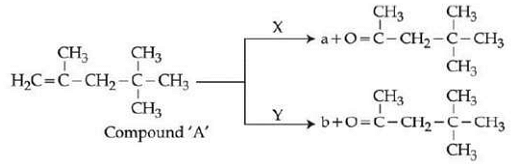
A compound A on reaction with X and Y produces the same major product but different by product a and b Oxidation of a gives a substance produced by ants X and Y respectively are :
The hydrocarbons such as Haloalkanes and Haloarenes are the ones, in which one or more hydrogen atoms are replaced with halogen atoms. The main difference between Haloalkanes and Haloarenes is that Haloalkanes are derived from open chained hydrocarbons, also called alkanes, and Haloarenes are derived from aromatic hydrocarbons.
Haloalkanes have hydrocarbons made up of aliphatic alkanes and one or more hydrogen atoms replaced by halogens (elements such as Chlorine, Bromine, Fluorine, Iodine, etc.) whereas, haloarenes consist of aromatic ring or rings and one or more hydrogen atoms replaced by halogens.
In haloalkanes, the halogen atom is attached to the sp3 hybridized carbon atom of the alkyl group whereas, in haloarenes, the halogen atom is attached to the sp3 hybridized carbon atom of the alkyl group.
Haloalkanes are saturated organic compounds where all the chemical bonds are attached to the carbon atom with single bonds and a single carbon atom is attached to the Halogen atom, whereas, the haloarenes differ from Haloalkanes by their method of preparation and properties.
Haloalkanes are made by aliphatic alkanes by the process of free radical halogenation, whereas, haloarenes are made by direct halogenation of aromatic rings.
Haloalkanes are odorless compounds, whereas, haloarenes have a sweet odor.
Haloalkanes precipitate in SN2 substitution reactions, whereas, haloarenes do not precipitate in SN2 substitution reactions.
Example of haloalkanes is CH3Cl (Methyl Chloride) and CH3CH2Br (Ethyl Bromide) and the example of haloarenes is Chlorobenzene, Bromobenzene.