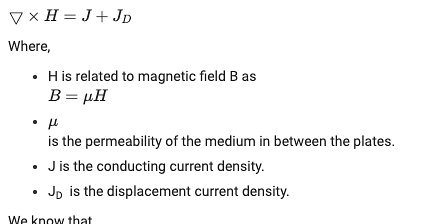
A capacitor of capacitance ‘C’, is connected across an ac source of voltage V, given by V=V0sinωt The displacement current between the plates of the capacitor, would then be given by
\(I_d=V_0\,\omega Csin\omega t\)
\(I_d=V_0\,\omega Ccos\omega t\)
\(I_d=\frac{V_0}{\omega C}cos\omega t\)
\(I_d=\frac{V_0}{\omega C}sin\omega t\)

The Correct Option is B
Solution and Explanation
To determine the displacement current \(I_d\) for a capacitor connected to an AC voltage source, we start by examining the given voltage expression: \(V = V_0 \sin \omega t\), where:
- \(V_0\) is the peak voltage,
- \(\omega\) is the angular frequency,
- \(t\) is the time.
In an AC circuit, the relationship between current and voltage in a capacitor is different from that in a resistor. For a capacitor, the current (or displacement current in this case) leads the voltage by a phase angle of \(\frac{\pi}{2}\) radians.
The displacement current through the capacitor is given by:
- The capacitor equation: \(Q = CV\), where \(Q\) is the charge on the capacitor.
- Differentiate with respect to time to find the current: \(I_d = \frac{dQ}{dt} = C \frac{dV}{dt}\).
Now, differentiate the voltage \(V = V_0\sin\omega t\) with respect to time:
- \(\frac{dV}{dt} = V_0 \omega \cos \omega t\).
Substitute into the expression for current:
- \(I_d = C \left( V_0 \omega \cos \omega t \right)\).
Simplifying, we get:
- \(I_d = V_0 \omega C \cos \omega t\).
Thus, the displacement current is given by the expression: \(I_d = V_0 \omega C \cos \omega t\). This matches the provided correct answer.
The other options can be ruled out since they do not incorporate the correct behavior of current leading the voltage by \(\frac{\pi}{2}\) radians, as seen in the use of \(\cos\) instead of \(\sin\) for current.
Therefore, the correct option is:
- \(I_d = V_0 \omega C \cos \omega t\)
Top Questions on Magnetism and matter
- An inductor stores \(16\,\text{J}\) of magnetic field energy and dissipates \(32\,\text{W}\) of thermal energy due to its resistance when an alternating current of \(2\,\text{A}\) (rms) and frequency \(50\,\text{Hz}\) flows through it. The ratio of inductive reactance to resistance is _______. \((\pi=3.14)\) Given: \[ U=16\,\text{J},\quad P=32\,\text{W},\quad I=2\,\text{A},\quad f=50\,\text{Hz} \]
- JEE Main - 2026
- Physics
- Magnetism and matter
- A long cylindrical conductor with large cross section carries an electric current distributed uniformly over its cross-section. Magnetic field due to this current is:
[A.] maximum at either end of the conductor
[B.] maximum at the axis of the conductor and minimum at the midpoint
[C.] minimum at the surface of the conductor
[D.] minimum at the axis of the conductor
[E.] same at all points in the cross-section of the conductor
Choose the correct answer from the options given below:- JEE Main - 2026
- Physics
- Magnetism and matter
- A plane electromagnetic wave is moving in free space with velocity \[ c=3\times10^{8}\ \text{m/s} \] and its electric field is given as \[ \vec E = 54\sin(kz-\omega t)\,\hat{j}\ \text{V/m}, \] where \(\hat{j}\) is the unit vector along the \(y\)-axis. The magnetic field \(\vec B\) of the wave is:
- JEE Main - 2026
- Physics
- Magnetism and matter
A current-carrying coil is placed in an external uniform magnetic field. The coil is free to turn in the magnetic field. What is the net force acting on the coil? Obtain the orientation of the coil in stable equilibrium. Show that in this orientation the flux of the total field (field produced by the loop + external field) through the coil is maximum.
- CBSE CLASS XII - 2025
- Physics
- Magnetism and matter
- When an external magnetic field of strength \(1.5 \times 10^{-3}\) A/m is applied to a rock sample, the measured intensity of magnetization is \(0.5 \times 10^{-3}\) A/m. The magnetic susceptibility of this rock is ________ (Round off to two decimal places).
- GATE GG - 2025
- Geology and Geophysics
- Magnetism and matter
Questions Asked in NEET exam
- Two cities X and Y are connected by a regular bus service with a bus leaving in either direction every T min. A girl is driving scooty with a speed of 60 km/h in the direction X to Y. She notices that a bus goes past her every 30 minutes in the direction of her motion, and every 10 minutes in the opposite direction. Choose the correct option for the period T of the bus service and the speed (assumed constant) of the buses.
- NEET (UG) - 2025
- Relative Velocity
- A physical quantity P is related to four observations a, b, c, and d as follows: P = a3 b2 (c / √d) The percentage errors of measurement in a, b, c, and d are 1%, 3%, 2%, and 4% respectively. The percentage error in the quantity P is:
- NEET (UG) - 2025
- Dimensional analysis and its applications
What is Microalbuminuria ?
- NEET (UG) - 2025
- Human physiology
The output (Y) of the given logic implementation is similar to the output of an/a …………. gate.

- NEET (UG) - 2025
- Logic gates
- An oxygen cylinder of volume 30 litre has 18.20 moles of oxygen. After some oxygen is withdrawn from the cylinder, its gauge pressure drops to 11 atmospheric pressure at temperature \(27^\circ\)C. The mass of the oxygen withdrawn from the cylinder is nearly equal to: [Given, \(R = \frac{100}{12} \text{ J mol}^{-1} \text{K}^{-1}\), and molecular mass of \(O_2 = 32 \text{ g/mol}\), 1 atm pressure = \(1.01 \times 10^5 \text{ N/m}^2\)]
- NEET (UG) - 2025
- Ideal-gas equation and absolute temperature
Concepts Used:
Displacement Current
Displacement current is a quantity appearing in Maxwell’s equations. Displacement current definition is defined in terms of the rate of change of the electric displacement field (D). It can be explained by the phenomenon observed in a capacitor.