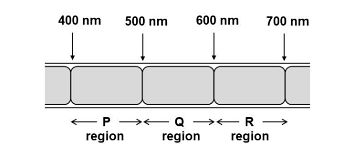
Different segments of a photosynthetic filamentous alga are exposed to different wavelengths of light as shown below. After a period of time, bacteria known to migrate towards high oxygen concentration, is spread on the surface of the alga. Which region(s) of the alga will have maximum bacterial congregation?
- P and R
- P and Q
- Only P
- Only Q

The Correct Option is A
Solution and Explanation
To determine which regions of the photosynthetic filamentous alga will have maximum bacterial congregation, we need to understand the relationship between light wavelength, photosynthesis, and oxygen production.
The bacteria migrate towards high oxygen concentration areas, which are produced in regions where photosynthesis is most active. Photosynthesis in algae is influenced by the availability of light wavelengths that chlorophyll and other pigments absorb effectively.
The key points to note are:
- Chlorophyll absorbs light most effectively in the blue (~400-500 nm) and red (~600-700 nm) regions of the spectrum.
- Region P is exposed to 400 nm light, and Region R is exposed to 600 nm light, both of which are within the optimal absorption range for photosynthesis.
- Region Q, exposed to 500 nm, does not coincide as effectively with the optimal absorption peaks of chlorophyll.
Given these observations, the regions where photosynthesis, and therefore oxygen production, will be maximum are Regions P and R. Consequently, the regions with the maximum bacterial congregation will be Regions P and R.
Conclusion: The correct answer is P and R, where the bacterial congregation will be maximum due to higher oxygen production.
Top Questions on Photosynthesis in higher plants
- Read the given statements and choose the correct option: Statement-I: In Calvin cycle, Carboxylation is catalysed by PEP Carboxylase
Statement-II: In Hatch-Slack pathway, Carboxylation is catalysed by RuBP Carboxylase.- KCET - 2025
- Biology
- Photosynthesis in higher plants
- Which of the following is the correct equation for photosynthesis?
- MHT CET - 2025
- Biology
- Photosynthesis in higher plants
Which of the following is responsible for the production of oxygen during photosynthesis?
A. Calvin cycle
B. Photolysis of water
C. Cyclic photophosphorylation
D. Reduction of NADP+- MHT CET - 2025
- Biology
- Photosynthesis in higher plants
- What is the role of chlorophyll in photosynthesis?
- MHT CET - 2025
- Biology
- Photosynthesis in higher plants
- Study the A, B and C equations given below and identify the correct match.
A. C6H12O6 + 2NAD + 2ADP + 2Pi → 2C2H4O3 + 2ATP + 2NADH + 2H+
B. Pyruvic acid + 4NAD + FAD + 2H2O + ADP + Pi → 3CO2 + 4NADH + 4H+ + ATP + FADH2
C.
- TS EAMCET - 2025
- Botany
- Photosynthesis in higher plants
Questions Asked in IIT JAM BT exam
- The wavelength of a photon emitted during a transition from \( n = 3 \) to \( n = 2 \) state in the H atom is .............. nm. (answer in integer).
- IIT JAM BT - 2025
- Biotechnology
- The porphyrin ring (tetrapyrrole structure) is NOT found in functional
- IIT JAM BT - 2025
- Biotechnology
Identify the taxa that constitute a paraphyletic group in the given phylogenetic tree.

- IIT JAM BT - 2025
- Genetics
The vector, shown in the figure, has promoter and RBS sequences in the 300 bp region between the restriction sites for enzymes X and Y. There are no other sites for X and Y in the vector. The promoter is directed towards the Y site. The insert containing only an ORF provides 3 fragments after digestion with both enzymes X and Y. The ORF is cloned in the correct orientation in the vector using the single restriction enzyme Y. The size of the largest fragment of the recombinant plasmid expressing the ORF upon digestion with enzyme X is ........... bp. (answer in integer)

- IIT JAM BT - 2025
- Biotechnology
- Match the animals in Group I with the major form of excreted nitrogen metabolite in Group II. \[ \begin{array}{c|c} \text{Group I} & \text{Group II} \\ \hline P:\; \text{Bony fishes} & 3:\; \text{Ammonia} \\ Q:\; \text{Lions} & 1:\; \text{Urea} \\ R:\; \text{Birds} & 2:\; \text{Uric acid} \\ \end{array} \]
- IIT JAM BT - 2025
- Metabolism